Column
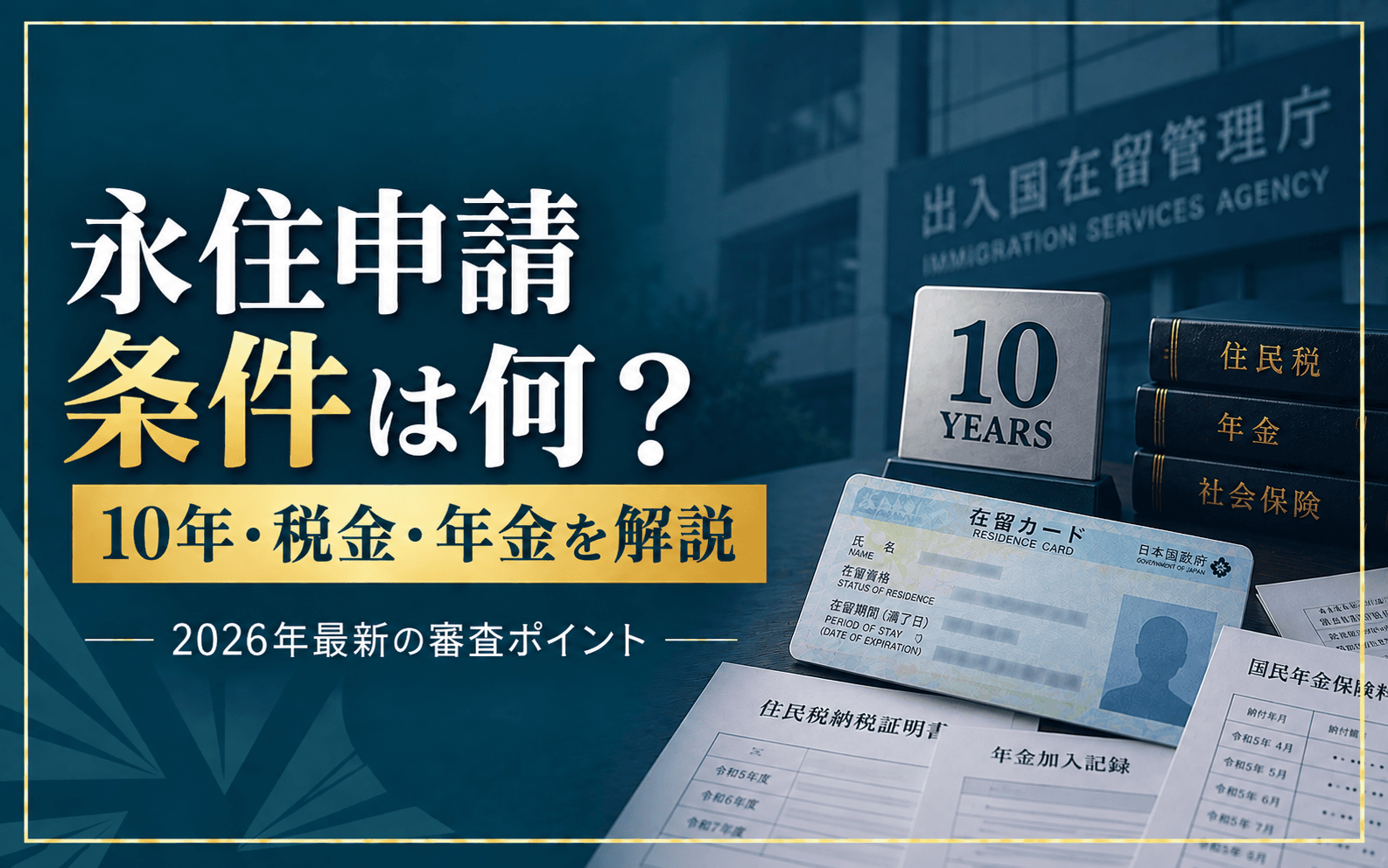
What Are the Requirements for Permanent Residence in Japan? 10 Years, Taxes, Pension, and Period of Stay 【2026 Update】
“How long do I need to live in Japan before applying for permanent residence?”
“Is there a minimum annual income?”
“What if I paid tax or pension contributions late?”
“Can I apply with a three-year period of stay?”
Permanent Residence is one of the most significant immigration statuses available to foreign nationals living long-term in Japan.
Once permission is granted, a Permanent Resident is generally no longer restricted by a specific period of stay or permitted field of activity.
Because of this substantially relaxed immigration status, Permanent Residence is examined more carefully than an ordinary change of status.
Japan’s Immigration Services Agency revised its Guidelines for Permission for Permanent Residence on February 24, 2026, so applicants should make sure they are using current information.
The Three Main Requirements
A general Permanent Residence application is assessed primarily under three broad requirements:
Good conduct
Ability to maintain an independent and stable livelihood
The applicant’s permanent residence must be considered consistent with Japan’s interests
The third requirement includes a number of important practical conditions involving residence history, taxes, pension, health insurance, immigration notifications, current period of stay, and compliance with the requirements of the applicant’s current status.
1. Good Conduct
Applicants are expected to obey Japanese law and maintain a lifestyle that would not be socially criticized as a resident.
Relevant matters can include:
Criminal convictions
Criminal fines
Traffic violations
Other legal violations
A single minor traffic violation does not automatically mean refusal, but the number, seriousness, and timing of violations can matter.
2. Stable Livelihood
Applicants must be expected to maintain a stable life in Japan without becoming a public burden.
Japan does not publish a nationwide fixed rule stating:
“Annual income must be at least ¥X.”
Instead, the assessment may consider:
Applicant’s income
Spouse’s income
Number of dependents
Rent or mortgage
Employment stability
Savings
Overall household finances
3. Permanent Residence Must Be in Japan’s Interests
This broad requirement contains many of the practical conditions that applicants need to check.
Generally 10 Years of Continuous Residence
For a typical applicant holding a work status, the general rule is:
at least 10 consecutive years of residence in Japan.
Within those 10 years, the applicant generally needs:
at least five consecutive years under an eligible work status or residential status.
Periods under:
Technical Intern Training
Specified Skilled Worker (i)
do not count toward this five-year work-status portion.
Ten Years Since Arrival Is Not Enough by Itself
For example:
5 years as a student
+
5 years under Engineer/Specialist in Humanities/International Services
may satisfy the general residence-history framework.
By contrast:
8 years as a student
+
2 years under a work status
does not generally satisfy the separate five-year work/residential-status requirement.
Highly Skilled Professionals May Qualify Earlier
The general 10-year requirement has several exceptions.
70 Points
Certain highly skilled foreign professionals who maintain 70 or more points for three years may qualify under a shortened residence period.
80 Points
Applicants who meet the requirements for 80 or more points for one year may qualify under a one-year route.
In some cases, an applicant does not need to currently hold the Highly Skilled Professional status itself, provided they can establish the required points at the relevant dates.
Taxes Must Be Paid on Time, Not Merely Paid Eventually
Current Permanent Residence guidelines expressly state that even where public obligations have been fully paid by the time of application,
late performance of those obligations is, in principle, evaluated negatively.
For applicants under ordinary work statuses, resident-tax records are generally reviewed for the most recent five years.
Periods in which resident tax was paid directly by the applicant may require additional evidence showing that payments were made by the deadlines.
Pension and Health Insurance: The Most Recent Two Years Matter
General Permanent Residence applications normally require evidence covering the most recent two years of:
Public pension
Public health insurance
Applicants continuously enrolled in Employees’ Pension Insurance and employee health insurance will often have a relatively straightforward record.
However, job changes can create periods in which National Pension or National Health Insurance obligations arose.
Late payment can be important even if the amount was later paid in full.
Immigration Notification Duties Also Matter
The guideline’s concept of public obligations includes not only tax, pension, and health insurance but also notification duties under immigration law.
Depending on the status, these can include notifications relating to:
Changing employers
Leaving employment
Changes to affiliated organizations
Divorce or death of a spouse
Applicants should confirm that required notifications were properly made.
Can You Apply With a Three-Year Period of Stay?
As of September 2026, an important transitional rule remains in effect.
The guideline generally requires the applicant to hold the maximum period of stay available for the current status.
However, through March 31, 2027, a three-year period of stay is still treated as satisfying this requirement.
From April 1, 2027, the general rule will require the actual maximum period available for that status.
A limited transitional arrangement also applies to certain people holding a three-year period on March 31, 2027.
Important February 2026 Change
The revised guideline also expressly requires the applicant’s current status of residence to satisfy the relevant landing-permission criteria or other applicable regulatory requirements.
In practical terms, applicants should make sure that their actual employment or activities genuinely comply with their current status.
Depending on the status, this can involve matters such as:
Actual job duties
Education or professional background
Remuneration
Employer
Activities permitted under the status
What If Your Current Status Expires While Permanent Residence Is Pending?
A Permanent Residence application does not automatically extend your current period of stay.
If your existing status will expire before a decision is made, you must separately file an extension of period of stay application.
Permanent Residence Fee Becomes ¥200,000 From October 2026
For Permanent Residence applications accepted on or after October 1, 2026, the fee payable upon approval will be:
¥200,000.
The relevant date is the application acceptance date.
Applications accepted by September 30, 2026 remain subject to the previous fee even if approval is issued later.
Different Rules Apply to Certain Spouses and Children
Special rules apply to certain spouses and children of Japanese nationals, Permanent Residents, and Special Permanent Residents.
The ordinary 10-year rule does not apply mechanically to every applicant.
This will be covered in a separate article.
Pre-Application Checklist
For a typical work-status applicant, check whether:
You have generally lived in Japan for at least 10 years
At least five years are under an eligible work or residential status
Your employment and income are stable
Resident tax was paid by the deadline
Pension contributions were paid by the deadline
Health insurance contributions were paid by the deadline
Required immigration notifications were made
You do not have serious criminal or repeated traffic issues
Your current period of stay satisfies the requirement
Your current activities comply with your status of residence
Frequently Asked Questions
Q. Does 10 Years in Japan Guarantee Permanent Residence?
No. Residence history is only one requirement.
Q. Does Time as a Student Count?
It forms part of the residence history, but the general rule also requires five years under an eligible work or residential status.
Q. What Is the Minimum Income?
No nationwide fixed minimum annual income has been officially published.
Q. What If I Paid Resident Tax Late?
Late payment may be evaluated negatively even if the tax has now been fully paid.
Q. What If I Later Paid Missed National Pension Contributions?
The actual payment history and deadlines need to be reviewed. Timely payment is important.
Q. Can I Apply With a Three-Year Period of Stay?
As of September 2026, yes, under the current transitional treatment, subject to the other requirements.
Q. Do Highly Skilled Professionals With 80 Points Need 10 Years?
Certain applicants with 80 or more points may qualify under a one-year route.
Permanent Residence Is Not Decided by Residence Length Alone
Immigration authorities also review:
employment, income, tax, pension, health insurance, immigration notifications, period of stay, compliance with the current status, and conduct.
Enlight Administrative Scrivener’s Office can review your residence history, income, resident tax, pension, health insurance, employment changes, and Highly Skilled Professional points before filing.
The initial Permanent Residence eligibility check is free of charge.
Permanent Residence support is generally available for applicants within the jurisdiction of the Tokyo Regional Immigration Services Bureau.
References
Immigration Services Agency: Guidelines for Permission for Permanent Residence, revised February 24, 2026
Immigration Services Agency: Permanent Residence Application
Immigration Services Agency: Permanent Residence Application 3
Immigration Services Agency: Permanent Residence Applications for Highly Skilled Foreign Professionals
Immigration Services Agency: Revision of Residence Permission Fees Effective October 1, 2026