Column
Can Spouses Live Apart on Spouse or Dependent Status? Work Transfers, Children’s Schooling and Marital Conflict
Can a couple continue living in Japan while residing separately on spouse or Dependent status? Learn how work assignments and children’s schooling differ from marital breakdown, why actual married life and financial support matter, and what to check for renewal and notifications.
“My spouse has been transferred, but our child’s school makes it difficult for us to move together.”
“Our relationship has deteriorated, and we want to live separately.”
Both involve a couple living at different addresses, but they are not necessarily assessed in the same way for residence purposes.
What matters is why you live apart and whether actual marital life or dependent support continues.
Unavoidable circumstances such as a work assignment or childcare may be considered individually. But if the marriage has broken down and actual married life has ended, continued residence may be affected.
This article focuses on living separately within Japan and distinguishes spouse-based residence status from Dependent status.
Spouse-based status and Dependent status have different foundations
“Spouse visa” commonly refers to Spouse or Child of Japanese National, where held as a spouse, or Spouse or Child of Permanent Resident, where held as a spouse of a permanent resident or other qualifying person.
A spouse or child financially supported by a foreign national residing in Japan under a qualifying work or other status will usually be considered under Dependent status.
Spouse-based status: consider the reason for separation, actual married life and future living arrangements.
Dependent status: consider the reason, spousal or parent-child relationship, and actual life supported by the sponsor.
The Immigration Services Agency defines Dependent activities as daily activities carried out as the supported spouse or child of a person holding a qualifying status.
Even for the same living arrangement, first identify the residence status you actually hold.
Source: Immigration Services Agency: Dependent status
Can work assignments or children’s schooling justify living apart?
A work assignment away from the family home
If a spouse is transferred by their employer and moving the whole family is difficult, there may be a reasonable explanation for living apart.
The Japan Legal Support Center explains, for people on Japanese-national spouse status, that an assignment away from home may provide a legitimate reason and that separation alone does not decide the issue.
However, simply saying “it is a work assignment” does not guarantee that there is no problem.
The transfer history and duration, communication, visits home and payment of living expenses should agree with the actual circumstances.
Source: Japan Legal Support Center: engagement, marriage and divorce
Children’s schooling and care
For example, relocating with a transferred spouse may require a child to change schools. Entrance examinations or disruption to school life may lead one parent and the child to remain in the original home.
In its explanation of status revocation, the Immigration Services Agency gives an example involving unavoidable childcare circumstances where spouses live apart but continue to share their livelihood. That guidance concerns revocation.
Schooling needs should likewise be examined individually in connection with the family’s circumstances.
A school-related reason does not automatically make separation acceptable: the need to live apart and the continuing reality of family life must be considered.
Not being subject to revocation is different from being guaranteed permission at the next renewal.
Source: Immigration Services Agency: examples where status is not revoked
Separation following marital conflict can put continued residence at risk
“We no longer get along, so I do not want to live together.”
“We will stop living as a married couple but will not file for divorce.”
These situations differ from a temporary arrangement caused by a work transfer.
The Japan Legal Support Center explains that circumstances such as the history and duration of separation, contact between spouses and sharing of living expenses are considered together. A marriage that has lost its substantive social basis may no longer support the status.
Remaining legally married does not prevent problems with continued residence or renewal if actual married life has ended.
Where factors such as prolonged lack of contact, fully separate finances and no intention to repair the relationship occur together, check promptly whether the existing status remains appropriate.
Source: Japan Legal Support Center: engagement, marriage and divorce
DV-related refuge and divorce proceedings require separate consideration
Not every separation involving relationship problems should be treated identically.
The Immigration Services Agency lists temporary refuge or protection from domestic violence, and divorce mediation or litigation, as examples where a legitimate reason may be recognized.
Do not assume you must remain in a dangerous home to protect your status. Prioritize safety while obtaining individual advice on the necessary residence procedures.
Source: Immigration Services Agency: examples where status is not revoked
Dependent status also requires attention to actual financial support
Dependent status is based not merely on the spousal or parent-child relationship, but on daily life supported by a sponsor holding a qualifying status.
Source: Immigration Services Agency: Dependent status
When considering separate homes, check:
Who will pay rent, living expenses and school costs
Whether the sponsor’s financial support will continue
Whether the sponsor’s own status and activities in Japan continue
Whether the family relationship and need for separate homes can be explained
Living separately while support continues is different from a situation where the dependency relationship has effectively ended.
An example in which a work assignment was considered for Japanese-national spouse status cannot automatically be applied to Dependent status. Each status must be examined under its own requirements.
“Less than six months apart is safe” is not the rule
It is inaccurate to assume that separation is automatically harmless for the first six months on spouse-based status.
A person residing as a spouse under Spouse or Child of Japanese National or Spouse or Child of Permanent Resident may face revocation if they have continuously failed to engage in spouse activities for six months or more without a legitimate reason.
Dependent status is covered by a different revocation ground involving failure to engage in the relevant activities for three months or more. Legitimate reasons and the particular circumstances must also be assessed.
These provisions do not establish an automatic grace period counted from the day separate living begins.
The six- and three-month periods do not guarantee a permitted duration of separation, and revocation and renewal are different assessments.
What needs checking also depends on whether marital or family activities continue after the move, or whether the underlying reality had already ended before it. Do not rely on duration alone.
Source: Immigration Services Agency: revocation of residence status
Describe the facts accurately and make the required notifications
Do not state that you live together when you actually live elsewhere because you are worried about residence consequences.
A mid- to long-term resident who changes address must generally notify the municipality within 14 days of moving to the new residence.
Source: Immigration Services Agency: notifications for mid- to long-term residents
Separation and divorce are different events. A person holding spouse-based Japanese-national, permanent-resident spouse or Dependent status as a spouse generally also needs to notify immigration within 14 days of divorce or the spouse’s death.
Keeping the same address on a residence record does not itself prove actual married life or dependency.
Organize the history, actual living arrangements and required notifications so that the explanation at renewal is consistent.
Source: Immigration Services Agency: procedures for mid- to long-term residents
How an administrative scrivener can help
A living-apart issue is not necessarily solved by preparing one explanation letter.
The current status, reason and duration, relationship, finances, children’s circumstances and residence expiry must be considered together.
Professional advice can help you identify:
What must be checked to continue under the existing status
What evidence should be reviewed to explain the living arrangement
Whether explanations of support and finances agree with other documents
When to start renewal preparation and required notifications
Whether a change to another status should be considered
The purpose is not to invent a reason, but to organize the real circumstances and reduce missing explanations or inconsistencies between application documents.
Disputes about divorce terms or child custody may require advice from an attorney.
Frequently Asked Questions (FAQ)
Q1. Does living apart immediately cancel spouse-based residence status?
Living apart does not by itself immediately end the status. However, the reason and actual marital life can affect renewal and continued residence.
Q2. Is living apart always accepted for a work assignment?
No guarantee can be given. The need and duration, continuing marital relationship and payment of expenses must also be considered.
Q3. Can a wish to avoid changing a child’s school be considered?
It may be relevant to explaining schooling and care needs. A school-related reason does not automatically secure permission; the need and actual family life must be considered together.
Q4. Can I renew if we no longer get along but have not divorced?
Remaining legally married does not guarantee renewal. A relationship that has effectively broken down may affect continued residence.
Q5. Can I treat Dependent status the same as spouse-based status?
No. Dependent status also depends on continuing daily life as a supported spouse or child. The time periods in the revocation provisions are not interchangeable either.
Q6. Is separation to escape domestic violence a problem?
DV-related refuge and protection are official examples of circumstances in which a legitimate reason may be recognized. Prioritize safety and obtain individual advice on the necessary procedures.
Conclusion
Living apart on spouse-based or Dependent status is not assessed solely by whether two addresses differ.
Reasonable circumstances such as work assignments, schooling or childcare may be considered where actual marital life or support continues.
But where marital conflict has ended the reality of married life, do not assume that remaining legally married makes everything safe.
If you plan to live separately, or already do and renewal is approaching, organize the reasons and actual living situation and seek advice early.
Consult us about spouse-based or Dependent status
Enlight Administrative Scrivener Office accepts consultations about spouse-based residence and Dependent status.
We review circumstances such as work assignments, children’s schooling and changes in the relationship, and explain matters to check for continued residence or renewal and the scope of support available.
Enlight Administrative Scrivener Office | Administrative Scrivener 宮島 詩卉
Telephone: 03-5284-7981 | Weekdays 10:00–18:00
Free consultation and enquiries
Related article and services
References
Japan Legal Support Center: engagement, marriage and divorce
Immigration Services Agency: examples where status is not revoked
Immigration Services Agency: notifications for mid- to long-term residents
Immigration Services Agency: procedures for mid- to long-term residents
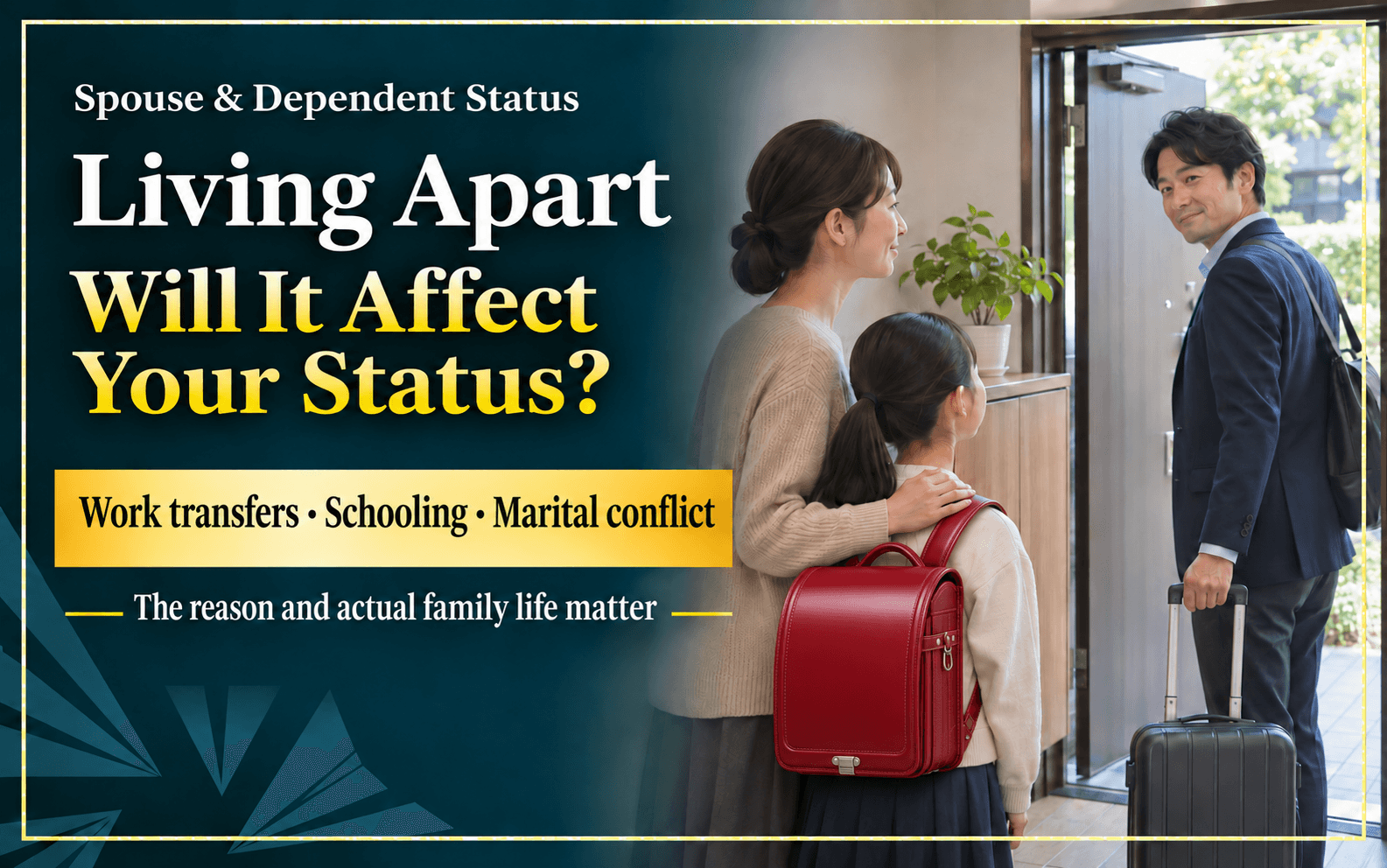
This article provides general information based on public materials checked on November 21, 2026. It does not mean that a work assignment or schooling automatically makes living apart acceptable. Assessment depends on the residence status, history, actual marital life and support. Guidance on revocation grounds does not guarantee permission to renew. The banner’s people and family scene are illustrative.