Column
What Happens at a Japanese Naturalization Interview? Questions, Timing, and How to Prepare 【2026 Update】
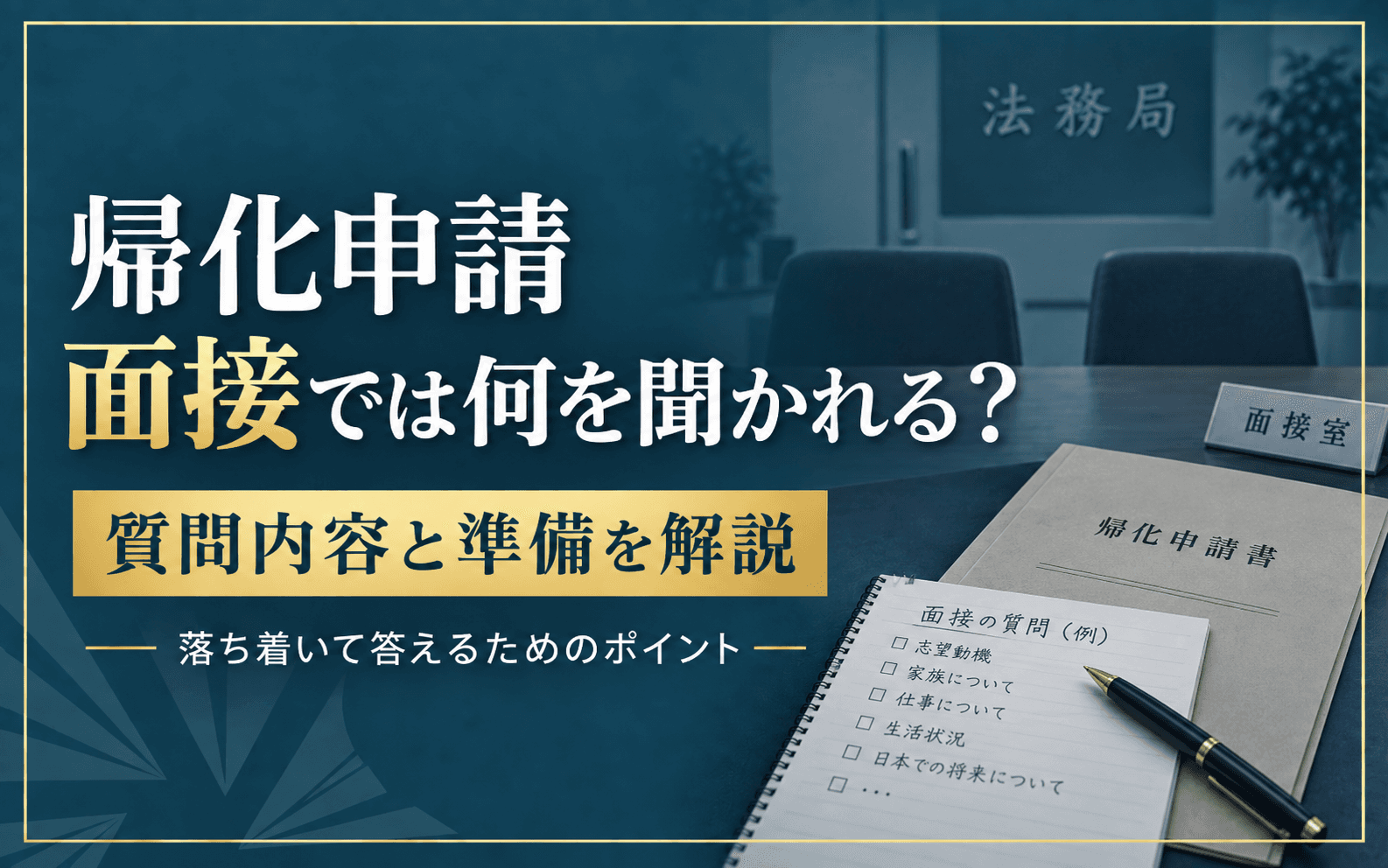
After formally filing a naturalization application, many applicants become concerned about the interview at the Legal Affairs Bureau.
Common questions include:
“What will they ask me?”
“Is there a fixed list of interview questions?”
“Do I need to memorize my entire application?”
“Will my spouse also be interviewed?”
The first thing to understand is:
the naturalization interview is not a test with predetermined correct answers.
Regional Legal Affairs Bureaus explain that the interview is used to ask about matters that could not be fully confirmed from the application and supporting documents alone.
The best preparation is therefore not memorizing model answers.
It is:
understanding your own application and being able to explain your actual circumstances accurately.
When Does the Interview Take Place?
The timing varies by Legal Affairs Bureau and by case.
The Mito Legal Affairs Bureau gives an approximate timeframe of two to three months after formal filing.
The Maebashi Legal Affairs Bureau gives an approximate timeframe of around three months after filing.
These are examples, not a nationwide fixed deadline.
How Long Does the Interview Take?
Published examples also vary.
Mito states approximately one hour, while Maebashi states approximately one to two hours.
The actual length depends on the applicant’s circumstances and what needs to be clarified.
Is There a Fixed List of Questions?
No nationwide official list of standard naturalization interview questions has been published.
Claims such as:
“Memorize these 20 questions and you will be fine”
should therefore not be treated as an official standard.
The interview is generally based on:
your application, supporting documents, and matters that require further clarification.
It is useful to review the following areas before the interview.
1. Your History in Japan
Naturalization applications include a detailed personal history.
You should therefore be familiar with:
When you came to Japan
Where you studied
When you started working
Job changes
Periods of unemployment
Address history
You do not need to memorize every date mechanically.
However, your explanation should not materially conflict with the history you submitted.
2. Your Current Employment
Be prepared to explain:
Employer
When you joined
What you actually do
Employment type
Work location
Rather than simply saying:
“I work for a company,”
you should be able to describe your actual job in your own words.
3. Income and Household Finances
Naturalization includes a financial-stability requirement.
The Ministry of Justice explains that this is assessed in light of the family members who share the household’s living expenses, rather than solely by the applicant’s personal income.
Before the interview, it is useful to understand:
Your income
Your spouse’s income
Rent or mortgage
Household expenses
Savings
Major debts
You do not need to memorize every monthly expense, but you should understand the household’s overall financial situation.
4. Family Relationships
Questions may relate to family members already listed in your application, including:
Parents
Brothers and sisters
Spouse
Children
Former spouse
Children from a previous relationship
Applicants with circumstances involving divorce, remarriage, adoption, recognition of parentage, or parental authority should make sure they understand how those relationships are reflected in the documents.
5. Married Life
Married applicants may be asked about their current family life.
Possible areas for clarification include:
When you married
How you met
Whether you currently live together
How household expenses are managed
If spouses live separately or there are other unusual circumstances, be prepared to explain them accurately.
6. Taxes, Pension, and Social Insurance
Tax and social insurance compliance are important in naturalization review.
The Ministry of Justice states that tax compliance is one of the matters considered when assessing good conduct.
If you have previously had:
Late resident-tax payments
Unpaid National Pension contributions
Social insurance gaps between jobs
Late tax filings
organize:
when the issue occurred, why it happened, and how it was resolved.
7. Traffic or Other Legal Violations
If you have traffic violations, make sure you understand your own record.
Review:
When it occurred
What happened
How the matter was handled
Do not dismiss something simply because you consider it minor.
8. Your Life in Japan
The interview may also involve your actual life in Japan, such as:
Daily routine
Family life
Activities outside work
Future plans in Japan
There is no need to invent an ideal answer.
Explain your real life naturally.
9. Why You Want Japanese Nationality
A statement of reasons for naturalization is one of the principal documents in the application.
You should therefore be able to explain:
Why you want to naturalize
Why you want to continue living in Japan
How you see your life after acquiring Japanese nationality
You do not need to memorize your written statement word for word.
But your interview explanation should not fundamentally contradict it.
10. Japanese-Language Ability
Current Ministry of Justice guidance states that applicants should have Japanese ability sufficient for everyday life, including speaking and reading/writing, as part of integration into Japanese society.
Because the interview is conducted in Japanese, you need to be able to:
Understand the question
Follow what is being discussed
Explain your own circumstances
What If Your Japanese Is Not Perfect?
There is no published rule stating that one grammar mistake results in denial.
The practical issue is whether you can communicate in Japanese well enough for daily life and the naturalization procedure.
If you do not understand a question, it is better to ask the officer to repeat or clarify it than to guess and give an inaccurate answer.
Can Your Spouse Be Interviewed?
Yes.
The Mito Legal Affairs Bureau states that the applicant and the applicant’s spouse are interview subjects.
Maebashi similarly states that the applicant and the applicant’s spouse or others may be interviewed.
Married applicants should therefore make sure that their spouse is also familiar with important facts relating to:
Family circumstances
Married life
Income
Household finances
What If the Couple Gives Different Answers?
Spouses do not need to give identical, memorized answers.
People naturally remember and describe things differently.
However, major inconsistencies concerning important facts such as cohabitation, household finances, or marital circumstances may require explanation.
The goal is not to “match answers.”
It is to make sure that the application reflects reality.
Additional Documents May Be Requested Before or After the Interview
The Maebashi Legal Affairs Bureau expressly notes that additional documents may be requested before or after the interview.
The interview therefore does not necessarily mark the end of document review.
If your circumstances change during the examination—for example, because of a job change, move, marriage, divorce, birth of a child, or income change—updated information may also be required.
What Not to Do at the Interview
Do Not Memorize Artificial Model Answers
This is not a job interview.
Accuracy matters more than polished wording.
Do Not Guess When You Do Not Understand
Ask for clarification instead.
Do Not Hide Facts You Think Are Unfavorable
Taxes, traffic history, and employment changes may already be reflected in objective records.
Do Not Ignore Your Own Application
Even if an Administrative Scrivener assisted with the preparation, you should understand what was submitted in your name.
Seven Things to Review Before the Interview
1. Personal History
Review addresses, education, and employment.
2. Family Relationships
Review parents, siblings, spouse, and children.
3. Employment
Know your employer, duties, and start date.
4. Income and Household Finances
Understand the household’s income and major expenses.
5. Taxes and Pension
If there have been issues, organize the facts.
6. Traffic History
Know your own record.
7. Reasons for Naturalization
Read your statement again and make sure you can explain it naturally.
Frequently Asked Questions
Q. Is There a Fixed Naturalization Interview Question List?
No nationwide official list has been published.
The interview is used to clarify matters arising from the submitted documents.
Q. How Soon After Filing Is the Interview?
It varies.
Published regional examples include approximately two to three months or around three months after filing.
Q. How Long Does It Take?
Published examples range from approximately one hour to one or two hours.
Q. Does My Spouse Need to Attend?
Possibly.
Follow the instructions from the Legal Affairs Bureau handling your case.
Q. Should I Memorize My Statement of Reasons?
No.
Understanding it and explaining it naturally is more important.
Q. Can Additional Documents Be Requested After the Interview?
Yes.
Additional documentation may still be requested during the examination.
The Interview Is Not About Finding the “Right Answer”
The most important thing is not sounding impressive.
It is:
understanding your application and accurately explaining the facts of your own life.
Before the interview:
Review your application
Organize your personal history
Confirm your family and employment circumstances
Be ready to explain why you want Japanese nationality in your own words
Enlight Administrative Scrivener’s Office can also assist with pre-interview review and organizing the matters likely to require clarification, in addition to preparing the naturalization application itself.
You are welcome to contact us if:
“I am worried about what they will ask.”
“I am not confident answering in Japanese.”
“I do not know how much preparation my spouse needs.”
The initial naturalization eligibility check is free of charge.
Enlight Administrative Scrivener’s Office
Gyoseishoshi (Administrative Scrivener): Shiki Miyajima
Telephone: 03-5284-7981
Office hours: Weekdays 10:00–18:00
Online consultations throughout Japan and WeChat consultations are also available.
References
Ministry of Justice: Nationality Q&A
Mito Legal Affairs Bureau: Naturalization Procedure
Maebashi Legal Affairs Bureau: Naturalization Procedure
Tokyo Legal Affairs Bureau naturalization application documents