Column

Column
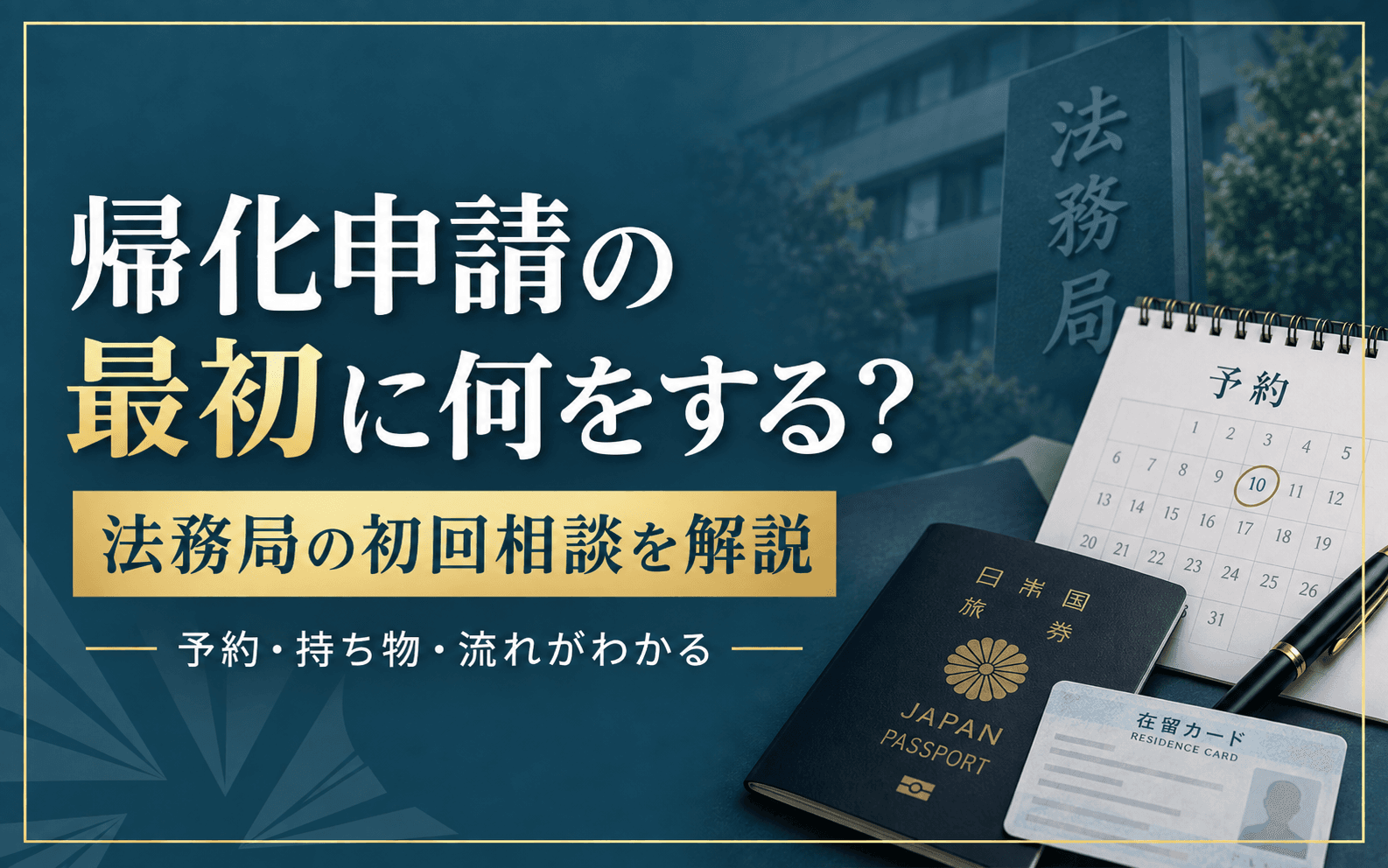
People beginning the naturalization process often ask:
“What should I do first?”
“Do I simply gather my documents and submit them?”
“What happens at the first consultation?”
“Can I consult the Legal Affairs Bureau before I have every document?”
Japanese naturalization is not usually a process where you simply complete a form and submit it immediately.
The process generally begins by consulting the Legal Affairs Bureau with jurisdiction over your place of residence, where your circumstances and required documents can be reviewed.
Which Legal Affairs Bureau Should You Contact?
Naturalization consultations are handled by the Legal Affairs Bureau or District Legal Affairs Bureau responsible for your residential address.
Your first step should therefore be to confirm:
which office has jurisdiction over where you live.
Even within Tokyo, different areas are handled by different offices and branch offices.
Do not assume that the office used by a friend or family member is also the correct office for you.
Do You Need an Appointment?
At the Tokyo Legal Affairs Bureau, naturalization consultations are conducted by appointment.
Applicants are instructed to prepare the required materials and contact the appropriate office by telephone to arrange the consultation.
It is therefore best not to assume that you can simply walk in without an appointment.
What Happens During the First Consultation?
The first consultation is not merely a chance to collect application forms.
It is an opportunity to determine:
what documents your individual case requires and how you should proceed.
Before the consultation, it is useful to organize information concerning:
Nationality
Date of arrival in Japan
Current status of residence
Family structure
Marital history
Employment
Income
Taxes
Pension and social insurance
Traffic history
Japanese-language ability
Naturalization Consultation Questionnaire
The Tokyo Legal Affairs Bureau currently asks applicants to complete and bring a naturalization consultation questionnaire to the initial consultation.
It is therefore useful to整理 your personal history in advance, including:
Address
Immigration status
Family details
Education
Employment history
Income
Do You Need Every Document at the First Consultation?
The first consultation and the formal filing are different stages.
The Tokyo Legal Affairs Bureau states that the application is formally accepted once the required application forms and supporting documents have been assembled.
In simple terms:
First consultation = identify what you need and how to prepare
Formal filing = submit once the required documents are complete
You should nevertheless bring any materials specifically requested for the initial consultation.
Documents Prepared by the Applicant
Naturalization applications commonly involve documents such as the following.
This contains basic personal information such as your name, date of birth, and address.
Certain date and signature fields should be left blank until the formal filing if instructed by the Legal Affairs Bureau.
Lists information concerning parents, spouse, children, and siblings.
Covers matters such as:
Address history
Education
Employment history
Explains why you wish to acquire Japanese nationality.
The Tokyo Legal Affairs Bureau instructs applicants to prepare the final statement in their own handwriting. A computer-generated final document or a version handwritten by someone else is not accepted.
Covers household income, expenses, savings, and other financial matters.
Applicants who operate a business or company may need additional business information.
Supporting Documents Differ by Nationality
The foreign civil-status documents required for naturalization vary according to nationality.
The Tokyo Legal Affairs Bureau provides separate guidance for applicants from China, Taiwan, Korea, and other countries or regions.
Chinese applicants, for example, commonly need to organize documents relating to:
Birth
Family relationships
Marriage and divorce
Nationality
These are prepared together with Japanese records concerning residence, taxes, pension, employment, and income.
Foreign-Language Documents Need Japanese Translations
Foreign-language documents generally need a Japanese translation.
The current Tokyo guidance states that:
The entire document must be translated
Partial translation is not sufficient
Translator information and the translation date should be recorded
The applicant may translate the document if they can do so accurately
Original Documents and Copies
Naturalization preparation also involves specific rules for originals and copies.
Documents that can be submitted are generally prepared with an original and a copy.
For items such as passports or driver’s licenses, where the original cannot be surrendered, copies are prepared and the original is brought for verification.
Check the current formatting and copying instructions before preparing a large number of documents.
Should You Obtain Every Foreign Document Before the First Consultation?
Usually, it is better not to collect every possible document without first confirming what your case requires.
A more efficient approach is:
organize your family and personal history
then:
confirm the documents actually required
and finally:
obtain the appropriate foreign records.
This can prevent unnecessary applications, incorrect documents, and having to obtain documents again.
What If a Required Document Cannot Be Obtained?
Do not simply omit it.
If a document genuinely cannot be obtained, explain:
Why it cannot be obtained
What attempts have been made
Whether alternative evidence is available
to the Legal Affairs Bureau officer and follow their instructions.
What Happens After the First Consultation?
A typical process is:
Initial consultation
↓
Confirm required documents
↓
Obtain Japanese and foreign documents
↓
Prepare Japanese translations
↓
Prepare application forms
↓
Document review by the Legal Affairs Bureau
↓
Provide additional documents if necessary
↓
Formal filing once the application is complete
The first consultation is therefore the beginning of the process, not the final filing itself.
Should You Consult an Administrative Scrivener Before or After the First Consultation?
Either is possible.
Professional support can help you review:
Basic eligibility
Tax and pension issues
Likely foreign-document requirements
Questions to confirm with the Legal Affairs Bureau
Support can then focus on:
Documents specifically requested by the Legal Affairs Bureau
Additional materials
Application forms
Personal history
Statement of reasons
For applicants with extensive foreign civil-status documentation, including many Chinese applicants, organizing the overall process early can be particularly useful.
Seven Things to Review Before the First Consultation
Confirm the correct office.
Check your residence card.
Organize your address, education, and employment history.
Review parents, siblings, spouse, children, and marital history.
Review current employment, income, and job changes.
Check for unpaid obligations, late payments, or gaps.
Begin organizing your reasons in your own words.
Frequently Asked Questions
Naturalization applications are handled by the Legal Affairs Bureau or District Legal Affairs Bureau with jurisdiction over your address.
At least at the Tokyo Legal Affairs Bureau, naturalization consultations require an appointment.
Normally, formal filing takes place after the required documents have been completed.
The final version is generally required to be handwritten by the applicant.
Yes, if you can translate them accurately and completely in accordance with the Legal Affairs Bureau’s requirements.
Explain the circumstances to the Legal Affairs Bureau rather than omitting the document without explanation.
The First Step Is to Organize Your Case, Not Collect Everything
Naturalization involves a large number of documents.
But the most efficient starting point is not:
“Collect everything that might possibly be needed.”
It is:
“Understand your own circumstances and determine what your case actually requires.”
Enlight Administrative Scrivener’s Office can assist with:
Initial eligibility review
Individualized document checklists
Japanese and foreign document organization
Chinese and English translation
Naturalization application preparation
Drafting support for the statement of reasons
Legal Affairs Bureau procedure support
You are welcome to contact us even if you are still at the stage of asking:
“Should I speak to the Legal Affairs Bureau first?”
“I want to check my situation before my first consultation.”
The initial naturalization eligibility check is free of charge.
Related
Do you need five years or ten years in Japan before applying for naturalization? Japan’s Nationality Act still provides a general five-year domicile requirement, while updated Legal Affairs Bureau guidance from April 2026 also states that ten or more years of residence in Japan, among other factors, is relevant to integration into Japanese society.
Read MoreHow is Japanese naturalization different for company owners and self-employed applicants? In addition to personal documents, business owners may need to provide corporate tax records, financial statements, social insurance records, business licenses, tax returns, and an Overview of Business.
Read MoreDoes a criminal record prevent Japanese naturalization? Criminal history is relevant to the good-conduct requirement, but a past offense does not automatically create a permanent bar to naturalization. This guide explains the differences between a conviction, arrest, non-prosecution, criminal fine, suspended sentence, and traffic penalty.
Read MoreLet's Start
Our scrivener carefully answers your visa and naturalization questions. Online consultations are available.