Column
What Should You Do After a Japanese Permanent Residence Refusal? Reapplication Timing and Key Issues 【2026 Update】
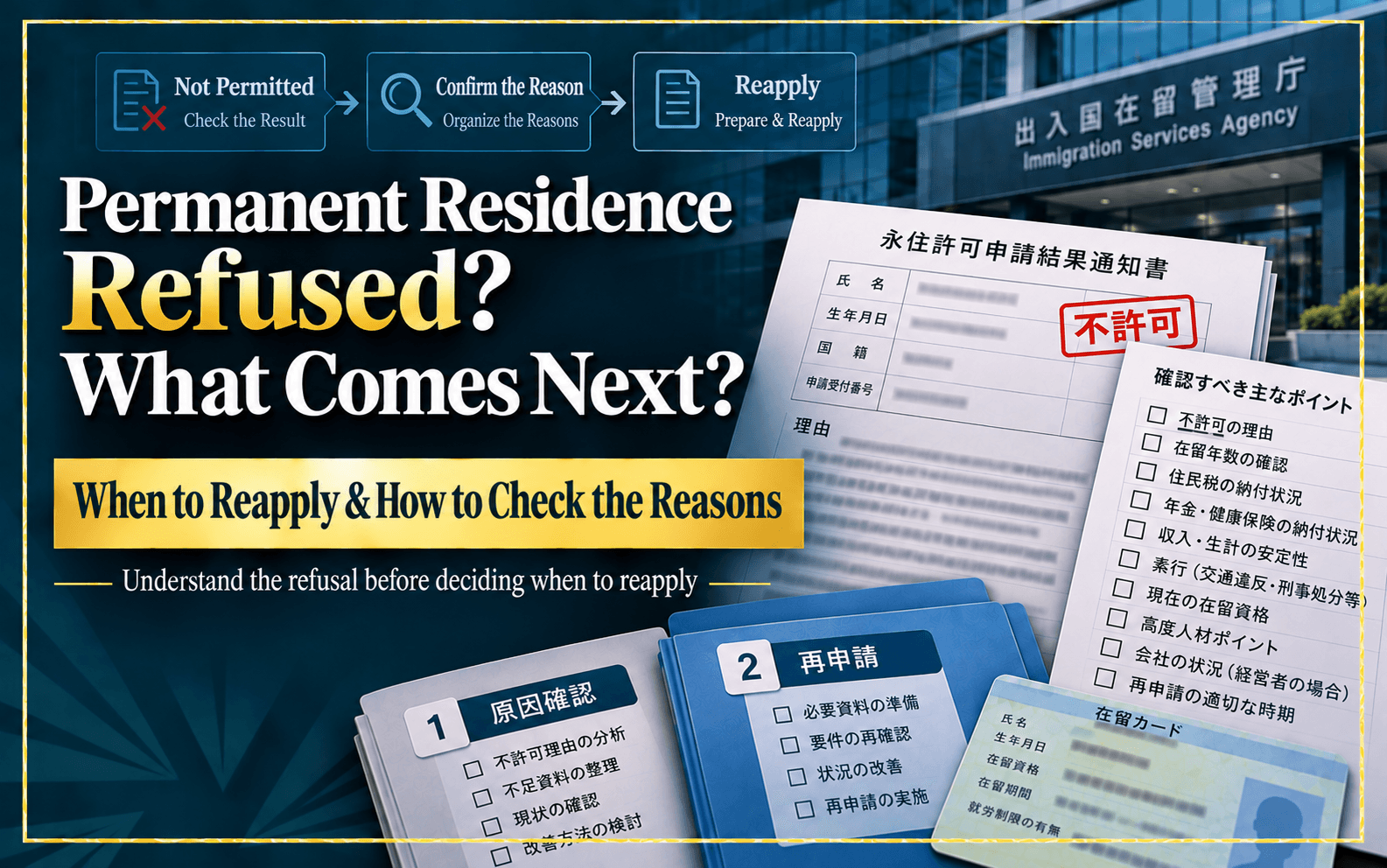
Can you immediately reapply after a Japanese Permanent Residence refusal? There is no published nationwide waiting period for a new PR application, and the official procedure does not provide an ordinary administrative appeal method. The important first step is identifying why the previous application was refused and whether the underlying issue has actually been resolved.
“My Permanent Residence application was refused. Can I apply again next month?”
“Should I wait six months?”
“If I submit more documents, will the next application be approved?”
The central point is:
there is no single nationwide PR reapplication waiting period.
The important question is why the previous application was unsuccessful.
The First Question Is Not “How Many Years Should I Wait?”
The Immigration Services Agency does not publish a general rule requiring applicants to wait a fixed number of months or years after a PR refusal.
However, being technically able to file again does not necessarily mean that filing immediately makes sense.
The underlying issue should first be identified.
1. Identify the Relevant PR Requirement
Potential issues can involve:
Residence duration
Taxes
Pension
Public health insurance
Income and livelihood
Conduct
Immigration notifications
Current period of stay
Compliance with the current status of residence
HSP eligibility
A new application should be considered in light of the issue that affected the previous case.
There Is No Ordinary Administrative Appeal Method Listed for PR Refusal
The Immigration Services Agency’s Permanent Residence procedure page lists:
Appeal method: none.
Accordingly, the practical focus after refusal is generally on identifying the problem and considering a new application when appropriate.
2. Late Tax Payments
Current PR guidance emphasizes performance of public obligations by their original deadlines.
Accordingly:
late payment
followed by
full payment later
does not necessarily mean the earlier issue has disappeared.
The actual payment period and subsequent compliance history need to be reviewed.
Pension and Health Insurance Require Similar Care
National Pension, National Health Insurance, periods between employers, self-employment, and company social-insurance obligations can all matter.
There is no official rule guaranteeing that an issue automatically becomes irrelevant after one fixed period.
3. Income and Financial Stability
Japan does not publish one nationwide minimum salary figure guaranteeing PR.
Where financial circumstances may have contributed to refusal, relevant matters can include:
Historical income
Current salary
Employment stability
Spouse’s income
Dependents
Overall household finances
A salary increase alone does not automatically establish that the entire PR case is now ready.
Insufficient Residence Duration Cannot Be Fixed by Adding More Documents
If the applicant simply had not reached the required qualifying residence period, longer explanations or additional savings evidence do not replace the missing years.
The applicant may need to reach the required period or determine whether an exception such as an HSP route is available.
4. Highly Skilled Professional Points
The 80-point route generally requires the relevant score:
at filing and one year earlier.
The 70-point route focuses on:
filing and three years earlier.
A strong current score does not correct an insufficient historical score.
Applicants must also be able to prove the points claimed.
5. Traffic and Criminal Issues
Cases involving criminal fines, drunk driving, unlicensed driving, serious accidents, or repeated violations should not be assessed by simply waiting an arbitrary six months or one year.
The actual disposition and timing need to be reviewed.
6. Problems With the Current Status of Residence
Where the applicant’s actual work does not comply with the present immigration status, the issue may extend beyond the PR application itself.
The underlying residence situation should be addressed before simply refiling PR.
Spouse-Based Cases Also Require More Than Marriage Duration
A spouse-based exception does not eliminate review of matters such as genuine married life, taxes, pension, health insurance, or relevant immigration obligations.
Long-term separation may require particular attention.
7. Recheck the Period-of-Stay Requirement
The current transitional rule treats a three-year period of stay as satisfying the PR maximum-period requirement through March 31, 2027.
A reapplication occurring after the transition may therefore require a fresh review of the applicant’s current period of stay.
Other Conditions Can Change While You Wait
While an applicant waits for one problem to improve, something else may change:
New job
Lower income
HSP age-point reduction
New period-of-stay rules
Family circumstances
A reapplication therefore requires a fresh review of the whole case, not only the previous refusal issue.
8. Refiling the Same Case Is Not Necessarily Useful
If the facts, eligibility, and underlying problem are unchanged, simply submitting substantially the same application again may not change the result.
The important question is:
what has actually changed since the previous refusal?
More Paper Is Not the Same as Stronger Eligibility
Where the underlying legal or factual requirement is not satisfied, adding a larger volume of documents does not solve the problem.
9. Cases Where Early Review Is Particularly Important
Professional review can be especially useful where:
The refusal reason is unclear
Taxes or pension were paid late
The 70- or 80-point HSP route was used
There is traffic or criminal history
The application was filed just after reaching ten years
The applicant has a long Student history
A recent job change occurred
The applicant owns a business
The spouses are living separately
There are substantial overseas absences
Reapplication may cross the 2027 period-of-stay transition
Frequently Asked Questions
Q. Can I Reapply One Month After Refusal?
There is no published fixed prohibition, but immediate refiling may have little value if the underlying issue remains unchanged.
Q. Is Six Months Enough?
There is no nationwide six-month rule.
Q. Is One Year Enough?
One year does not automatically guarantee eligibility or permission.
Q. Can I File an Ordinary Appeal Against a PR Refusal?
The Immigration Services Agency’s PR procedure page lists no administrative appeal method.
Q. Everything Is Paid Now. Can I Reapply?
The original payment timing may still need to be reviewed.
Q. My 80-Point Application Was Refused.
Recheck both current and historical points, supporting evidence, and the remaining PR requirements.
Q. Does PR Refusal Automatically Cancel My Current Status?
No. PR refusal and cancellation of the current status are separate matters.
However, a refusal related to non-compliance with the current status may require further review.
Reapplication Is About Resolving the Cause, Not Merely Waiting
Late taxes, insufficient residence history, insufficient HSP points, and criminal matters all require different approaches.
Enlight Administrative Scrivener’s Office reviews the previous application, reason for refusal, taxes, pension, residence history, income, HSP points, traffic or criminal history, family circumstances, and current immigration status before considering when a new PR application should proceed.
If a Permanent Residence application handled by our office is refused, we will confirm the reason for the refusal and provide one reapplication free of charge.
The initial Permanent Residence eligibility check is free of charge.
Permanent Residence support is generally limited to applicants within the jurisdiction of the Tokyo Regional Immigration Services Bureau.
References
Immigration Services Agency: Permanent Residence Application
Immigration Services Agency: Guidelines for Permission for Permanent Residence, revised February 24, 2026
Immigration Services Agency: Permanent Residence Self-Check Sheet
Immigration Services Agency: Immigration and Residence Examination Q&A
Immigration Services Agency: Permanent Residence Applications for Highly Skilled Foreign Professionals