Column
Can You Obtain Japanese Permanent Residence With Many Dependents? Household Income, Children, and Overseas Dependents 【2026 Update】
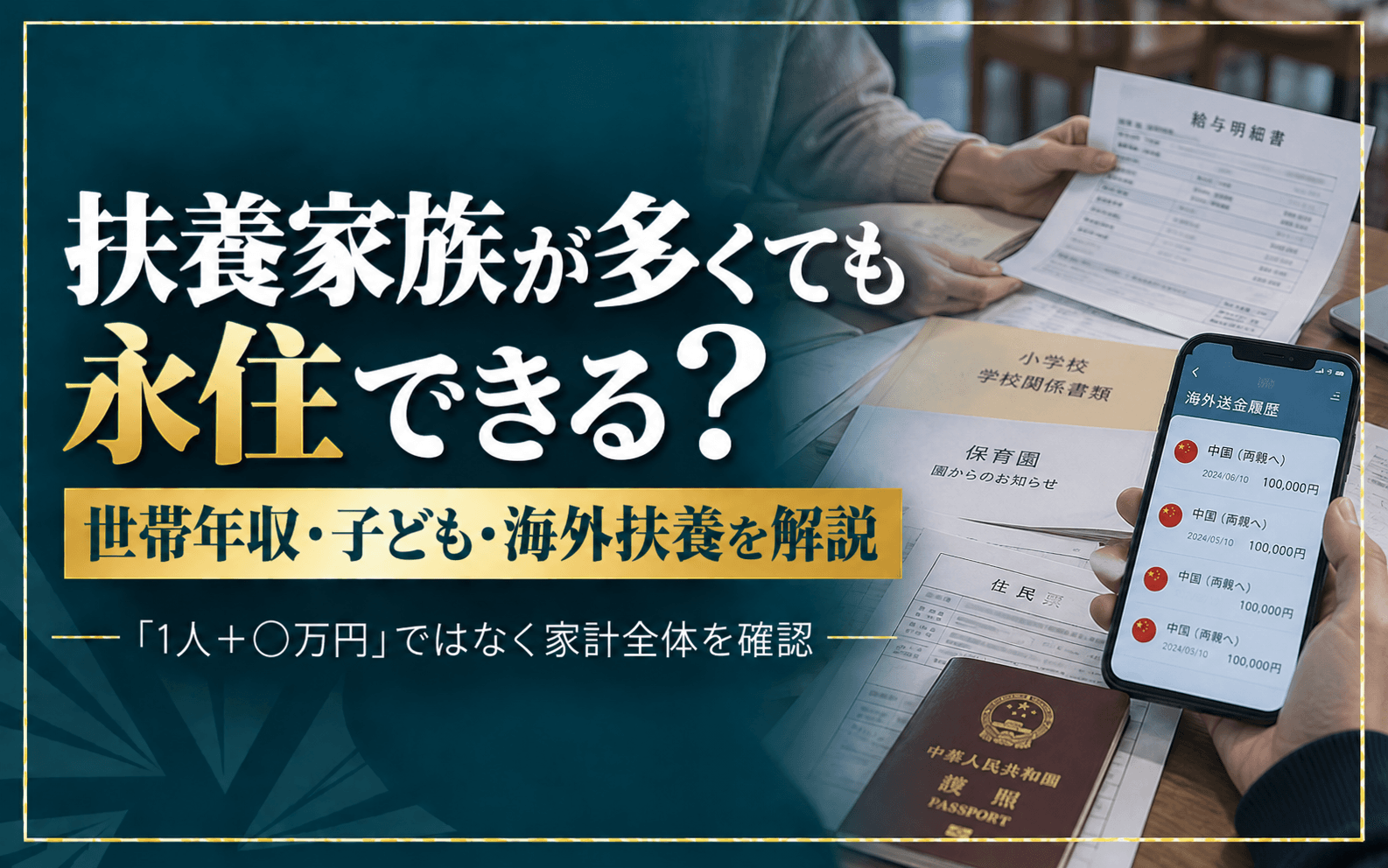
“I support my spouse and two children. How much income do I need?”
“I earn ¥4 million but have three children.”
“My spouse also works. Can both incomes be considered?”
“I regularly send money to my parents overseas.”
The starting point is important:
there is no officially published nationwide PR formula such as ¥3 million plus ¥300,000 for each dependent.
The current PR guideline instead asks whether the applicant’s assets or skills indicate that:
a stable life can be expected in the future. 法務省
Livelihood Can Be Considered at Household Level
The Immigration Services Agency explains that the independent-livelihood requirement can be satisfied where the applicant and spouse or other household members can collectively maintain stable living conditions. 法務省
The applicant’s salary therefore should not always be viewed in isolation.
1. Do Many Dependents Prevent PR?
No.
A household with a spouse and several children is not automatically excluded from Permanent Residence.
However, household expenses generally increase as the number of people supported increases.
The actual ability to maintain a stable future life therefore matters.
2. There Is No Official “Add ¥300,000 per Dependent” Rule
Immigration does not publish a fixed table stating:
one dependent = additional ¥X
two dependents = additional ¥Y.
Internet rules of thumb should not be treated as official approval criteria.
3. Can a Spouse’s Income Be Considered?
Yes, continuing income earned by a spouse can be relevant to the household’s actual financial stability.
Current employment-based PR documentation also requests occupational, income, and tax documents concerning the applicant or the person supporting the applicant. 法務省
Recent Income and Established Income Are Not Necessarily the Same
A spouse who started work only one month ago presents different evidence from a spouse who has been continuously employed for several years.
Both the amount and continuity of household income matter.
4. What if the Spouse Does Not Work?
A non-working spouse does not automatically prevent PR.
For example, one spouse may earn enough to support the household while the other cares for children.
The household should be assessed as a whole.
5. Do More Children Automatically Require a Specific Salary?
No official minimum-income table by number of children is published.
The applicant’s actual household circumstances matter more than a mechanical formula.
6. What About an Adult Child Living With the Applicant?
If an adult child works and genuinely contributes to the same household, that may form part of the household’s financial reality.
However, the child’s salary is not automatically treated as the applicant’s own income.
The actual household arrangement needs to be understood.
7. “Dependent” Has Several Different Meanings
The word may refer to:
A tax dependent
A social-insurance dependent
A person holding Dependent status
A person who is actually financially supported
These concepts are not identical.
PR Focuses on the Real Household Situation
The main livelihood question is who is actually being supported and how the household finances function.
8. Can You Support Parents Overseas and Still Obtain PR?
Yes.
Regularly supporting parents in China or another country does not by itself prevent PR.
However, overseas support represents a real financial obligation.
A household supporting children in Japan and parents overseas should be able to explain that its remaining income still supports stable living.
9. Are Many Overseas Dependents Automatically Negative?
No.
However, where tax filings identify numerous overseas dependents, it is sensible to confirm:
The actual family relationships
Genuine remittances
Correct tax treatment
The household’s overall expenses
10. Tax Deductions for Overseas Relatives Require Evidence
The National Tax Agency requires documents such as:
family-relationship documents
and:
remittance-related documents
where applicable for deductions involving relatives residing outside Japan. 国税庁
Certain overseas relatives aged 30 to 69 may also be subject to additional conditions involving at least ¥380,000 of annual support in specified situations. 国税庁
¥380,000 Is Not a PR Requirement
This amount relates to Japanese tax deductions for certain overseas relatives.
It is not a minimum annual remittance required for Permanent Residence.
11. What if Support Is Given in Cash?
Where a person claims tax deductions for overseas relatives, the ability to document remittances can be important.
The National Tax Agency specifically recognizes qualifying financial-transfer records and related evidence. 国税庁
12. Should Overseas Dependents Be Removed Before Applying for PR?
Not merely to make the application look stronger.
The actual family-support situation and tax records should remain accurate and consistent.
Employment-based PR applications currently generally review five years of resident-tax information. 法務省
A last-minute change does not erase the historical records.
13. A Spouse Working Under Dependent Status
Income earned by a spouse under Dependent status can be relevant to household finances.
However, the work must remain within the applicable immigration permission, including any Permission to Engage in Activity Other Than That Permitted.
Higher household income does not excuse immigration-status violations.
14. What if the Spouse Earns Enough to Leave Tax or Social-Insurance Dependency?
That is not inherently negative for PR.
If the spouse lawfully earns continuing income and properly handles taxes and social insurance, the increased household income can support the stability analysis.
15. Pension and Health Insurance
Employment-based PR documentation generally examines the most recent two years of public pension and public health-insurance compliance. 法務省
If a spouse ceases to qualify as a social-insurance dependent because income increases, the required enrollment changes should be completed properly.
16. A Spouse and Children Living Overseas
Some applicants work alone in Japan while supporting a spouse and children abroad.
This does not automatically prevent PR.
However, the applicant is effectively supporting both living costs in Japan and the overseas family, so actual financial sustainability deserves careful review.
17. Can Savings Compensate for a Larger Family?
Assets are relevant to the independent-livelihood analysis.
Current PR documentation allows evidence such as bank savings and real-estate assets concerning the applicant or supporter. 法務省
However, there is no automatic rule that a particular amount of savings makes ongoing income irrelevant.
18. What if Income Fell for One Year?
A temporary income reduction does not automatically result in refusal.
The reason for the reduction, current income, historical income, and overall household circumstances should be reviewed.
19. Cases That Particularly Deserve Pre-Filing Review
Careful review is useful where the applicant:
Supports a non-working spouse
Has two or more children
Has a working spouse
Has a spouse working under Dependent status
Lives with a working adult child
Regularly supports parents overseas
Claims overseas parents as tax dependents
Has several overseas dependents
Supports family both in Japan and abroad
Has a spouse who recently left social-insurance dependency
Makes substantial overseas remittances
Wants to rely on savings or assets
Frequently Asked Questions
Q. I Support My Spouse and Two Children. How Much Income Do I Need?
No nationwide fixed minimum based on family size is published.
The household’s actual income, stability, assets, and obligations must be considered.
Q. I Heard the Rule Is ¥3 Million Plus ¥300,000 per Dependent.
That is not an official nationwide Immigration Services Agency approval standard.
Q. Can My Spouse’s Salary Be Included?
A spouse’s continuing income can be an important part of the household-level livelihood assessment.
Q. My Spouse Does Not Work.
That alone does not prevent PR. The question is whether the household remains financially stable.
Q. I Support My Parents in China.
Overseas family support does not automatically prevent PR, but the remittance burden and household finances should be reviewed.
Q. Must I Send ¥380,000 to Each Overseas Dependent?
The ¥380,000 figure relates to specified Japanese tax-deduction rules, not to a PR minimum-remittance requirement.
Q. Can Large Savings Make Up for Lower Income?
Assets can be relevant, but PR examines whether stable living can continue in the future as a whole.
PR With Dependents Is Not a Simple “Income Divided by Family Members” Calculation
The more useful analysis is:
applicant income + spouse income + family size + overseas support + tax compliance + social insurance + assets.
Enlight Administrative Scrivener’s Office reviews both the Japanese household and overseas dependents together with the applicant’s historical income, taxes, pension, health insurance, and assets before assessing whether the PR application should proceed.
The initial Permanent Residence eligibility check is free of charge.
Permanent Residence support is generally limited to applicants within the jurisdiction of the Tokyo Regional Immigration Services Bureau.
References
Immigration Services Agency: Guidelines for Permission for Permanent Residence, revised February 24, 2026
Immigration Services Agency: Immigration and Residence Examination Q&A
Immigration Services Agency: Permanent Residence Application 3
National Tax Agency: Tax Deductions for Relatives Residing Outside Japan
National Tax Agency: Remittance Documents for Overseas Relatives
National Tax Agency: Dependent Deduction