Column
What Happens to Your Name and Registered Domicile After Japanese Naturalization? Can You Keep a Chinese Name? 【2026 Update】
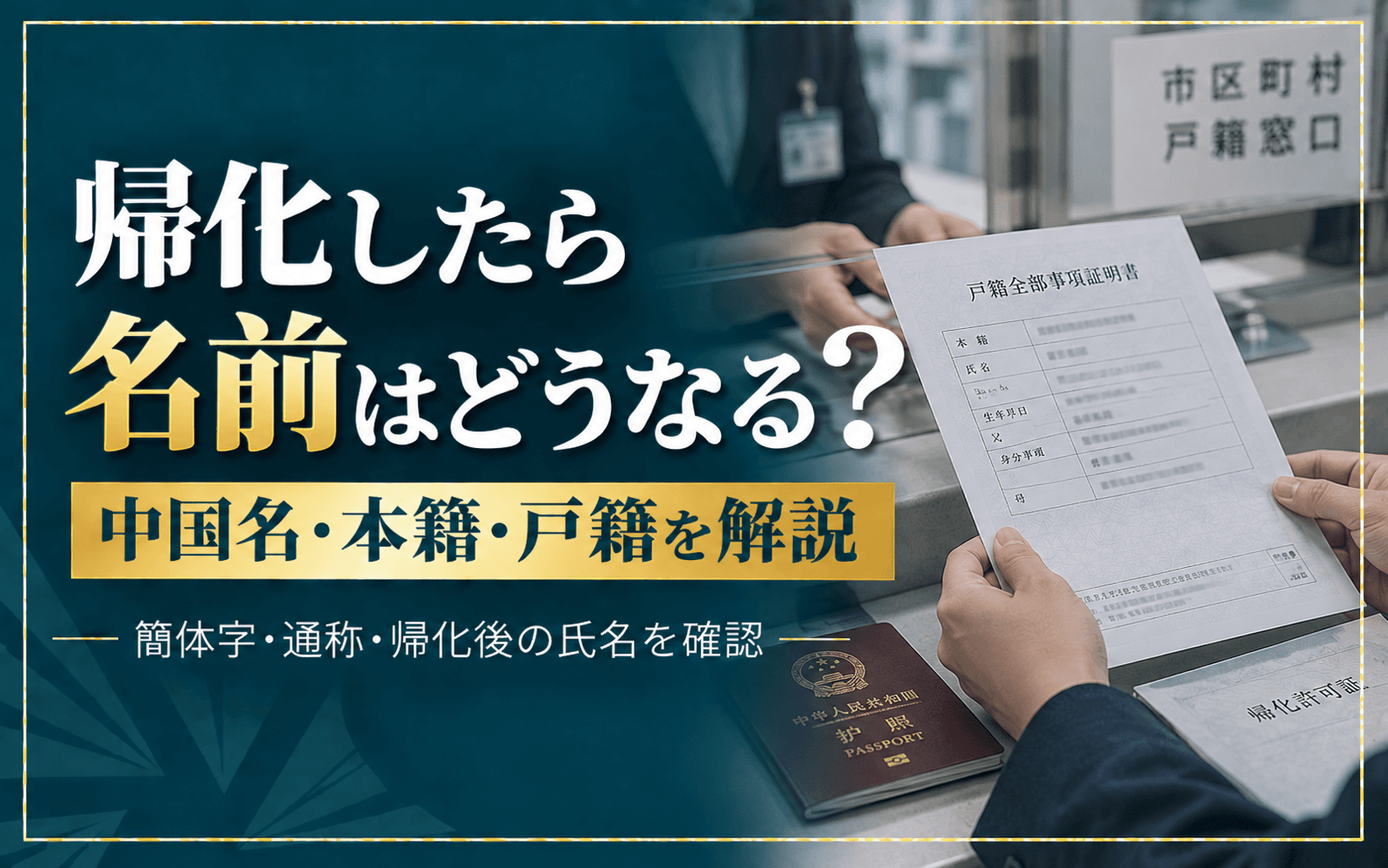
“Do I have to change my name to a Japanese name?”
“I want to keep the Chinese name my parents gave me.”
“Can simplified Chinese characters be entered in a Japanese family register?”
“Does my registered domicile have to be my current home address?”
A naturalization applicant needs to think about these issues before permission is granted.
The current naturalization application form includes fields for:
the registered domicile after naturalization
and:
the name and phonetic reading after naturalization. 法務省
Naturalization also results in the creation of a Japanese family register for the new Japanese national. 法務省
Naturalization Does Not Require a Japanese-Style Name
There is no general requirement to replace a Chinese name with a stereotypically Japanese surname and given name.
Within the applicable character and family-register rules, an applicant may consider:
Retaining the existing Chinese name
Retaining the surname but changing the given name
Using a long-established Japanese alias
Selecting an entirely new Japanese-style name
The key limitation concerns the characters that can be entered in the Japanese family register.
1. Can You Keep Your Existing Chinese Name?
Potentially, yes.
If the characters can be used under Japanese family-register rules, the applicant can consider retaining the same or a substantially similar name.
Naturalization does not itself require an applicant to abandon a culturally Chinese name.
2. What Happens to Simplified Chinese Characters?
The current naturalization-form instructions expressly state that simplified Chinese characters used in China and similar jurisdictions should be converted to the corresponding:
Japanese standard character form
when the application is completed. 法務省
Accordingly, the visual form of the name in the Japanese family register may differ from the form appearing on a Chinese passport.
Keeping the Same Name Does Not Always Mean Keeping Exactly the Same Glyph
A simplified character may be converted into the Japanese form even though the underlying name remains the same.
Chinese applicants should therefore check their exact characters before deciding the post-naturalization name.
3. What Characters Can Be Used for the Given Name?
Current Legal Affairs Bureau guidance generally limits the post-naturalization given name to:
Jōyō kanji
Jinmeiyō kanji
Hiragana
Katakana
within the applicable family-register rules. 法務局
A character commonly used in China is therefore not automatically available as a Japanese registered given-name character.
4. Are the Rules Identical for the Surname?
Not entirely.
Legal Affairs Bureau guidance indicates that certain additional proper Japanese characters can be used for the post-naturalization surname. 法務局
A person hoping to retain a Chinese surname should therefore check the exact character rather than assuming that the given-name rule applies identically.
5. Can the Registered Name Be Written in Roman Letters?
The current application instructions specify kanji, hiragana, katakana, and Arabic numerals for the application and state that alphabetic letters are not used. 法務省
Accordingly, a professional English name such as “LEO” is not simply entered into the family register in Roman letters as the formal Japanese name.
A katakana form may be considered where appropriate.
6. Can a Long-Used Alias Become the Formal Japanese Name?
An applicant who has long used a Japanese alias may consider that alias as the post-naturalization name if it satisfies the applicable rules.
However:
having an alias on Japanese records does not automatically make it the future family-register name.
The applicant still chooses and declares the post-naturalization name in the naturalization application.
7. Can You Keep the Chinese Surname but Change the Given Name?
That may be possible depending on the characters and family circumstances.
For example, an applicant may consider:
Chinese surname
a new Japanese-style given name.
Another applicant may prefer to retain the entire original name.
There Is No Official Advantage to Having a More Japanese-Sounding Name
Naturalization is not approved because a name sounds more Japanese.
The name choice is separate from the substantive requirements concerning residence, conduct, livelihood, taxes, and other factors.
8. What About Married Couples Applying Together?
A married couple needs to consider the post-naturalization surname together with the future family-register structure.
Legal Affairs Bureau guidance instructs married applicants, and applicants married to Japanese nationals, to specify which spouse’s surname will be used after naturalization. 法務局
The decision is therefore not always purely an individual naming preference.
9. What if the Applicant Is Married to a Japanese National?
For example:
Japanese husband: Tanaka
Chinese wife: Wang.
Before naturalization, the foreign spouse may continue using the original foreign surname.
After naturalization, however, the couple’s status as Japanese spouses and their family-register relationship must be considered when determining the surname.
10. What Is a Registered Domicile?
The Japanese honseki, or registered domicile, is the location assigned to the family register.
It is not the same thing as the person’s residential address.
A person can therefore have:
a residential address in one municipality,
and:
a registered domicile in another.
11. Does the Registered Domicile Have to Match the Current Address?
No.
Legal Affairs Bureau guidance states that the post-naturalization registered domicile may be chosen within the applicable rules. 法務局
It does not have to be the applicant’s current apartment or home address.
12. What Locations Can Be Used?
The registered domicile can be expressed using an existing land-lot designation or applicable residential-address designation.
A fictitious town name or nonexistent lot cannot be created.
Where there is uncertainty, the applicant should confirm the proper registered-domicile expression with the municipality concerned. 法務局
13. Does Renting Prevent You From Using a Location as Honseki?
No.
A registered domicile is not a declaration of ownership of the land.
The applicant does not have to own the property simply to use an eligible location as the registered domicile.
14. Can Honseki Be Changed Later?
Yes.
Japan’s family-register system has a formal:
transfer-of-registered-domicile notification
procedure. 法務省
So the initial honseki is not necessarily permanent for life.
15. Can the Name Be Changed Easily After Naturalization?
No.
Changing a registered surname or given name later is significantly different from moving the registered domicile.
The courts explain that changing a surname generally requires unavoidable circumstances, while changing a given name requires a legitimate reason, with Family Court permission. 裁判所
The naturalization guidance therefore advises applicants to choose the post-naturalization name carefully.
16. Is the Pronunciation Also Registered?
Yes.
Japan introduced the recording of phonetic readings in the family register from May 26, 2025.
A person first entered into a family register through naturalization reports the phonetic reading together with the relevant family-register procedure. 法務省
The naturalization application itself now includes the post-naturalization name and reading.
17. Can Any Pronunciation Be Chosen?
Current family-register rules generally require a reading recognized as a reading of the name characters. 法務省
Applicants hoping to retain a particular Chinese-derived pronunciation should therefore confirm the proposed reading where there is uncertainty.
18. Why Are Chinese Civil-Status Documents Important?
Naturalization creates a Japanese family register.
The authorities therefore need accurate evidence of the applicant’s:
Parents
Marriage
Children
Other family relationships
to create the record correctly. 法務省
This is why Chinese birth, family-relationship, marriage, and divorce documents can be so important.
19. Families Naturalizing Together
Where parents and children naturalize together, the family should review:
The family surname
Each child’s given name
Phonetic readings
The future family-register relationship
as a group.
Each child does not necessarily have to change the given name in the same way as the parents.
20. What Happens to Immigration Documents After Naturalization?
Once Japanese nationality is acquired, the person is no longer residing in Japan as a foreign national under a status of residence.
The person then uses Japanese systems such as the family register, resident record, and Japanese passport.
Where the name changes substantially, numerous registrations and accounts may also require updating.
Cases That Particularly Deserve Advance Review
Careful planning is useful where the applicant:
Wants to keep the current Chinese name
Wants to retain only the Chinese surname
Has simplified Chinese characters in the name
Has long used a Japanese alias
Uses an English professional name
Is married to a Japanese national
Is naturalizing together with a spouse
Is naturalizing with children
Wants a registered domicile different from the current residence
Wants to preserve a Chinese-derived pronunciation
Frequently Asked Questions
Q. Must I Adopt a Japanese-Style Name?
No.
An existing Chinese name may be considered if it satisfies Japanese family-register rules.
Q. Can I Keep Simplified Chinese Characters?
The naturalization application instructions require simplified Chinese characters to be converted to Japanese standard character forms.
Q. Can the Given Name Be in Katakana?
Katakana is among the permitted categories for a registered given name.
Q. Can My Formal Name Be Written in English Letters?
The current naturalization application does not use alphabetic letters as the registered-name characters.
Q. Can My Alias Become My Formal Name?
It may be selected if the applicable naming rules are satisfied, but it does not become the formal name automatically.
Q. Must My Honseki Be My Home Address?
No.
Residence and registered domicile are separate concepts.
Q. Can I Change Honseki Later?
Yes, Japan has a formal procedure for transferring the registered domicile.
Q. Can I Change My Name Later?
Not freely. A later registered-name change may require Family Court permission and a qualifying reason.
Your Post-Naturalization Name Is Not a Temporary Label
It becomes the person’s formal Japanese registered name and will be used across Japanese legal and administrative life.
For Chinese applicants in particular, it is worth resolving before filing:
whether to retain the Chinese name
how simplified characters will be converted
whether to use an existing alias
how the family surname will work
what phonetic reading will be registered
and:
where the new family register will be based.
Enlight Administrative Scrivener’s Office reviews the applicant’s current Chinese name, character forms, aliases, family relationships, proposed post-naturalization name and reading, and registered domicile together with the rest of the naturalization documentation.
The initial naturalization eligibility check is free of charge.
References
Ministry of Justice: Nationality Q&A
Ministry of Justice: Application for Permission to Naturalize
Ministry of Justice: Naturalization Application Form and Instructions
Ministry of Justice: Family Register Phonetic Reading System
Ministry of Justice: Characters Permitted in Given Names
Legal Affairs Bureau: Guide to Naturalization Applications
Courts of Japan: Permission to Change a Surname
Courts of Japan: Permission to Change a Given Name