Column
Can You Apply for Japanese Naturalization if You Own Property or Savings in China? Overseas Assets and Remittances Explained 【2026 Update】
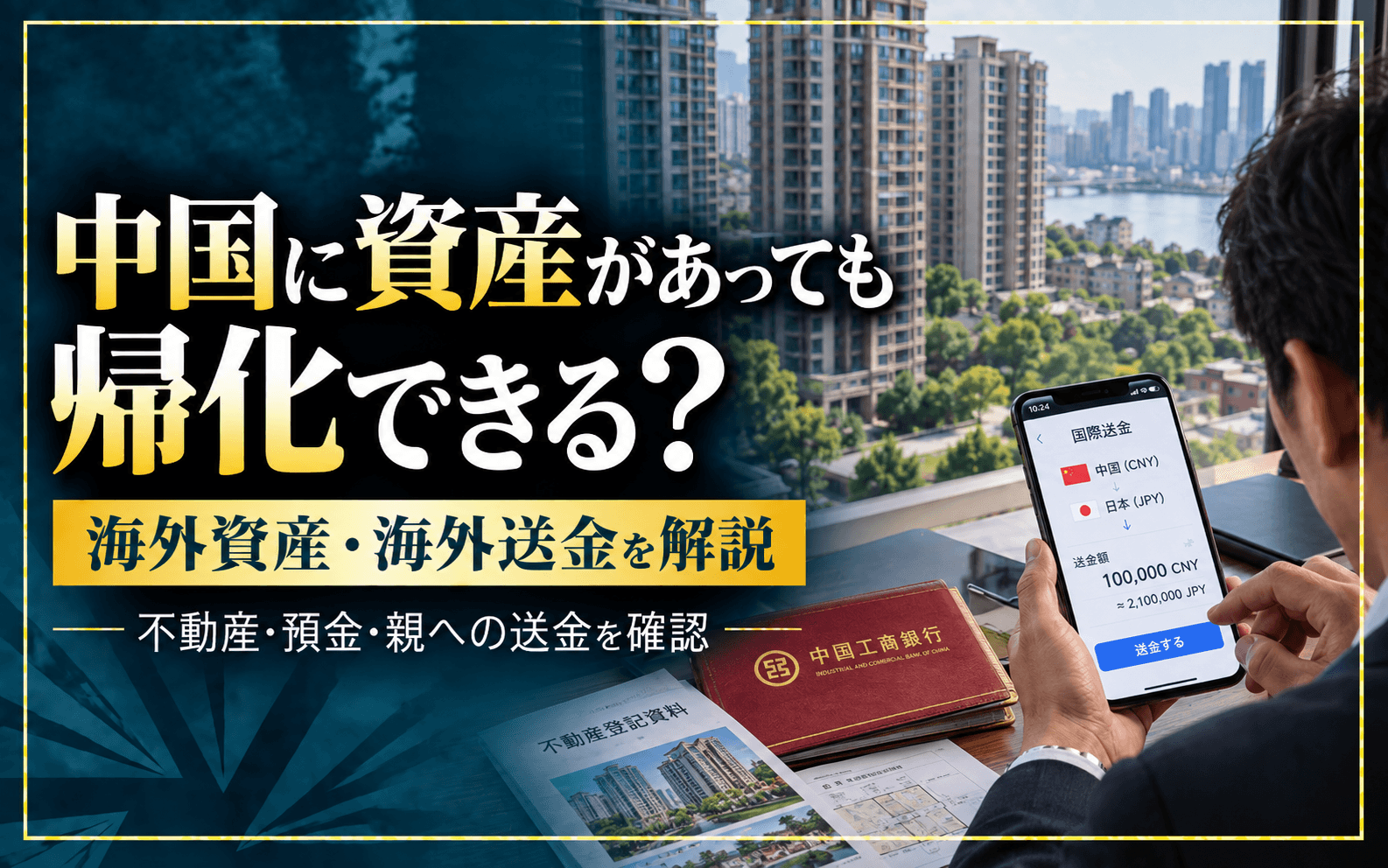
“I still own an apartment in China.”
“I have substantial savings in a Chinese bank account.”
“I send money to my parents in China every month.”
None of these facts automatically prevents naturalization.
The key issue is whether the applicant can accurately explain:
assets + income + remittances + taxes + household finances.
Owning Assets in China Does Not Automatically Harm a Naturalization Application
Common examples include:
Property in China
Chinese bank deposits
Investments
Ownership interests in Chinese companies
Regular financial support for relatives
There is no published rule stating that a person must dispose of all foreign assets before becoming Japanese.
Consistency Is More Important Than the Mere Existence of Foreign Assets
Naturalization documentation includes information concerning livelihood, assets, income, and expenses.
The Tokyo Legal Affairs Bureau also reviews relevant financial information concerning spouses and people sharing the applicant’s household.
Problems can therefore arise where one set of documents describes one financial picture while tax records, remittances, or bank records indicate another.
1. Property in China
An applicant may own:
A home purchased before moving to Japan
Inherited property
Investment property
Jointly owned family property
There is no general requirement to sell such property before naturalization.
However, whether the property generates income can be particularly important.
Rental Income From Chinese Property Requires Tax Review
Where rent is paid into a Chinese bank account, the applicant should not simply assume that the income is irrelevant to Japan.
Japanese tax treatment can depend on the applicant’s tax-residence classification and the nature of the income.
Because naturalization also involves reviewing tax records, overseas income and Japanese filings should be consistent.
Chinese Bank Savings
Holding a Chinese bank account is not itself unusual or problematic.
The important point is that the applicant’s description of assets should not conflict with the actual financial position.
Money Remaining Overseas Is Not Automatically Irrelevant
Whether money has been remitted to Japan and whether an asset or income has Japanese tax consequences are separate questions.
Applicants should not assume that anything kept outside Japan can simply be ignored.
2. The Foreign Asset Statement May Apply
Under Japanese tax law, certain residents who hold foreign assets worth more than:
¥50 million as of December 31
may be required to file a Foreign Asset Statement.
Whether the obligation applies depends on the individual’s Japanese tax-residence classification.
Accordingly, a foreign national with assets exceeding ¥50 million does not automatically have a filing obligation in every case.
Applicants with substantial property, deposits, shares, or business interests abroad should nevertheless check whether their Japanese tax compliance is complete.
Failure to File Does Not Automatically Mean Naturalization Refusal
Tax law and naturalization are separate systems.
The first question is whether a filing obligation actually existed.
Where a tax obligation was missed, it may be appropriate to resolve the tax position before determining the timing of the naturalization application.
Supporting Parents or Other Family Members Abroad
The Tokyo Legal Affairs Bureau expressly asks applicants supporting relatives who live overseas to prepare evidence of overseas remittances.
Examples may include regular transfers for:
Living expenses
Medical expenses
Housing costs
The remittance itself is not automatically negative.
3. Overseas Support Is Part of the Real Household Budget
If an applicant earns ¥5.5 million but sends ¥1.2 million per year to parents overseas, the actual household budget cannot be understood from salary alone.
Naturalization examines the applicant’s ability to maintain a stable livelihood.
Large recurring overseas support should therefore be considered together with the applicant’s expenses and dependents in Japan.
There Is No Need to Hide Overseas Remittances
The authorities themselves request remittance documentation where relevant.
The important issue is whether the actual remittances are consistent with the household information submitted in the application.
Cash Support Can Be Harder to Document
An applicant may hand cash to parents during visits home.
There is no general rule prohibiting that arrangement, but cash can be harder to document objectively than bank transfers.
Overseas Dependents Used for Japanese Tax Purposes
Where the applicant has treated overseas relatives as dependents for Japanese tax purposes, the naturalization application should not present a household picture that contradicts those tax records.
Large Transfers From China to Japan
A large incoming transfer may arise from:
Sale of Chinese property
Moving Chinese savings to Japan
Financial assistance from parents
Funding a Japanese home purchase
A large deposit is not inherently problematic.
The important point is that the source can be explained.
4. A Sudden Increase in Bank Savings
Where an account rises from ¥2 million to ¥20 million within a short period, the applicant may need to explain the source.
Depending on the circumstances, relevant evidence may include sale documents, overseas account records, remittance records, and Japanese bank records.
Money Received From Parents May Also Raise Gift-Tax Issues
Financial assistance from parents overseas can potentially have Japanese gift-tax consequences.
The fact that the donor is outside Japan does not necessarily remove Japanese tax considerations.
Income From a Chinese Company
An applicant may receive:
Salary
Director compensation
Dividends
Contract income
from a Chinese company.
That does not automatically prevent naturalization.
However, tax treatment, actual work activity, and the applicant’s current immigration status may all require review.
Ownership of a Chinese Company
Where an applicant owns or manages a company in China while living in Japan, the analysis may extend beyond ordinary bank savings.
Relevant questions can include whether the applicant receives income, actively manages the business from Japan, or holds a significant ownership interest.
Naturalization Does Not Require Moving Every Asset to Japan
There is no general rule requiring an applicant to sell all Chinese property, close all Chinese accounts, or move all funds to Japan before filing.
The essential issue is whether the applicant’s assets and income can be accurately explained and the applicant maintains a stable life in Japan.
Cases That Particularly Deserve Pre-Filing Review
Professional review can be useful where the applicant:
Owns property in China
Holds substantial savings abroad
May have more than ¥50 million in foreign assets
Receives rental income from foreign property
Receives salary or dividends from a Chinese company
Owns or manages a Chinese company
Regularly supports parents in China
Claims overseas relatives for Japanese tax purposes
Recently transferred substantial funds into Japan
Received major financial assistance from parents
Is uncertain whether foreign income was correctly reported in Japan
Is unsure whether a Foreign Asset Statement was required
Frequently Asked Questions
Q. Must I Sell My Apartment in China Before Naturalization?
No general rule requires that.
Q. I Have Significant Savings in a Chinese Bank.
That alone does not prevent naturalization. Consistency with the overall financial information is the important issue.
Q. I Send Money to My Parents Every Month.
That is not inherently a problem. The Tokyo Legal Affairs Bureau specifically asks for remittance evidence where an applicant supports relatives living abroad.
Q. I Receive Rent From Property in China.
The Japanese tax treatment should be reviewed.
Q. My Overseas Assets Exceed ¥50 Million.
A Foreign Asset Statement may be required for certain Japanese tax residents. Individual tax status should be checked.
Q. My Parents Sent Me a Large Amount for a Home Purchase.
The source of funds and possible Japanese gift-tax treatment should both be reviewed.
For Overseas Assets, the Key Question Is Not “Do You Have Them?” but “Do All the Records Match?”
Chinese applicants commonly retain property or savings in China.
The greater risk is not the mere existence of foreign assets, but inconsistencies among:
foreign assets + tax records + bank records + remittances + naturalization documents.
Enlight Administrative Scrivener’s Office reviews overseas property, foreign deposits, cross-border remittances, Japanese tax records, and household finances to identify inconsistencies before filing.
The initial naturalization eligibility check is free of charge.
References
Tokyo Legal Affairs Bureau: Naturalization
Tokyo Legal Affairs Bureau: Supporting Documents for Naturalization Applications — Chinese Nationals
Tokyo Legal Affairs Bureau: Naturalization Consultation Document Checklist — China
Tokyo Legal Affairs Bureau: Guide to Naturalization Applications
National Tax Agency: Foreign Asset Statement System
National Tax Agency: Foreign Asset Statement Forms