Column
Japanese Naturalization for Business Owners and Sole Proprietors: Company Taxes, Social Insurance, and Loss-Making Years 【2026 Update】
“I own a company in Japan. Can I apply for naturalization?”
“My company recorded a loss last year.”
“My company once paid social-insurance contributions late.”
Business owners and sole proprietors can apply for Japanese naturalization.
However, compared with an ordinary employee, there is a major difference:
the authorities may need to review both the individual and the business.
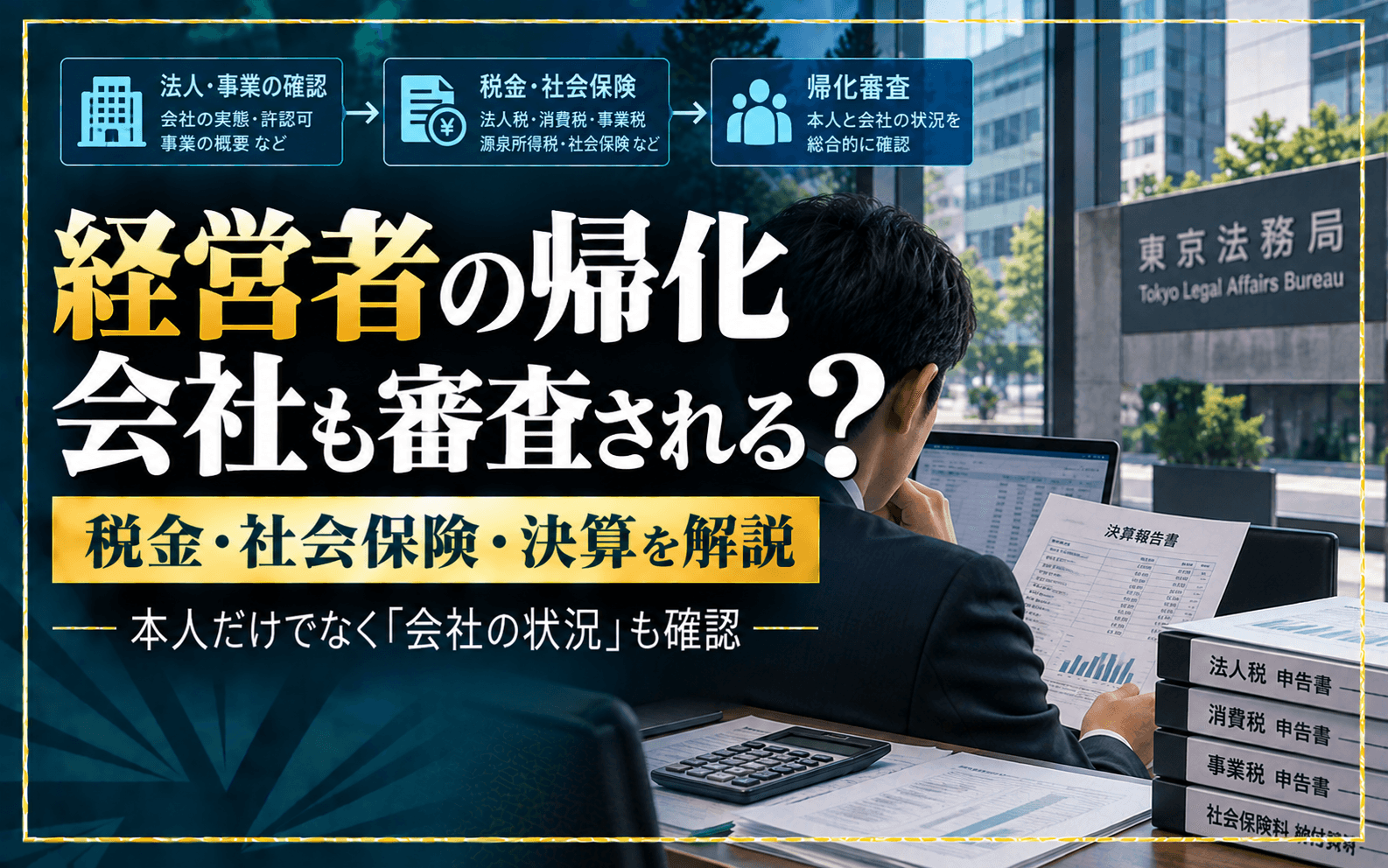
Business-Owner Naturalization Involves the Applicant and the Company
The Tokyo Legal Affairs Bureau currently requires people operating a company or sole proprietorship to prepare a document describing the:
outline of the business.
Corporate officers may also need to provide corporate registration records and relevant business licenses.
The review therefore goes beyond the amount of salary paid to the applicant.
Tax Documentation Is More Extensive Than for Ordinary Employees
A corporate officer may need company-level records concerning:
Prefectural and municipal corporate resident tax
Corporate enterprise tax
Corporate income tax
Consumption tax
Corporate tax returns and financial statements
Withholding records concerning the applicant
Withholding-income-tax payment records
These are in addition to the applicant’s personal tax documentation.
1. Personal Taxes
The applicant’s own resident tax and income-tax situation remains relevant.
For Chinese-national applications currently handled by the Tokyo Legal Affairs Bureau, multiple years of resident-tax certificates are required, with five fiscal years currently listed for applications accepted from September 2026 through May 2027.
Applicants required to file individual income-tax returns also need the relevant tax and filing records.
2. Company Taxes
Corporate taxes are separate from the owner’s personal taxes.
A clean personal resident-tax record does not make company tax compliance irrelevant.
Company Tax and Personal Tax Are Different Obligations
A corporation is legally separate from its representative.
Corporate tax payments do not replace the representative’s individual income and resident-tax obligations, and vice versa.
Both sides may therefore require review.
Company Social Insurance Is Also Important
The Tokyo Legal Affairs Bureau currently requires business owners of workplaces covered by Employees’ Pension and health insurance to provide evidence concerning company social-insurance payments for the most recent:
two years.
Where ordinary certificates do not establish whether payments were made at the appropriate time, additional dated receipts or bank-payment records may be required.
Does Paying Everything Later Solve a Late-Payment Issue?
Not automatically.
A company may have paid social-insurance premiums late because of temporary cash-flow difficulties and later cleared all outstanding amounts.
The specific period and timing should still be reviewed rather than looking only at the current balance.
Does a Loss-Making Year Prevent Naturalization?
There is no published nationwide rule stating that:
one loss-making year automatically results in refusal.
A business can record a loss because of startup costs, investment, temporary revenue reduction, or market conditions.
However, naturalization includes a livelihood requirement.
Relevant circumstances can therefore include:
Company performance
Director compensation
Household income
Savings
Business continuity
Historical income
One Loss-Making Year Is Different From Repeated Losses
A business that was profitable for years, made a major investment, and temporarily recorded one loss is different from a company experiencing recurring losses, insolvency, and declining director compensation.
The word “loss” alone does not decide the case.
Company Profit Is Not the Same as the Owner’s Personal Income
For example:
Company revenue: ¥80 million
Company profit: ¥8 million
Director compensation: ¥2.4 million
Corporate money does not automatically become the representative’s personal income.
The applicant’s own and household financial circumstances still need to be reviewed.
Can the Director Simply Increase Compensation Before Filing?
A last-minute increase does not erase historical income and financial statements.
The current salary should also make sense in light of the company’s financial condition.
What If the Company Was Recently Established?
There is no published rule prohibiting naturalization solely because the company is new.
However, where the applicant has only recently moved from employment into business ownership, evidence of business and income stability may still be limited.
Examples include:
No completed first financial year
Limited revenue history
Newly established director compensation
Recent social-insurance enrollment
The question is therefore not only whether filing is technically possible, but whether the present timing is appropriate.
Sole Proprietors Have Additional Issues Too
A sole proprietor may need records relating to:
Individual income-tax returns
Consumption tax
Enterprise tax
Withholding income tax
Business licenses
The Tokyo Legal Affairs Bureau currently lists such documents for applicable sole proprietors.
Revenue Is Not the Same as Income
A business may have:
Revenue: ¥10 million
Expenses: ¥7.5 million
Taxable business income: ¥2.5 million
A large top-line sales figure alone does not establish the applicant’s livelihood.
Aggressive Expense Deductions Can Affect the Numbers Seen in the Application
Lawful business expenses are not a problem by themselves.
However, where tax filings consistently show very low personal income, the naturalization review still needs to assess the household’s actual livelihood.
Official tax records cannot simply be replaced by an oral explanation that the applicant “actually has more money.”
Businesses Requiring Licenses Must Be Properly Licensed
Some businesses require permits or licenses, such as certain restaurant, construction, real-estate, lodging, or secondhand-goods businesses.
The Tokyo Legal Affairs Bureau lists relevant business licenses among the documents for business owners.
Overseas Companies and Assets Can Add Complexity
Some applicants operate businesses both in Japan and abroad.
That can involve:
Overseas companies
Foreign-source income
Overseas assets
Cross-border remittances
The Bureau’s current consultation materials also include foreign-asset reporting among the possible items to review.
Household Circumstances Still Matter
The livelihood condition is not determined solely from the applicant’s own income.
The Tokyo Legal Affairs Bureau also requests financial information concerning spouses and others sharing the household where relevant.
Business Manager Status Should Also Be Reviewed
Many foreign company owners hold Business Manager status.
Its immigration criteria were substantially revised in October 2025.
Where the applicant’s present residence status itself raises a compliance issue, the naturalization application should not be viewed in complete isolation from that underlying immigration position.
Cases That Particularly Deserve Pre-Filing Review
Professional review can be especially useful where the applicant:
Is a representative director or corporate officer
Is a sole proprietor
Recently established the company
Has one or more loss-making years
Operates an insolvent company
Receives relatively low director compensation
Recently changed director compensation substantially
Has late corporate tax, consumption tax, or enterprise-tax payments
Has concerns about withholding-tax handling
Has late company social-insurance payments
Operates another business abroad
Has overseas assets or foreign income
Currently holds Business Manager status
Frequently Asked Questions
Q. My Company Had a Loss. Can I Apply?
There is no nationwide rule making a single loss year an automatic refusal. The business, personal income, and household circumstances need to be reviewed together.
Q. All Corporate Income Tax Has Been Paid.
Other applicable company taxes, withholding tax, personal taxes, and social insurance may still require review.
Q. My Company Paid Social Insurance Late.
The Tokyo Legal Affairs Bureau currently reviews two years of company social-insurance payments for applicable business owners and may request evidence showing timely payment.
Q. The Company Has High Revenue but My Director Compensation Is Low.
Company revenue and personal income are different. The household livelihood and company condition should both be reviewed.
Q. I Just Established My Company.
There is no universal waiting period, but the available evidence of business and livelihood stability should be considered.
Q. I Am a Sole Proprietor.
Tax returns, business tax, consumption tax, withholding tax, and relevant licenses may all become part of the review.
Business-Owner Naturalization Cannot Be Judged From Personal Salary Alone
For a business owner, the review can extend beyond personal income to:
corporate tax + social insurance + financial statements + business reality + household livelihood.
Enlight Administrative Scrivener’s Office reviews both the applicant and the business before determining whether the naturalization application should proceed at the present time.
The initial naturalization eligibility check is free of charge.
References
Tokyo Legal Affairs Bureau: Naturalization
Tokyo Legal Affairs Bureau: Initial Naturalization Consultation
Tokyo Legal Affairs Bureau: Supporting Documents for Chinese Nationals
Tokyo Legal Affairs Bureau: Naturalization Consultation Document Checklist — China
Tokyo Legal Affairs Bureau: Guide to Naturalization Applications