Column

Column
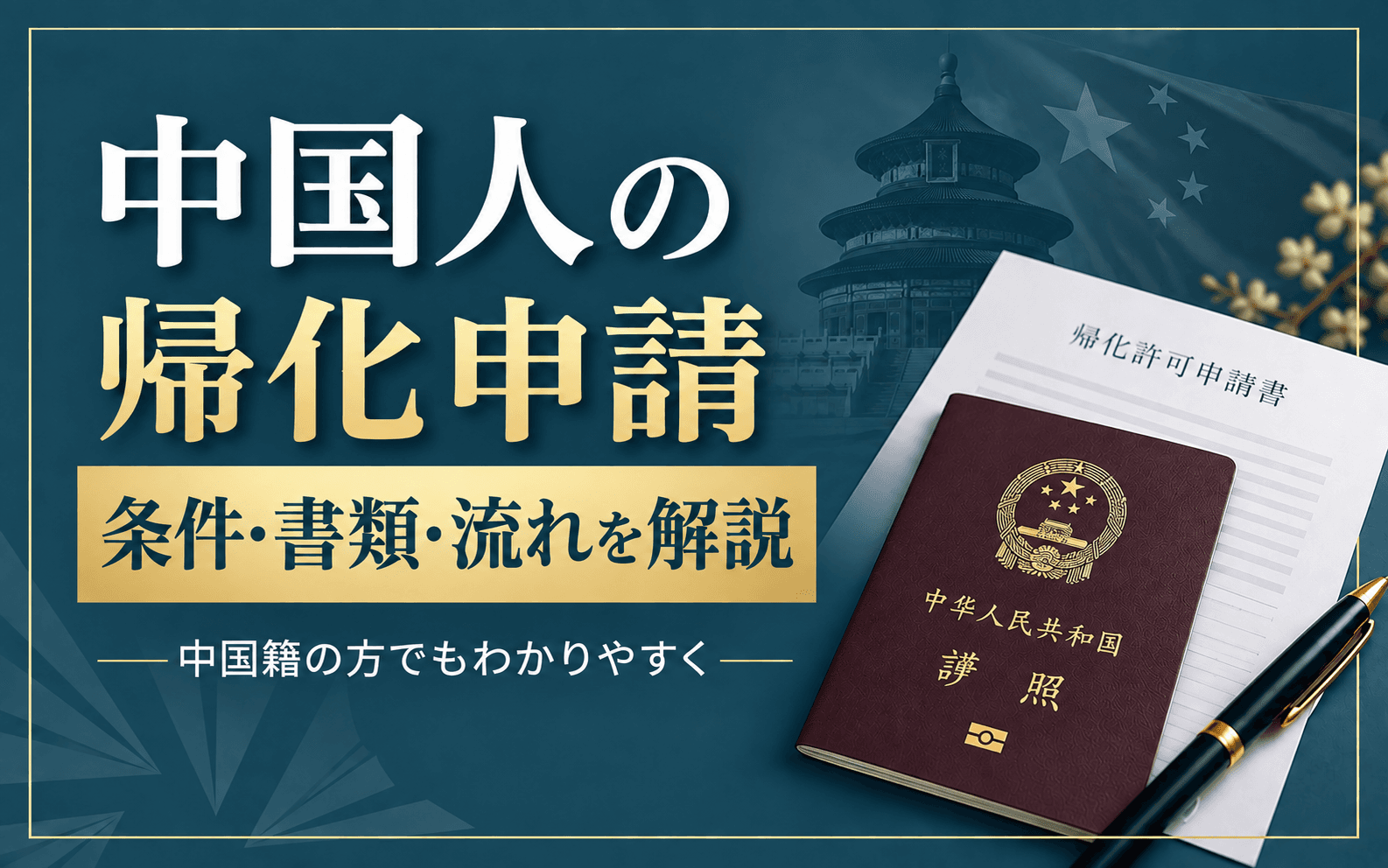
Chinese nationals living in Japan often ask:
“Should I apply for permanent residence or naturalization?”
“What documents do I need from China?”
“Which family members need to be covered by my family relationship documents?”
“Do Chinese documents need Japanese translations?”
“What happens to my Chinese nationality?”
For Chinese applicants, naturalization involves not only reviewing tax, pension, employment, and residence history in Japan, but also preparing official Chinese documents establishing birth, marriage, and family relationships.
The exact documents vary depending on family structure, marital history, place of birth, and occupation.
What Does Naturalization Mean for a Chinese National?
Naturalization is the process by which a foreign national acquires Japanese nationality with permission from the Minister of Justice.
After naturalization, you are no longer living in Japan under a foreign national’s status of residence.
You become a Japanese national.
This is fundamentally different from permanent residence.
A Permanent Resident remains a foreign national, while a naturalized person acquires Japanese nationality itself.
For Chinese nationals, it is therefore important to consider the possible effects on:
Chinese nationality
Chinese passport
Japanese family registration
Future travel to China
Property and legal procedures in China
Chinese Nationals Are Subject to the Same Basic Naturalization Requirements
There is no completely separate set of eligibility rules solely for Chinese applicants.
The main areas include:
Residence history in Japan
Age and legal capacity
Good conduct
Taxes and social insurance
Household financial stability
Treatment of Chinese nationality
Japanese-language ability
Integration into Japanese society
The basic statutory residence requirement is generally five continuous years of domicile in Japan.
However, current naturalization practice should not be reduced to:
“Five years means I am automatically ready to apply.”
Your overall life in Japan and degree of integration are also reviewed.
Spouses and children of Japanese nationals may qualify for relaxed requirements.
Chinese Civil-Status Documents Often Take the Most Time
For Chinese applicants, one of the more time-consuming parts of the process is obtaining notarized and official civil-status documents from China.
Used to establish the applicant’s birth details.
Used to establish relationships with:
Father
Mother
Brothers and sisters
Additional documents may be required if the certificate does not cover all necessary family relationships.
Married applicants may need a marriage notarial certificate and/or marriage certificate.
Applicants with a previous divorce may need divorce-related certificates.
In some cases, documents concerning the parents’ civil status may also be required.
Applicants with children may need documents establishing the parent-child relationship.
Special family circumstances may require additional evidence.
Nationality-Related Documents From the Chinese Embassy or Consulate
In addition to Chinese notarized documents, applicants may need nationality-related consular documentation issued by the Chinese Embassy or a Chinese Consulate in Japan.
The timing and type of certificate should be confirmed with the Legal Affairs Bureau handling the application.
Does China Recognize Dual Nationality?
China generally does not recognize dual nationality.
Chinese applicants should therefore review the consequences of acquiring Japanese nationality and confirm the latest Chinese consular procedures before naturalization.
Keep Your Old Chinese Passports
Old passports may be important.
Naturalization review may require past passport copies in order to confirm previous travel and residence history.
If you still have expired passports, keep them.
Chinese Documents Require Japanese Translations
Chinese-language documents generally need Japanese translations.
The translation should normally:
Cover the entire document
Not omit sections
Identify the translator
Include other information required by the Legal Affairs Bureau
Self-translation may be accepted if the applicant can translate accurately.
For naturalization applications handled by Enlight Administrative Scrivener’s Office, translation support for Chinese and English civil-status documents is generally included within the standard service scope.
Documents Required in Japan
Applicants may also need:
Certificate of residence
Residence card
Passports
Certificate of employment
Salary statements
Withholding tax certificates
Taxation certificates
Tax payment certificates
Pension records
Social insurance records
Driving record certificates
Bank and asset records
Corporate or business documents
The required documents differ for employees, business owners, and self-employed applicants.
Naturalization Forms Must Also Be Prepared
The process also involves preparing documents such as:
Application for permission to naturalize
Family overview
Personal history
Entry and exit history
Statement of reasons for naturalization
Household financial summary
Business overview, where applicable
It is especially important that:
names, dates of birth, family relationships, address history, and employment history are consistent across Chinese documents, Japanese records, passports, and the application forms.
The Final Motivation Statement Is Generally Handwritten
The final statement explaining the applicant’s reasons for naturalization is generally expected to be handwritten by the applicant.
An Administrative Scrivener can assist with:
Organizing the content
Drafting
Editing
Checking consistency with other documents
but the applicant completes the final handwritten version.
General Application Process
Check:
Arrival and residence history
Status of residence
Employment
Income
Taxes
Pension
Family structure
Travel history
Traffic violations
Japanese ability
Naturalization is handled by the Legal Affairs Bureau with jurisdiction over your address.
Appointments are commonly required.
Organize:
Japanese documents + official and notarized Chinese documents.
Collect the necessary materials from China and Japan.
Prepare the forms and make sure the information is consistent across all documents.
The applicant generally needs to appear in person.
The Legal Affairs Bureau may conduct an interview and request updated or additional documents.
If naturalization is approved, it is announced in the Official Gazette and Japanese nationality is acquired from the date of publication.
Common Issues for Chinese Applicants
The certificate may list the applicant and parents but omit siblings.
Simplified Chinese characters, Japanese kanji, and katakana may all appear.
Chinese and Japanese records may not match exactly.
This can make travel-history reconstruction more difficult.
Some documents may need to be reissued by the time the application is filed.
Frequently Asked Questions
Usually not by itself.
Additional notarized birth and family relationship documents may be required.
They may be.
If sibling relationships are not sufficiently established, additional birth documents may be requested.
Possibly, if you can translate accurately and meet the Legal Affairs Bureau’s formatting requirements.
China generally does not recognize dual nationality.
The specific consular procedures should be confirmed before naturalization.
In some cases, family members or representatives may assist, but procedures vary by locality and document type.
Yes.
There is no universal JLPT-level requirement, although practical Japanese ability is still necessary.
Organize Your Chinese Documents Before You Start Collecting Everything
Rather than obtaining every possible notarized document first, it is usually more efficient to determine:
which documents your individual case actually requires
and then obtain them.
This can reduce unnecessary costs and repeated applications.
Chinese-Language Support Available
Enlight Administrative Scrivener’s Office provides support including:
Eligibility review
Individualized document checklist
Application preparation
Drafting the motivation statement
Obtaining certain Japanese public records
Chinese and English translation
Appointment coordination
Accompaniment to the Legal Affairs Bureau
Interview preparation
Consultations are available in Chinese and via WeChat.
The initial eligibility check is free of charge.
Enlight Administrative Scrivener’s Office
Gyoseishoshi (Administrative Scrivener): Shiki Miyajima
Telephone: 03-5284-7981
Office hours: Weekdays 10:00–18:00
References
Tokyo Legal Affairs Bureau guidance for Chinese naturalization applicants
Tokyo Legal Affairs Bureau naturalization forms
Regional Legal Affairs Bureau guidance
Embassy of the People’s Republic of China in Japan
Related
Do you need JLPT N2 or N3 to apply for Japanese naturalization? This guide explains the practical Japanese-language ability expected for naturalization, including speaking, reading, writing, Legal Affairs Bureau consultations, interviews, and the handwritten statement of reasons.
Read MoreCan you apply for Japanese naturalization shortly after changing jobs? This guide explains how job changes, income changes, probationary periods, unemployment gaps, and changing jobs during the application process can affect the review.
Read MoreCan you still apply for Japanese naturalization if you have unpaid or late resident tax, income tax, pension, or health insurance contributions? This guide explains what the Legal Affairs Bureau reviews and what applicants with previous payment issues should check before filing.
Read MoreLet's Start
Our scrivener carefully answers your visa and naturalization questions. Online consultations are available.