Column
Can You Apply for Japanese Naturalization Soon After Changing Jobs? 【2026 Update】
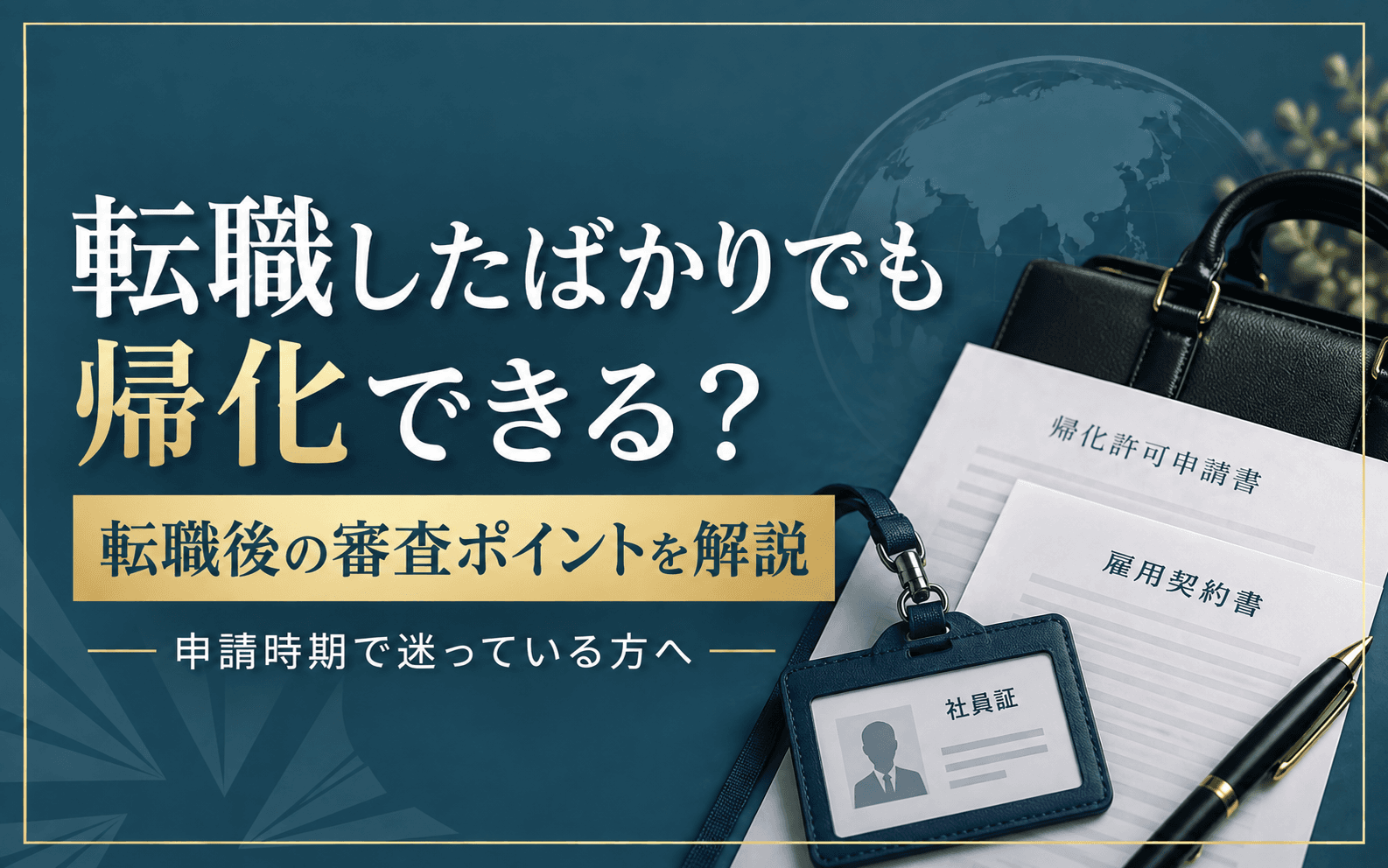
Naturalization applicants often ask:
“I just changed jobs. Can I still apply?”
“I am planning to leave my current company.”
“I have changed jobs several times. Will that hurt my application?”
“Can I change jobs after filing for naturalization?”
The key point is:
changing jobs does not automatically make you ineligible for naturalization.
Japan does not publish a universal rule stating:
“You must work for X months after changing jobs before applying.”
What matters is whether your employment, income, immigration status, and overall living situation remain stable after the change.
Financial Stability Matters More Than Staying With One Employer
Naturalization includes a financial-stability requirement.
The authorities want to know whether you can continue to maintain a stable life in Japan.
This does not necessarily mean that your own salary must remain unchanged.
Where spouses or family members share living expenses, the household’s overall financial position may also be considered.
Therefore:
a temporary decrease in your personal income after changing jobs does not automatically make naturalization impossible.
Can You Apply Immediately After Changing Jobs?
There is no general rule prohibiting it.
A job change may raise little concern where you:
Move to a better position
Continue in the same professional field
Increase your income
Maintain stable employment
However, immediately after changing jobs you may have:
A very short employment history with the new company
Only one or two salary statements
A probationary period
A gap between jobs
These factors may require additional explanation or documentation.
Is There a Six-Month or One-Year Waiting Period?
No universal waiting period has been publicly established.
The appropriate timing depends on factors such as:
Employment contract
Monthly salary
Expected annual income
Employment type
Probationary period
Household income
Savings
Previous employment history
Any unemployment gap
What Documents Are Important After a Job Change?
You will generally need documents showing:
where you currently work
and:
what income you currently receive.
These may include:
Certificate of employment
Salary statements
Salary certificate
What If Your Income Decreases?
A lower salary does not automatically make naturalization impossible.
Japan does not publish a fixed minimum annual income required for all naturalization applicants.
The key question is:
Can you and your household continue to live stably in Japan?
For example, a salary decrease may not be a major concern if household expenses remain manageable and finances are otherwise stable.
Greater care may be needed if:
Income falls substantially
The household struggles to cover ordinary expenses
Jobs are repeatedly changed after only short periods
There is a long period of unemployment
Do Multiple Job Changes Hurt an Application?
There is no published rule stating:
“More than X job changes means denial.”
The overall pattern matters more than the number itself.
Relevant points include:
Length of each job
Reasons for leaving
Gaps between jobs
Income history
Current stability
Career Development Is Different From Repeated Short-Term Employment
Moving after several years to advance your career is different from leaving a new employer every few months.
The broader employment history is what matters.
Can You Apply During a Probationary Period?
There is no universal rule prohibiting an application during probation.
However, it may be useful to review:
Whether regular employment is expected
Contract length
Salary
Household financial stability
If continued employment is still highly uncertain, waiting until the situation is clearer may sometimes be appropriate.
Do You Have to Be a Permanent Full-Time Employee?
No.
Naturalization is not automatically unavailable to:
Fixed-term employees
Temporary agency workers
Part-time workers
Self-employed applicants
Employment type alone is not the deciding factor.
Financial stability matters more.
What If There Is a Gap Between Jobs?
A few days between jobs and several months of unemployment are very different situations.
Review:
Length of the gap
How living expenses were covered
Savings
Spouse’s income
Taxes
Pension
Health insurance
Pension and Health Insurance During Job Changes
After leaving an employer, you may need to arrange:
National Pension
National Health Insurance
until your new employer’s coverage begins.
Do not assume that a short gap can simply be ignored.
Naturalization review includes social insurance compliance.
Immigration Notifications After Changing Jobs
Applicants holding work-based statuses such as Engineer/Specialist in Humanities/International Services should also confirm whether they need to report changes to the Immigration Services Agency.
Naturalization procedures do not replace immigration notification obligations.
Make Sure the New Job Fits Your Status of Residence
Until naturalization is actually approved, you remain a foreign national and must continue to comply with your current immigration status.
If you hold a work-based status of residence, make sure your new job falls within the activities permitted under that status.
Can You Change Jobs After Filing?
Yes, a job change can occur while the application is pending.
However:
you should promptly inform the Legal Affairs Bureau handling your case.
Changes to:
Employer
Employment circumstances
Address
Immigration status
should not be concealed.
What Additional Documents May Be Required?
Depending on the case, the Legal Affairs Bureau may request:
New employment certificate
New salary statements
Employment agreement
Updated social insurance records
Immigration-related documents
Report the change first and follow the officer’s instructions.
What If You Become Unemployed During the Review?
The authorities may need updated information concerning:
Savings
Spouse’s or household income
Reason for leaving the job
Job-search situation
Future financial plans
Becoming unemployed does not automatically result in denial.
However, it is an important change that should be reported.
Is It Better to Apply Before or After Changing Jobs?
There is no single answer.
You Already Know You Will Resign Soon
If you expect to leave immediately after filing, it may be worth considering whether applying after your new employment situation is clearer would make the process more straightforward.
Your New Job Is Already Confirmed
You may choose to start the new job, organize your:
Employment records
Salary documents
Social insurance
Immigration procedures
and then apply.
You Are Only Considering a Change
You do not necessarily need to give up a reasonable career opportunity solely because you are considering naturalization.
The application timing can be adjusted around the actual job change.
Does a Higher Salary After Changing Jobs Make Naturalization Easier?
A higher salary may support the financial-stability assessment.
However:
higher income does not automatically guarantee approval.
Naturalization also reviews:
Conduct
Immigration status
Taxes
Pension
Japanese-language ability
Family circumstances
Nationality issues
Seven Things to Check Before Applying After a Job Change
1. Current Employer and Start Date
Know exactly when your current employment began.
2. Employment Type
Review your current contract.
3. Actual Salary
Use actual payroll records, not only the salary stated in the job offer.
4. Gaps Between Jobs
Organize the dates clearly.
5. Taxes, Pension, and Health Insurance
Check that nothing was missed during the transition.
6. Immigration Notifications
Confirm whether your status of residence requires notification.
7. Whether the New Job Fits Your Current Status
Review your actual job duties.
Frequently Asked Questions
Q. Can I Apply One Month After Changing Jobs?
There is no universal waiting period.
The decision should be based on your current employment, income, and household stability.
Q. I Have Changed Jobs Three Times. Is That a Problem?
Not automatically.
The length of each job, gaps between jobs, and present stability are more important than the number alone.
Q. My Income Decreased After Changing Jobs.
That does not automatically make naturalization impossible.
The household’s overall financial stability matters.
Q. I Am Still on Probation.
There is no universal rule prohibiting an application during probation.
However, the stability of your current employment should be reviewed.
Q. Can a Temporary Agency Worker Apply?
Yes, depending on the circumstances.
Employment status alone does not determine eligibility.
Q. I Changed Jobs After Filing. Do I Need to Report It?
Yes.
You should promptly notify the Legal Affairs Bureau handling your naturalization application.
Changing Jobs Does Not Mean You Have to Give Up on Naturalization
Do not automatically conclude:
“I changed jobs, so I cannot apply.”
At the same time, do not assume:
“Changing jobs has nothing to do with naturalization.”
A job change can affect:
Income
Employment stability
Social insurance
Immigration status
Household finances
The real question is:
whether you can continue to live in Japan lawfully and with reasonable financial stability after the change.
Enlight Administrative Scrivener’s Office can review:
Employment history
Job changes
Income
Status of residence
Social insurance
as part of the initial naturalization eligibility assessment.
The initial eligibility check is free of charge.