Column
Do Unpaid or Late Taxes and Pension Contributions Affect Japanese Naturalization? 【2026 Update】
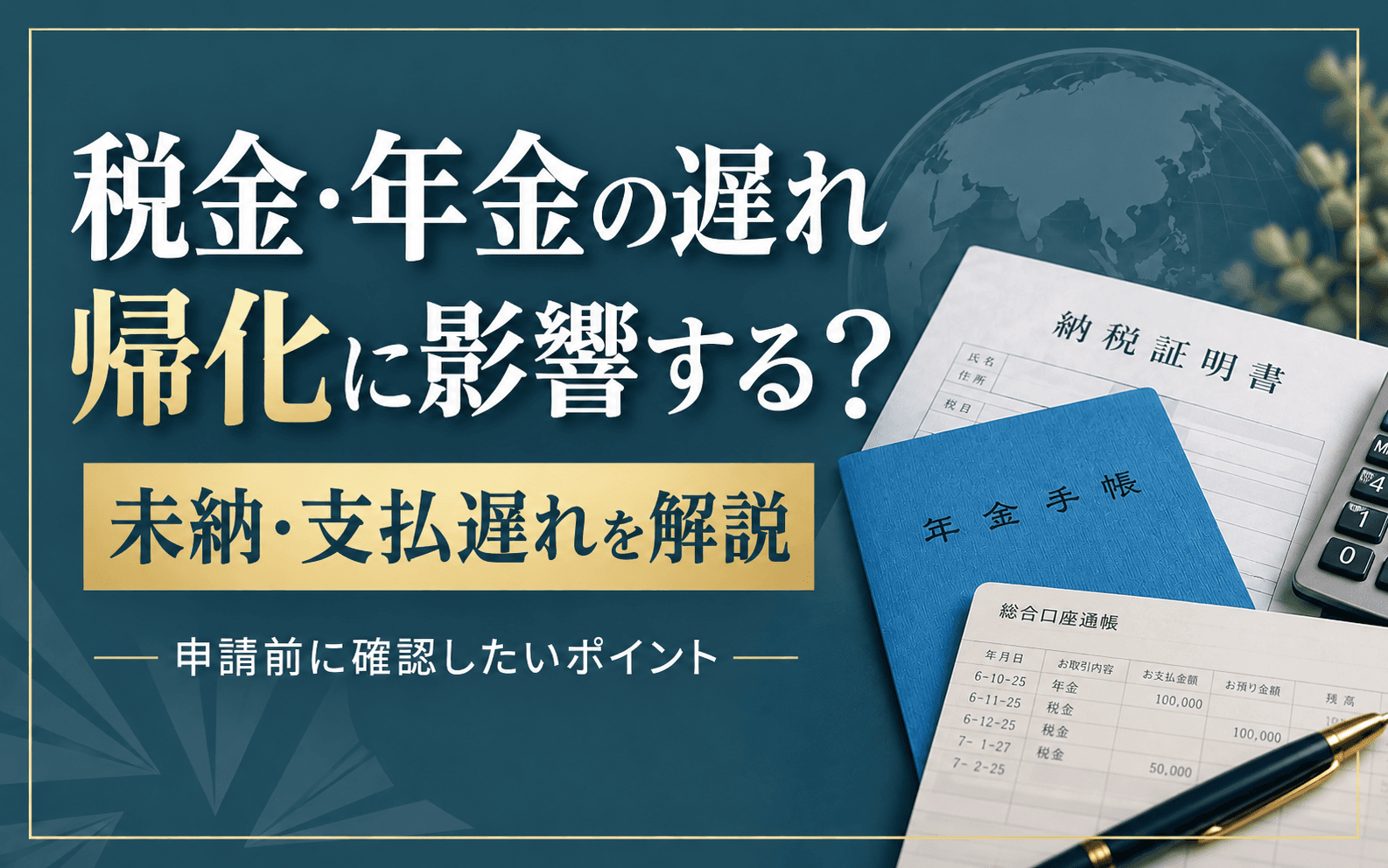
People preparing for Japanese naturalization often ask:
“I once paid my resident tax late. Can I still naturalize?”
“I have unpaid National Pension months.”
“If I pay everything now, will the problem be resolved?”
“My company deducts everything from my salary. Is that enough?”
Tax, pension, and social insurance payment history is an important part of the naturalization examination.
One of the general requirements for Japanese naturalization is good conduct.
The Ministry of Justice explains that good conduct is assessed comprehensively, taking into account not only criminal history but also matters such as tax compliance and conduct in society.
Therefore:
“I have no unpaid balance today, so it does not matter when I paid in the past.”
is not necessarily correct.
From April 1, 2026, Japan strengthened its naturalization review and extended the period for reviewing tax and social insurance payment history.
Naturalization Reviews More Than Whether You Currently Owe Money
The authorities may review not only:
“Is there an unpaid balance now?”
but also:
“Were the obligations paid properly and on time over the relevant period?”
For example, current Tokyo Legal Affairs Bureau guidance requires multiple years of resident-tax records from ordinary salaried applicants.
Where resident tax was paid through ordinary collection, applicants may also need evidence showing that payments were made at the proper time during the most recent five years.
Therefore:
Paying all arrears immediately before applying does not automatically mean that the earlier payment history is irrelevant.
Naturalization Review Became Stricter in April 2026
An important change took effect on April 1, 2026.
The Minister of Justice explained that the revised naturalization review would:
Strengthen the assessment of integration into Japanese society
Extend the review period for tax and social insurance payment history under the conduct and livelihood requirements
among other changes.
This means that older internet articles published before April 2026 may describe shorter review periods than those currently used.
How Many Years of Resident Tax Are Reviewed?
As of September 2026, Tokyo Legal Affairs Bureau guidance for Chinese applicants asks ordinary salaried employees without a tax-return obligation to provide:
Taxation or non-taxation certificates covering the most recent five years.
Multiple years of resident-tax payment certificates are also required.
If the applicant has paid resident tax through ordinary collection, evidence showing timely payment during the most recent five years may also be required.
Examples include:
Bankbook records showing automatic withdrawals
Dated payment receipts
Tax payment certificates that show the date of payment
Special Collection vs. Ordinary Collection
Special Collection
Under special collection, the employer deducts resident tax from the employee’s salary and pays it to the municipality.
This is common for company employees.
Current Tokyo guidance states that where resident tax was paid through special collection, separate evidence showing each payment date is not required.
Ordinary Collection
Under ordinary collection, the taxpayer pays resident tax directly.
Payment may be made through:
Convenience stores
Banks
Automatic bank withdrawal
For ordinary collection, keeping evidence that payments were made by the due date is especially important.
Does One Late Resident-Tax Payment Make Naturalization Impossible?
Not automatically.
There is no published rule stating that one late payment always results in denial.
However, current Legal Affairs Bureau guidance specifically asks for evidence of payment at the appropriate time, so payment timing is clearly relevant.
If you have paid late, review:
Which tax year was involved
The original due date
The actual payment date
Why payment was late
Whether subsequent payments have been timely
before deciding when to apply.
What If Resident Tax Is Still Unpaid?
First determine exactly which tax and which period remain unpaid.
Current Tokyo guidance indicates that where a tax payment certificate still shows unpaid amounts, additional earlier-year documentation may be requested.
It is generally better to understand and address the situation before formally preparing the application.
Is Income Tax Also Reviewed?
Yes.
Applicants who are required to file tax returns may be asked for additional income-tax documentation.
Current Tokyo guidance includes:
Income tax payment certificates for the most recent three years
A copy of the most recent tax return
for certain applicants.
This can be particularly relevant if you:
Have side income
Receive salary from multiple employers
Operate a business
Have other income requiring a tax return
Failure to File a Required Tax Return Requires Particular Care
If you were legally required to file a tax return but did not do so, the issue is not simply:
“Was the tax eventually paid?”
It may also involve:
“Was the required tax filing itself completed?”
Before preparing a naturalization application, consider confirming with the tax office or a tax accountant whether:
Any tax years remain unfiled
A late tax return is required
An amended return is required
Administrative scriveners do not replace tax accountants for tax filing or professional tax determinations.
How Many Years of Pension Contributions Are Reviewed?
Current Tokyo Legal Affairs Bureau guidance requests evidence relating to the most recent two years of public pension contributions.
Relevant evidence may include:
Pension payment receipts
Insured-person record statements
Payment history records
Nenkin Net records
Pension Payments Are Reviewed for Timing, Not Only Completion
Social insurance may also be reviewed for whether payments were made on time.
Where ordinary certificates do not show payment timing, the Legal Affairs Bureau may request evidence covering the most recent two years showing that social insurance contributions were paid at the proper time.
Examples include:
Bank withdrawal records
Dated receipts
Therefore:
Paying old pension arrears in a lump sum later is not necessarily treated exactly the same as having paid every contribution on time from the beginning.
What If You Have Unpaid National Pension Months?
Start by checking your actual pension record.
Confirm:
Which months are unpaid
Whether payment is still possible
Whether you had an approved exemption
Whether you used the student payment special system or payment deferment
You can review this through:
Nenkin Net
A pension office
Official insured-person records
What About Approved Exemptions or Student Payment Special Status?
An approved:
Student payment special arrangement
Pension contribution exemption
Payment deferment
is a formal statutory arrangement.
It is therefore not the same as simply failing to pay without obtaining any approval.
The documents required will depend on your individual pension history, so it is advisable to organize the records before applying.
Are Company Employees Safe If They Are Enrolled in Employees’ Pension Insurance?
If your employer properly enrolls you in:
Employees’ Pension Insurance
Health insurance
and deducts contributions from your salary, you do not personally make each monthly payment.
Current Tokyo guidance states that company employees whose social insurance contributions are deducted from salary generally do not need separate evidence proving the exact timing of those payments.
However, you should still check for:
Gaps between jobs
Failure to switch to National Pension
Failure to enroll in National Health Insurance
during periods when you were not covered by an employer.
Pay Attention to Gaps Between Jobs
When leaving one employer and joining another, there may be a period in which you must personally arrange:
National Pension
National Health Insurance
depending on the circumstances.
Even applicants who have spent most of their careers as employees should review whether any coverage gaps occurred during job changes.
National Health Insurance Is Also Reviewed
Naturalization review is not limited to pension contributions.
Current Tokyo guidance also calls for evidence concerning the most recent two years of National Health Insurance contributions where applicable.
Company Owners Must Also Review the Company’s Social Insurance
For company owners or corporate officers, reviewing only personal pension payments may not be enough.
Where the company is subject to Employees’ Pension Insurance and health insurance, evidence concerning the company’s social insurance payments for the most recent two years may be required.
Therefore:
“My personal contributions are fully paid, but my company has unpaid social insurance premiums.”
may still require careful review.
Self-Employed Applicants and Company Owners Have More Tax Items to Review
Self-Employed Applicants
Depending on the situation, documentation may concern:
Income tax
Consumption tax
Individual business tax
Withholding income tax
Current Tokyo guidance requires some self-employed applicants to provide consumption-tax and business-tax certificates covering the most recent three years.
Company Owners and Corporate Officers
Additional items may include:
Corporate tax
Corporate resident tax
Corporate business tax
Consumption tax
Withholding income tax
Corporate social insurance
Naturalization preparation is therefore generally more complex for company owners than for ordinary employees.
Can a Spouse’s or Family Member’s Tax and Pension History Matter?
Yes, depending on the household.
Tokyo Legal Affairs Bureau guidance states that tax-related documentation may also be required for:
a spouse and other people who share the same household economy.
The naturalization livelihood requirement itself is assessed on the basis of family members who share the same household economy.
Therefore:
“My own payments are perfect, so my family’s situation can never matter.”
is not always correct.
If I Pay Everything Now, Can I Apply Immediately?
That requires individual review.
Paying all current arrears is important.
However:
Paying today does not erase the fact that earlier payments were late.
Current naturalization documentation may be used to review:
Whether obligations were paid
Whether they were paid on time
Whether proper payments continued over the relevant period
Applicants with late payments should therefore consider not only whether the balance is now zero, but also how long timely payment has continued since the problem was resolved.
Is There a Fixed Waiting Period After a Late Payment?
No universal rule has been published stating:
“Wait X years after a late payment and naturalization will be approved.”
However, current Tokyo guidance uses important review periods such as:
Timely resident-tax payments: most recent five years
Social insurance contributions: most recent two years
for relevant applicants.
This does not mean:
Approval is guaranteed after five years
or:
Anything older than two years is automatically irrelevant.
Naturalization remains an individual and comprehensive examination.
Do Not Hide Unpaid or Late Payments
Naturalization applications involve objective records such as:
Taxation certificates
Tax payment certificates
Payment receipts
Pension records
Nenkin Net information
Social insurance payment certificates
The better approach is to:
understand your payment history accurately before applying.
Seven Things to Check Before Applying
1. Whether Any Taxes Are Currently Unpaid
Review resident tax, income tax, and other applicable taxes.
2. Whether Resident Tax Was Paid Late
Pay particular attention to periods of ordinary collection.
3. Whether Any Required Tax Returns Were Missed
Applicants with side income, multiple salaries, or business income should review this carefully.
4. Whether There Are Unpaid National Pension Months
Obtain your pension record.
5. Whether Health Insurance Contributions Were Properly Paid
Check any periods under National Health Insurance.
6. Whether There Were Coverage Gaps Between Jobs
Review periods after leaving employer social insurance.
7. For Company Owners, Review the Company’s Payments
Corporate tax and corporate social insurance may also be relevant.
Frequently Asked Questions
Q. I Paid Resident Tax Late Once. Can I Still Naturalize?
One late payment does not automatically mean denial.
However, current review does consider whether taxes were paid on time.
The timing, reason, and subsequent payment history should be reviewed.
Q. Everything Is Fully Paid Now. Can the Authorities Still See Earlier Late Payments?
Possibly.
For periods of ordinary collection, current Tokyo guidance may require evidence showing whether resident tax was paid on time during the previous five years.
Q. If I Pay All Pension Arrears Now, Is Everything Fine?
Paying the arrears is important, but Legal Affairs Bureaus also review whether social insurance obligations were paid at the proper time.
A zero balance alone does not automatically resolve every issue.
Q. My Company Deducts Pension From My Salary. Do I Need to Worry?
Proper payroll deduction generally makes the review simpler.
However, check any gaps caused by job changes or periods outside employer coverage.
Q. I Had a Student Pension Exemption. Is That a Problem?
An officially approved student payment special arrangement or statutory exemption is different from simple non-payment.
Review your pension record and prepare the relevant documentation if necessary.
Q. Can My Family’s Unpaid Taxes Affect My Application?
Depending on the household economy, documentation for a spouse or other financially connected family members may also be relevant.
Q. When Should I Apply If I Had Late Payments?
There is no universal “wait X years” rule.
The type of obligation, timing of the late payment, and the period of proper payment afterward should be reviewed before deciding.
Review Tax and Pension Issues Before Filing
Past payment problems do not necessarily mean:
“You can never naturalize.”
However, it is equally unsafe to assume:
“Everything is paid now, so the past does not matter.”
Since April 2026, the Japanese government has extended the review of tax and social insurance payment history in naturalization cases.
Before applying, organize:
What was unpaid
When it was paid
How late the payment was
Whether timely payment has continued
Whether there are issues involving family members or a company you operate
Enlight Administrative Scrivener’s Office reviews tax, pension, and social insurance circumstances as part of the initial naturalization eligibility assessment.
You are welcome to consult us if:
“I paid something late in the past and do not know whether it matters.”
“My pension record has a gap.”
“I am not sure whether now is the right time to apply.”
The initial naturalization eligibility check is free of charge.
Enlight Administrative Scrivener’s Office
Administrative Scrivener: Shiki Miyajima
Telephone: 03-5284-7981
Office hours: Weekdays 10:00–18:00
Online consultations throughout Japan and WeChat consultations are also available.
References
Ministry of Justice: Nationality Q&A
Minister of Justice press conference concerning strengthened naturalization examination
Tokyo Legal Affairs Bureau: Documents Required for Naturalization Applications by Chinese Nationals
Tokyo Legal Affairs Bureau: Naturalization Guidance
※Japan has not published a universal rule stating that a particular amount of late tax, pension, or social insurance payment automatically results in approval or denial, or that waiting a fixed number of years guarantees approval. Individual payment history and household circumstances are reviewed case by case.