Column
Do Traffic Violations Affect Japanese Naturalization? Key Points to Check Before Applying【2026 Update】
Applicants considering Japanese naturalization often ask:
“I had one speeding violation. Can I still naturalize?”
“I received one parking ticket. Will it affect my application?”
“How many traffic violations are allowed?”
The first important point is:
Having one traffic violation does not automatically mean that you cannot be naturalized.
However, one of the general requirements for Japanese naturalization is good conduct.
Traffic violations may therefore be relevant to the examination.
The Ministry of Justice explains that good conduct is assessed comprehensively by considering matters such as criminal history, the nature of any offenses, tax compliance, and whether the applicant has caused problems in society.
There is therefore no published universal rule stating:
“You will be approved as long as you have no more than X violations.”
or:
“Minor violations never matter.”
Naturalization Requires Good Conduct
Good conduct is one of the general requirements for naturalization.
The examination looks not only at whether a violation exists, but also at matters such as:
The nature of the violation
The number of violations
When they occurred
Other aspects of the applicant’s conduct
Traffic violations should therefore be considered in context rather than by counting tickets alone.
There Is No Official Rule Saying “X Violations Are Acceptable”
You may encounter statements online such as:
“Two violations within five years are fine.”
However, the Ministry of Justice does not publish a rule stating that:
“Naturalization will be approved if there are no more than X traffic violations in five years.”
Each case is examined individually.
Even a single violation can involve different circumstances depending on:
The type of violation
How recent it was
Whether an accident occurred
Whether there was a license suspension
Whether violations continued afterward
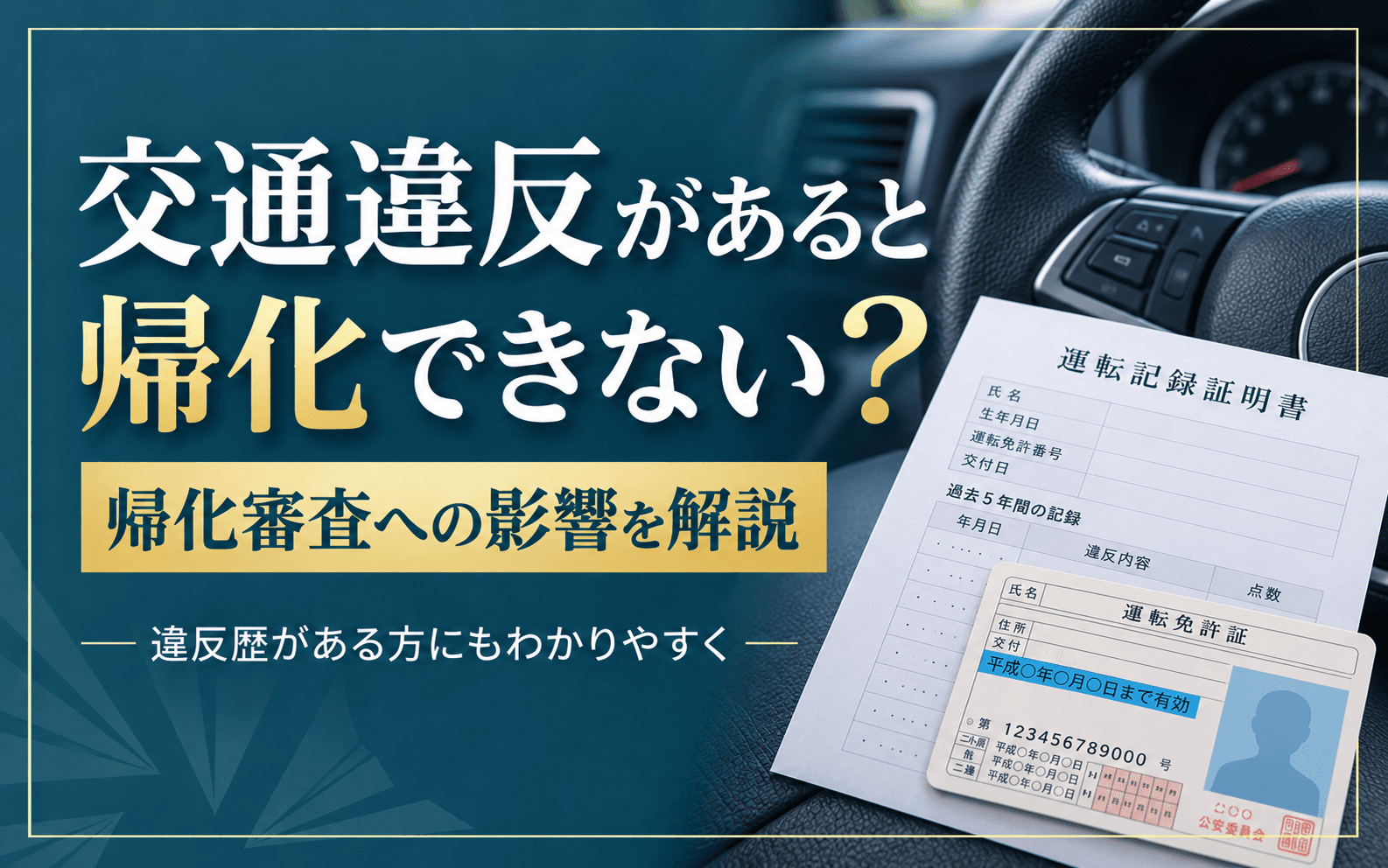
A Five-Year Driving Record Certificate Is Used in Naturalization Applications
For applicants who hold a driver’s license, some Legal Affairs Bureaus require a five-year driving record certificate.
The certificate is issued by the Japan Safe Driving Center.
It can show records concerning:
Traffic violations
Traffic accidents
Administrative sanctions relating to a driver’s license
What Appears on the Driving Record Certificate?
The certificate may include:
Date of the violation
Type of violation
Penalty points
Traffic accidents
Administrative dispositions
For this reason, it is not advisable to assume that an old violation should simply be omitted from your explanation.
Your statements should be consistent with objective records.
Pay Attention to When the Certificate Is Issued
Tokyo Legal Affairs Bureau currently asks applicants to bring a five-year driving record certificate issued within the previous two months.
It also states that a new certificate may be requested again before the final naturalization decision.
Because the naturalization process can take a considerable amount of time, obtaining the certificate too early may mean that another one is required later.
What If You Have Had a License Suspension, Cancellation, or Expiration?
Greater care may be needed if you have experienced:
License suspension
License cancellation
License expiration
A serious traffic accident
Legal Affairs Bureau guidance may also require a driving license history certificate from applicants whose license has expired or been cancelled.
These circumstances generally require more careful review than a single minor violation.
Does a Blue Ticket Not Matter Because It Is Not a Criminal Conviction?
Not necessarily.
Japan’s Traffic Infraction Notification System applies to certain comparatively minor Road Traffic Act violations.
If the prescribed infraction fine is paid within the required period, the case is generally resolved without criminal punishment.
However:
“No criminal punishment” does not mean “the violation is completely irrelevant to naturalization.”
Paying the infraction fine does not automatically erase the administrative penalty points associated with the violation.
Traffic violations may also appear on the driving record certificate.
Therefore, even blue-ticket violations should be accurately reviewed before applying.
Which Traffic Violations Require Particular Care?
There is no publicly announced universal naturalization threshold.
However, greater caution is appropriate where circumstances include the following.
Repeated Violations Within a Short Period
One isolated minor violation is different from repeatedly violating traffic laws over a short period.
License Suspension or Other Administrative Sanctions
If accumulated points resulted in a license suspension or other administrative disposition, the circumstances should be reviewed carefully.
Accidents Involving Injury
Where the violation involved an accident, the nature and outcome of the accident may also be relevant.
More Serious Violations
More serious conduct such as:
Drunk driving
Driving without a license
requires particularly careful consideration.
These are not treated as ordinary minor infractions under the standard traffic infraction system.
Repeated Violations After a Previous Offense
The applicant’s conduct after the original violation can also matter.
A person who maintains safe driving afterward is in a different situation from someone who repeatedly commits new violations.
What About Parking Violations?
Parking violations should also be reviewed rather than automatically dismissed as unimportant.
Depending on how the case was handled, parking matters may involve procedures concerning the driver’s infraction fine or a vehicle user’s parking violation payment.
If you no longer remember how a past case was handled, it may be useful to review the relevant driving records.
How Many Years Must Pass After a Violation?
There is no official rule stating:
“After X years, a traffic violation no longer matters for naturalization.”
The content, timing, and circumstances are considered together.
The fact that a five-year driving record certificate is commonly required shows that recent driving history is an important area of review.
However:
This does not mean that every serious event older than five years is automatically irrelevant.
Serious accidents or criminal penalties may require separate consideration.
Should You Hide a Traffic Violation?
No.
Naturalization requires numerous official records, including driving-related documentation.
A better approach is to:
understand the facts accurately and be prepared to explain them consistently.
If you do not remember your traffic history, consider reviewing a driving record certificate before preparing the application.
Five Things to Check Before Applying
1. Number of Violations During the Recent Period
Confirm how many violations you have actually had.
2. Type of Violation
Identify whether it involved speeding, failure to stop, traffic signals, or another violation.
3. Date of the Violation
Determine whether the event was recent or occurred several years ago.
4. Administrative Sanctions
Check whether you received a license suspension or another administrative sanction.
5. Traffic Accidents
If an accident occurred, organize the details, including whether there was property damage or personal injury.
You Can Review Your Driving Record in Advance
If you do not remember your driving history accurately, you may obtain a driving record certificate for your own review.
The Japan Safe Driving Center issues certificates covering:
Five years
Three years
One year
However, a certificate obtained early for your own review may not satisfy the issuance-date requirement when you later submit your naturalization application.
Bicycle Traffic Violations Also Require Attention
From April 1, 2026, Japan’s Traffic Infraction Notification System was extended to certain bicycle traffic violations committed by riders aged 16 or older.
The good-conduct requirement for naturalization is not limited only to automobile driving.
You should therefore not assume:
“Traffic-law violations on a bicycle can never matter for naturalization.”
Complying with Japanese law in daily life is important.
However, there is no published universal standard explaining how a specific individual bicycle violation will affect a naturalization application.
Frequently Asked Questions
Q. I Have One Speeding Ticket. Can I Still Apply?
One speeding violation does not automatically make naturalization impossible.
The seriousness, timing, and overall violation history should be considered.
Q. Are Two Traffic Violations Automatically Acceptable?
No official rule states that two violations, or any other particular number, are automatically acceptable.
The type and timing of the violations must also be considered.
Q. Is a Blue-Ticket Violation a Criminal Record?
Under the traffic infraction system, payment of the prescribed infraction fine generally allows the matter to be resolved without criminal punishment.
However, this does not mean that the traffic violation itself or administrative penalty points disappear.
Q. Does a Gold Driver’s License Mean There Is No Problem?
Not necessarily.
A gold license does not automatically establish that the naturalization good-conduct requirement is satisfied.
Naturalization examines the applicant’s conduct more broadly.
Q. Should I Disclose an Old License Suspension?
You should accurately review the facts.
Legal Affairs Bureau guidance may require driving-history documentation where a license has expired or been cancelled.
Q. What If I Receive a Traffic Violation After Applying?
The examination does not freeze on the date the application is accepted.
The Legal Affairs Bureau may request another driving record certificate while the application is still under examination.
Safe driving remains important until the final decision.
A Traffic Violation Does Not Mean You Should Automatically Give Up
If you have a traffic violation, you do not need to immediately conclude:
“I can no longer naturalize.”
At the same time, you should not assume:
“It was minor, so I do not need to check it.”
Review:
Number of violations
Type of violation
Date
Accidents
Administrative sanctions
Driving conduct afterward
and then consider whether the present timing is appropriate for an application.
Enlight Administrative Scrivener’s Office can review traffic violations together with the other naturalization requirements during the initial eligibility check.
You are welcome to contact us if you are asking:
“I have a violation and want to know whether I can apply.”
“Should I apply now or wait before filing?”
The initial naturalization eligibility check is free of charge.
Enlight Administrative Scrivener’s Office
Administrative Scrivener: Shiki Miyajima
Telephone: 03-5284-7981
Office hours: Weekdays 10:00–18:00
Online consultations throughout Japan and WeChat consultations are also available.
References
Ministry of Justice: Nationality Q&A
Tokyo Legal Affairs Bureau: Documents Required for Naturalization
Japan Safe Driving Center: Driving Record Certificates
Tokyo Metropolitan Police Department: Traffic Infraction Notification System
National Police Agency: Traffic Infraction Notification System
※Japan does not publish a universal number of traffic violations or waiting period that automatically determines naturalization approval or denial. Individual circumstances, including the nature, timing, and frequency of violations and the applicant’s overall conduct, are considered.