Column
Documents Required for Japanese Naturalization|A Guide for Chinese Applicants 【2026 Update】
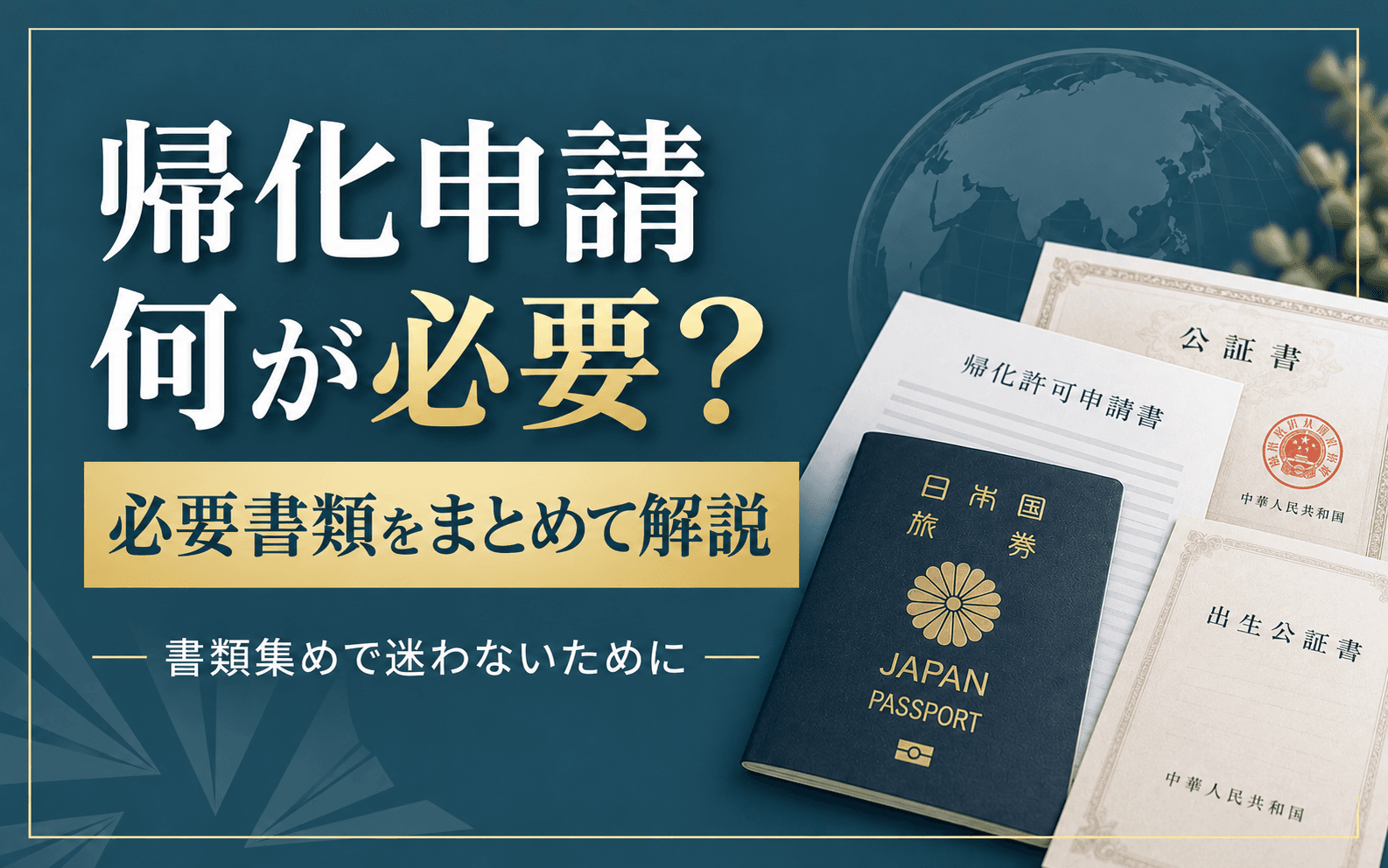
One of the most common questions from people considering Japanese naturalization is:
“What documents do I actually need?”
“Are documents from city hall enough?”
“Which Chinese notarial certificates are required?”
“How many years of tax records do I need?”
“Do I need my old passports?”
A naturalization application is not completed by submitting a single application form.
A substantial number of documents are used to confirm matters such as the applicant’s:
nationality, family relationships, address history, employment, income, taxes, pension contributions, and travel history.
The required documents are also not identical for every applicant.
They vary depending on factors such as:
Nationality
Family structure
Marital history
Occupation
Type of income
Residence history
This article organizes the main documents commonly required for Japanese naturalization based on official information available in 2026.
Naturalization Documents Can Be Divided Into Seven Main Categories
It is helpful to organize the required documents into the following groups:
Naturalization application documents prepared by the applicant
Documents proving nationality, birth, and family relationships
Residence and address-related documents in Japan
Employment, income, and asset documents
Tax, pension, and social insurance documents
Driving, education, and qualification documents
Japanese translations of foreign-language documents
1. Naturalization Application Documents Prepared by the Applicant
Several forms must be prepared specifically for the naturalization application.
Application for Permission to Naturalize
This is the main application form.
It includes information such as the applicant’s name, date of birth, and address.
Photographs are also required.
Family Overview
This document records information concerning family members such as:
Parents
Spouse
Children
Brothers and sisters
Information about relatives living outside Japan may also need to be included.
Personal History
The applicant provides details of:
Address history
Education
Employment history
Civil status history
Because naturalization involves a detailed review of past circumstances, applicants who do not remember old addresses or employers should organize this information in advance.
Entry and Exit History
This form records periods when the applicant left and re-entered Japan.
Statement of Reasons for Naturalization
This document explains why the applicant wishes to acquire Japanese nationality.
The final version is generally required to be handwritten by the applicant.
Household Financial Summary
This document records matters such as:
Income
Expenses
Savings
Real estate
Loans
Business Overview
Company owners, corporate executives, and self-employed applicants may also need to provide information about their business activities.
2. Documents Proving Nationality, Birth, and Family Relationships
Naturalization involves acquiring Japanese nationality.
For that reason, the applicant must establish not only:
“What nationality do I currently hold?”
but also:
“Who are my parents, who am I married to, and what are my family relationships?”
Official documents issued by the applicant’s home country are generally used to establish these matters.
Documents Chinese Applicants Should Pay Particular Attention To
Chinese applicants often need documents issued by Chinese notarial offices or Chinese diplomatic missions in Japan.
Certificate of Nationality
A nationality-related consular certificate issued by the Chinese Embassy or a Chinese Consulate in Japan may be required.
The timing for obtaining it should be confirmed with the Legal Affairs Bureau handling the application.
Birth Notarial Certificate
This establishes the applicant’s birth details.
It is generally obtained from a Chinese notarial office.
Family Relationship Notarial Certificate
This establishes relationships between the applicant and family members such as parents and siblings.
Depending on the contents of the certificate, additional documents such as siblings’ birth certificates may be required.
Marriage Documents
Married applicants may need documents such as:
Marriage notarial certificate
Marriage certificate
Divorce Documents
Applicants with a history of divorce may need:
Divorce notarial certificate
Divorce certificate
Documents Concerning the Parents’ Marriage or Divorce
In some cases, documents concerning the parents’ civil status may also be necessary.
Children’s Birth Documents
Applicants with children may need birth documents establishing the parent-child relationship.
Adoption, Parental Authority, and Recognition Documents
Additional evidence may be necessary if there are matters involving adoption, parental authority, recognition of parentage, or other special family relationships.
Japanese Civil Status Notifications May Also Need to Be Confirmed
If you have previously filed matters with a Japanese municipal office, such as:
Birth notification
Marriage notification
Divorce notification
Death notification
Adoption notification
Recognition of parentage
Change of parental authority
documents establishing the contents of those notifications may also be required.
3. Passports, Residence Card, and Address Documents
Documents concerning your residence history in Japan are also important.
Residence Card
Copies of both sides of the residence card are generally prepared.
Passports
Not only your current passport but also expired passports may be important.
For Chinese applicants, some Legal Affairs Bureau guidance requests copies of all passports, including expired ones.
Pages containing immigration stamps or other usage may also need to be copied.
If you still have your old passports, it is advisable to keep them.
Certificate of Residence
A certificate of residence is used to confirm the household and current address.
Additional records may be necessary if past addresses also need to be established.
4. Employment, Income, and Asset Documents
Naturalization applications review whether the applicant can maintain a stable life in Japan.
Employment and income documents are therefore important.
Company Employees
Documents may include:
Certificate of employment
Salary certificate
Salary statements
Withholding tax certificate
Company Owners and Corporate Executives
Additional documents may include:
Corporate registration certificate
Business licenses
Corporate tax records
Financial statements
The volume of documents is generally greater than for an ordinary employee.
Self-Employed Applicants
Documents may include:
Tax returns
Business tax records
Business licenses
Savings
Depending on the circumstances, evidence may include:
Bank balance certificate
Copies of bankbooks
Online banking transaction history
Real Estate
Owners of real estate may need property registration records.
Tenants may need to provide a lease agreement or similar document.
5. Tax Documents
Tax compliance is an important part of a naturalization application.
Even for company employees, it is not enough to assume:
“My company handles my taxes, so I do not need to prepare anything.”
Company Employees
Under Tokyo Legal Affairs Bureau guidance published in September 2026 for Chinese applicants, ordinary salary earners may be asked for documents including:
Multiple years of taxation or non-taxation certificates
Multiple years of tax payment certificates
The most recent withholding tax certificate
Evidence that resident tax was paid at the proper time
Where resident tax is deducted directly from salary through special collection, some separate payment evidence may not be required.
Applicants Who Recently Changed Jobs
If you had multiple employers during the relevant year, withholding tax certificates from all employers may need to be reviewed.
The combined income should also be checked against the income shown on the taxation certificate.
Applicants Who File Tax Returns
Additional documents may include:
Income tax payment certificates
Copies of income tax returns
Company Owners and Self-Employed Applicants
Additional taxes may need to be documented, including:
Corporate tax
Consumption tax
Business tax
Corporate resident tax
Withholding income tax
Applicants running a company or business should therefore organize their tax records carefully before applying.
6. Pension and Social Insurance Documents
Pension and health insurance participation and payment history may also be reviewed.
Company employees are commonly enrolled in Employees’ Pension Insurance and health insurance through their employer.
However, applicants with job changes or gaps in employment may need to review their contribution history carefully.
For company owners, whether the company has properly enrolled in social insurance can also be important.
If there have been unpaid or late payments, it is advisable to understand the situation before applying.
7. Driving, Education, and Qualification Documents
Driving Documents
Applicants with a driver’s license may need documents such as:
Five-year driving record certificate
Copies of both sides of the driver’s license
Driving license history certificate where relevant
Some driving record documents must be recently issued, so timing matters.
Education and Qualifications
Depending on the applicant, documents may include:
Certificate of enrollment
Graduation certificate
Evidence of highest educational qualification
Professional qualification certificates
Applicants who have taken tests such as the JLPT or J.TEST may also prepare their results.
This does not mean that a specific JLPT level is a universal requirement for naturalization.
Foreign-Language Documents Require Japanese Translations
Documents written in Chinese or other foreign languages require Japanese translations.
Important points generally include:
Use an A4 translation
Translate the entire document
Identify the translator
Include the translation date
Partial translation is generally not sufficient.
Where the applicant can translate accurately, self-translation may be accepted.
Chinese and English Translation Support Is Available
For naturalization applications handled by Enlight Administrative Scrivener’s Office, translation of Chinese and English home-country documents is generally included in the standard service fee.
How Many Copies Are Required?
Legal Affairs Bureaus may require both originals and copies of documents.
The exact number of copies and copying format should be confirmed with the bureau handling your application.
Do Not Necessarily Obtain Every Document Immediately
A common mistake is to think:
“I will obtain every document that looks necessary right away.”
This may not be efficient.
Some official certificates need to be recently issued at the time of application.
If obtained too early, they may have to be obtained again.
Also, some documents may not be required depending on your occupation or family situation.
A better approach is:
First determine exactly what is required
↓
Confirm when each document should be obtained
↓
Collect them in the appropriate order
Why a Generic Online Checklist May Not Be Enough
Many websites publish general naturalization document checklists.
However, additional documents may be necessary if you:
Have remarried
Have divorced parents
Have several siblings
Were born outside your home country
Have changed jobs multiple times
Own a company
Have side income
Support family members living abroad
Have filed marriage or divorce notifications in Japan
For this reason, each applicant should prepare an individualized document list based on their own circumstances.
Frequently Asked Questions
Q. Are the required naturalization documents the same for everyone?
No.
They vary depending on nationality, family circumstances, marital history, occupation, income, and residence history.
Q. Is a Chinese household registration book enough?
Usually not.
Additional documents such as birth notarizations, family relationship notarizations, and marriage or divorce records may be required.
Q. Do I need old passports?
They are often important.
Some Legal Affairs Bureau guidance for Chinese applicants specifically requests copies of all passports, including expired ones.
Q. How Many Years of Tax Documents Are Required?
This varies depending on the applicant, jurisdiction, and date of application.
As of September 2026, Tokyo Legal Affairs Bureau guidance for ordinary salary earners includes tax-related documents covering multiple years, including approximately five years of certain records.
Always confirm the latest requirements before obtaining the documents.
Q. Can I Translate Chinese Documents Myself?
If you can translate them accurately, self-translation may be accepted.
However, the entire document should be translated and translator information should be included.
Q. What If a Required Document Cannot Be Obtained?
Do not simply omit it without explanation.
Explain why the document cannot be obtained to the Legal Affairs Bureau and confirm what alternative evidence may be acceptable.
An Individualized Document List Is Essential
A naturalization application is not simply a matter of:
“Collect everything on a generic internet checklist.”
Chinese applicants in particular may need to organize:
Birth notarial certificates
Family relationship notarizations
Marriage and divorce documents
Nationality certificates
Old passports
Japanese translations
Japanese-side documents also vary according to:
Taxes
Pension
Employment
Income
Address history
Travel history
For this reason, determining your individual document list before you begin collecting documents can reduce unnecessary expense and repeated requests.
Support Is Available From the Document-Preparation Stage
Enlight Administrative Scrivener’s Office provides support including:
Individualized required document lists
Obtaining certain Japanese public documents
Preparing naturalization application forms
Drafting the naturalization motivation statement
Translation of Chinese and English documents
Coordination of Legal Affairs Bureau appointments
Accompaniment to the Legal Affairs Bureau
Interview preparation
You are welcome to contact us even if you are still asking:
“I do not know which notarized documents I need.”
“I do not know how many years of tax documents to prepare.”
“My family situation is complicated and I am not sure which documents apply to me.”
The initial naturalization eligibility check is free of charge.
Enlight Administrative Scrivener’s Office
Administrative Scrivener: Shiki Miyajima
Telephone: 03-5284-7981
Office hours: Weekdays 10:00–18:00
Online consultations throughout Japan and WeChat consultations are also available.
References
Ministry of Justice: Nationality Q&A
Tokyo Legal Affairs Bureau: Naturalization Application Forms
Tokyo Legal Affairs Bureau: Documents Required for Chinese Naturalization Applicants
Nagoya Legal Affairs Bureau: Documents Required for Chinese Naturalization Applicants