Column
What Are the Requirements for Japanese Naturalization? 7 Key Conditions Explained by an Administrative Scrivener 【2026 Update】
Foreign nationals who have lived in Japan for many years often have questions such as:
“How many years do I need to live in Japan before applying for naturalization?”
“Is there a minimum annual income requirement?”
“Will traffic violations or a recent job change affect my application?”
“How much Japanese do I need to speak?”
Naturalization is the process by which a foreign national obtains Japanese nationality with the permission of the Minister of Justice.
A naturalization application is not assessed solely on how long you have lived in Japan. Your residence history, conduct, financial situation, Japanese-language ability, and other circumstances are also considered.
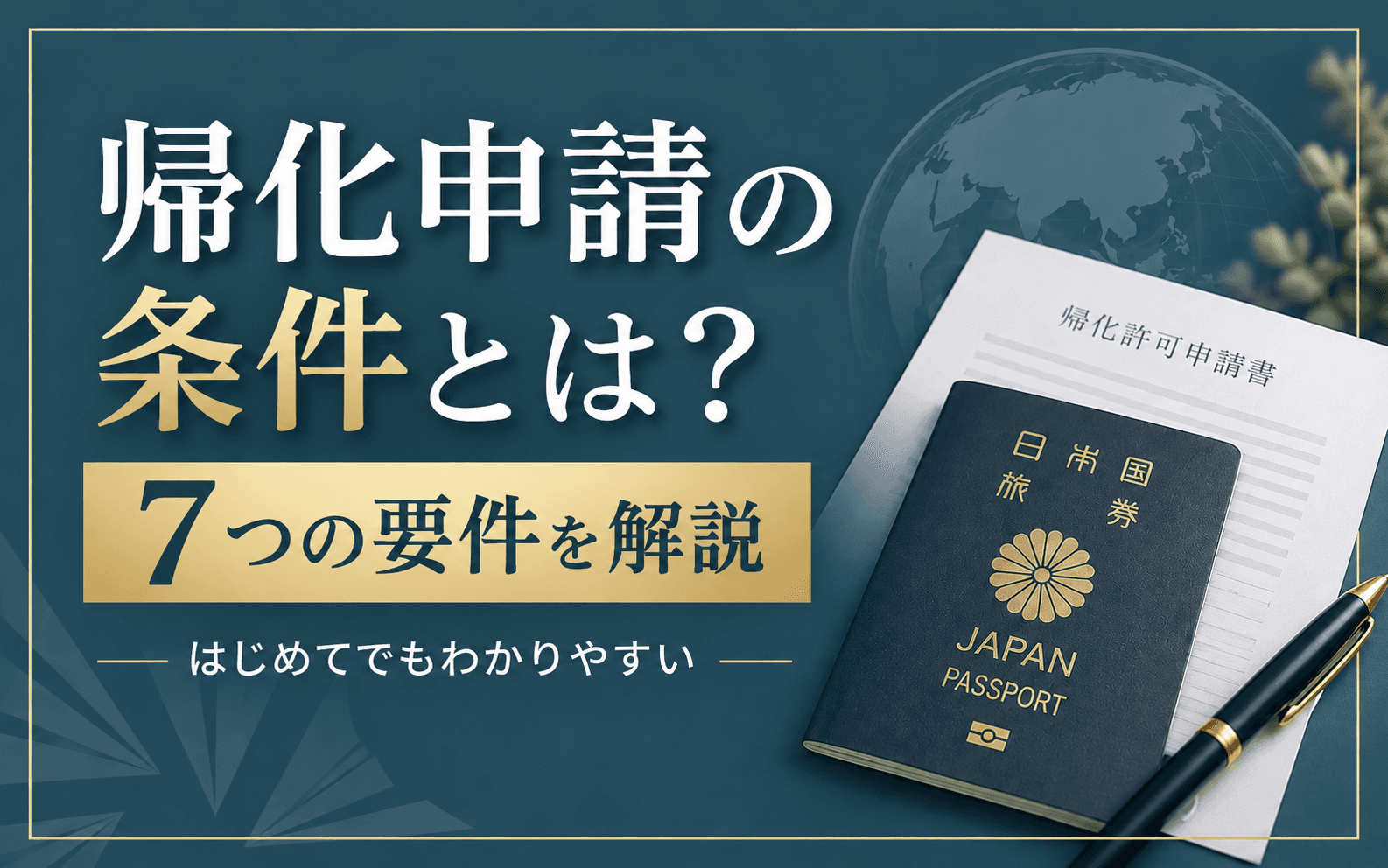
This article explains seven major points reviewed in a naturalization application, based on information currently published by the Ministry of Justice and Legal Affairs Bureaus as of 2026.
7 Key Points Reviewed in a Japanese Naturalization Application
The following seven areas are particularly important:
1. Residence requirement
Your period of residence in Japan2. Capacity requirement
Your age and whether you are legally an adult under the law of your home country3. Good conduct requirement
Criminal history, traffic violations, tax payments, and similar matters4. Financial stability requirement
Whether you are able to maintain a stable life in Japan5. Prevention of dual nationality
Whether you can generally relinquish or lose your current nationality6. Constitutional compliance requirement
Whether you are involved in activities aimed at violently overthrowing Japan’s constitutional system7. Integration into Japanese society
Japanese-language ability and your overall life in Japan
It is important to understand that meeting these conditions does not automatically guarantee approval.
The Ministry of Justice explains that the statutory requirements are minimum conditions for naturalization and that satisfying them does not necessarily mean that permission will be granted.
1. Residence Requirement|Living in Japan for a Certain Period
As a general rule under Japan’s Nationality Act, an applicant must have continuously maintained a domicile in Japan for at least five years before applying for naturalization.
During that period, the applicant should also have been residing in Japan under a lawful status of residence.
However, under current naturalization practice, it is not accurate to assume that living in Japan for five years automatically means that you are ready to apply.
As of 2026, Legal Affairs Bureaus also consider factors such as Japanese-language ability, residence history, and the extent to which the applicant has integrated into Japanese society.
Some Legal Affairs Bureaus indicate that approximately 10 years of residence in Japan, in principle, may be considered as one factor when assessing integration into Japanese society.
Therefore,
“I have lived in Japan for five years, so I can apply immediately.”
is not always a correct assumption.
Your current residence status and overall history in Japan should be reviewed before deciding when to apply.
Requirements May Be Relaxed for Spouses of Japanese Nationals and Certain Other Applicants
Some requirements may be relaxed for people who have particularly close ties to Japan.
Examples may include:
People born in Japan
Spouses of Japanese nationals
Biological children of Japanese nationals
People who previously held Japanese nationality
For this reason, eligibility cannot be determined solely by counting the number of years since you first came to Japan.
2. Capacity Requirement|Generally 18 Years of Age or Older
As a general rule, an applicant must be:
18 years of age or older and legally an adult under the law of their home country.
However, the requirements may be relaxed in certain cases, such as for children of Japanese nationals or children applying together with their parents.
Therefore, being under the age of 18 does not necessarily mean that naturalization is impossible.
3. Good Conduct Requirement|Taxes and Criminal History Are Also Reviewed
Applicants must generally be considered to have good conduct.
Matters that may be reviewed include:
Criminal history
Traffic violations
Tax payment history
Pension and social insurance payments
Other issues relating to daily conduct
An important point is that:
“One traffic violation means naturalization is impossible.”
is not a correct rule.
The authorities consider the nature of the violation, how many times it occurred, when it occurred, and the applicant’s circumstances afterward.
Matters to Review Before Applying
Before preparing an application, it is advisable to review:
Resident tax
Income tax
Pension payments
Social insurance
Traffic violations
Criminal history
If you have had late payments or unpaid obligations in the past, it may be necessary to carefully consider the timing of your application.
4. Financial Stability Requirement|A High Personal Income Is Not Always Necessary
Naturalization applicants must also demonstrate that they can maintain a stable life in Japan.
However, the authorities do not publish a universal rule stating:
“You must earn at least ¥X per year to qualify.”
The financial stability requirement is not necessarily assessed solely on the applicant’s individual income.
The financial situation of family members who share the same household economy may also be considered.
For example:
Husband: company employee
Wife: homemaker
Even if the wife has no personal income, she may still satisfy the financial stability requirement if the husband’s income is sufficient to support the household.
The key issue is not simply the applicant’s salary.
What matters is:
“Can the household maintain a stable life in Japan?”
5. Prevention of Dual Nationality|Generally Relinquishing or Losing Your Current Nationality
As a general rule, naturalization in Japan requires the applicant to relinquish or lose their current nationality.
Generally, the applicant must either:
Be stateless, or
Lose their current nationality upon acquiring Japanese nationality
However, exceptional treatment may be possible where the applicant cannot relinquish their nationality for reasons beyond their control.
Nationality rules differ from country to country, so it is important to confirm how your home country handles loss or renunciation of nationality before applying.
6. Constitutional Compliance Requirement
A person who advocates or attempts the violent overthrow of the Government of Japan, or who forms or joins an organization engaged in such activities, cannot be granted naturalization.
This is not an issue that affects most ordinary applicants, but it is one of the conditions expressly provided for under Japan’s Nationality Act.
7. Integration into Japanese Society|Japanese-Language Ability Is Important
Japanese-language ability is also an important part of the naturalization process.
Applicants are expected to have:
Japanese-language ability sufficient for ordinary daily life.
This generally includes the ability to:
Hold everyday conversations in Japanese
Read simple Japanese texts
Write basic Japanese
Answer questions from Legal Affairs Bureau officials
Is JLPT N1 or N2 Required?
A common question is:
“Do I need JLPT N1 or N2 to apply for naturalization?”
At present, Legal Affairs Bureaus do not publish a uniform rule requiring:
“JLPT N2 or above.”
Therefore, not having a JLPT certificate does not automatically make you ineligible.
However, because the naturalization process may include interviews with Legal Affairs Bureau officials, applicants are expected to have sufficient speaking, reading, and writing ability for ordinary daily life.
Which Is Correct: “5 Years” or “10 Years”?
As of 2026, this is one of the most confusing aspects of naturalization.
The answer is that:
“5 years” and “10 years” refer to different considerations.
Residence Requirement Under the Nationality Act
The basic statutory requirement is:
Continuous domicile in Japan for at least five years.
Current Naturalization Practice
In addition to the statutory residence requirement, current Legal Affairs Bureau guidance also considers Japanese-language ability, life in Japan, and overall integration into Japanese society.
In that context, approximately 10 years of residence may be referred to as one factor in certain guidance.
Therefore,
“I have lived in Japan for five years, so I can definitely apply for naturalization.”
is not necessarily correct.
Requirements may also be relaxed for certain applicants, including spouses or children of Japanese nationals.
The appropriate timing for an application depends on the applicant’s individual circumstances.
Quick Checklist: Do You Potentially Meet the Naturalization Requirements?
You may wish to check whether the following apply to you:
You have lawfully lived in Japan for a certain period
You do not have serious issues with tax payments
You have a stable financial basis
You do not have serious criminal history or similar issues
You can speak, read, and write Japanese at a level sufficient for daily life
There are no major problems concerning your nationality after naturalization
You intend to continue living in Japan
However, this checklist alone cannot determine whether your application will be approved.
Other matters may also need to be reviewed, including:
Job changes
Income
Family composition
Long periods outside Japan
Traffic violations
Taxes
Pension payments
Documents from your home country
The relevant points differ depending on each applicant’s circumstances.
Preparing for Naturalization Is Just as Important as Meeting the Requirements
After confirming that you may satisfy the basic conditions, you will need to prepare a substantial number of documents.
Depending on your circumstances, these may include:
Birth-related documents
Documents relating to your parents and siblings
Marriage and divorce records
Income documents
Tax documents
Pension and social insurance documents
Employment-related documents
Notarial or official documents from your home country
Required documents vary depending on nationality, occupation, family relationships, marital history, and other circumstances.
As a general rule, the naturalization application itself must be submitted in person by the applicant at the Legal Affairs Bureau with jurisdiction over the applicant’s address.
Even when you hire an administrative scrivener, the entire process cannot be completed entirely on your behalf.
However, an administrative scrivener can assist with:
Preliminary eligibility assessment
Organizing required documents
Obtaining certain Japanese public documents
Preparing the application documents
Drafting a naturalization motivation statement
Translating foreign-language documents
Coordinating appointments with the Legal Affairs Bureau
Preparing for interviews
This can significantly reduce the burden of preparing an application.
Frequently Asked Questions
Q. If I have lived in Japan for five years, can I apply for naturalization?
Not necessarily.
The Nationality Act generally requires at least five years of continuous domicile in Japan, but your residence status, Japanese-language ability, conduct, financial situation, and other factors are also reviewed.
Current Legal Affairs Bureau practice also considers the applicant’s degree of integration into Japanese society.
Q. Is there a minimum annual income requirement?
No universal minimum annual income amount is publicly specified.
The authorities consider not only the applicant’s own income but also the financial situation of family members who share the same household economy.
The key issue is whether the household can maintain a stable life.
Q. Can I apply without a JLPT certificate?
Yes. There is currently no published rule requiring a particular JLPT level.
However, applicants are expected to have sufficient Japanese speaking, reading, and writing ability for everyday life.
Q. Does having a traffic violation mean I cannot naturalize?
Not necessarily.
The nature, number, and timing of violations, as well as the applicant’s subsequent circumstances, are considered.
Q. If I am married to a Japanese national, do I still need a long period of residence?
Certain requirements may be relaxed for spouses of Japanese nationals and other applicants with close ties to Japan.
Therefore, the same residence period does not necessarily apply in every case.
Not Sure Whether You Can Apply? Start With an Eligibility Check
Naturalization eligibility cannot be determined solely by how many years you have lived in Japan.
It is necessary to review factors such as:
Residence history, employment, income, taxes, pension payments, family relationships, travel history, traffic violations, and Japanese-language ability.
At Enlight Administrative Scrivener’s Office, we can review your current circumstances before you formally engage us for a naturalization application.
You are welcome to contact us even if:
“I have not decided whether to apply yet.”
“I only want to know whether I currently meet the requirements.”
The initial naturalization eligibility check is free of charge.
Enlight Administrative Scrivener’s Office
Administrative Scrivener: Shiki Miyajima
Telephone: 03-5284-7981
Office hours: Weekdays 10:00–18:00
Online and WeChat consultations are also available.
References
Ministry of Justice: “Nationality Q&A”
Tokyo Legal Affairs Bureau: Guidance for People Considering Naturalization
Naturalization guidance published by regional Legal Affairs Bureaus
※The required documents and matters reviewed vary depending on nationality, family circumstances, occupation, residence history, and other factors. For an actual application, please confirm the latest requirements with the Legal Affairs Bureau having jurisdiction over your address or consult a qualified professional.