Column
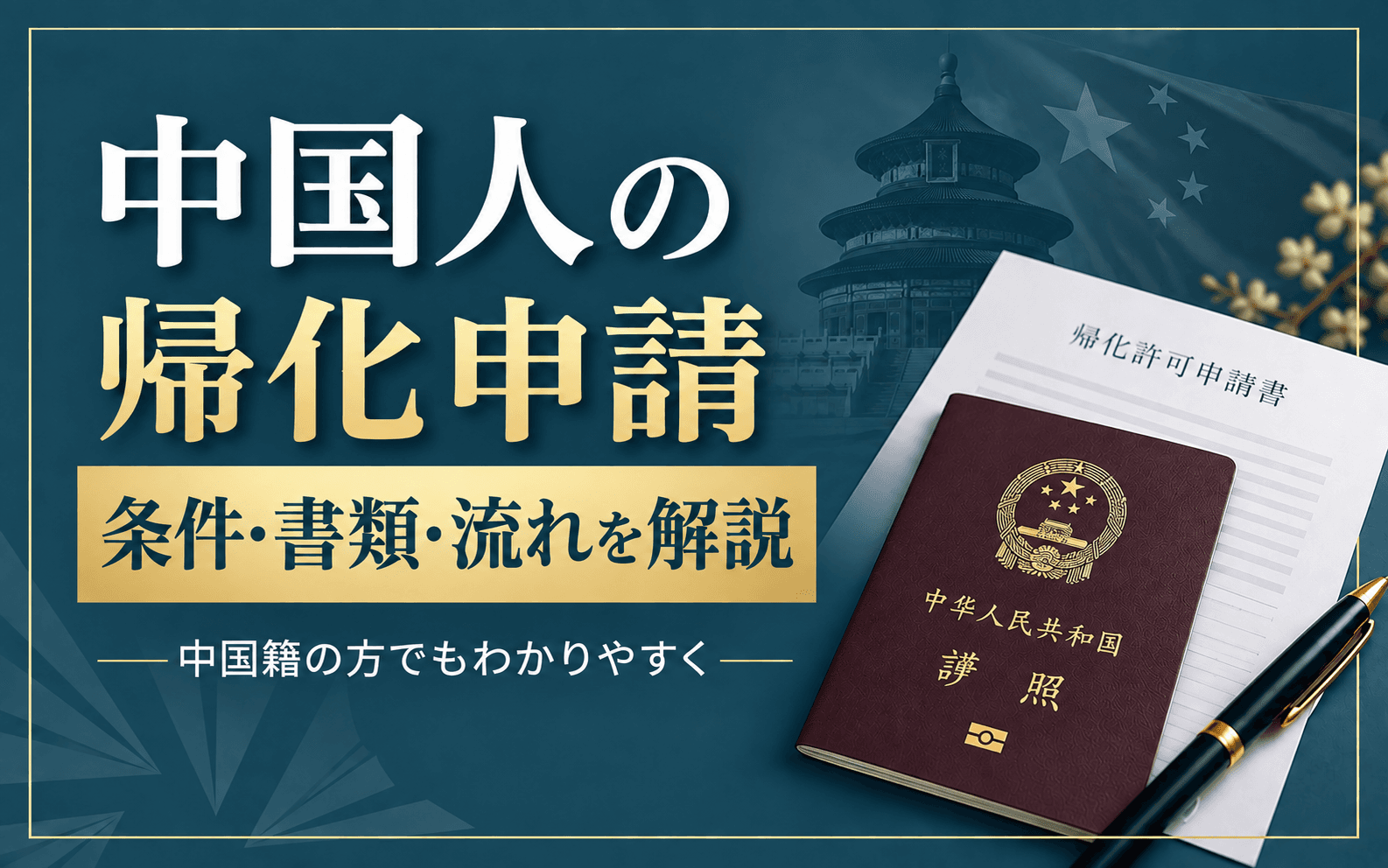
Japanese Naturalization for Chinese Nationals|Requirements, Documents, and Application Process 【2026 Update】
Chinese nationals who have lived in Japan for many years often have questions such as:
“Should I apply for permanent residence or naturalization?”
“What documents do I need to obtain from China?”
“Which family members need to be included in a family relationship notarization?”
“Do I need to translate Chinese documents into Japanese myself?”
“What happens to my Chinese nationality after naturalization?”
When a Chinese national applies for Japanese naturalization, it is not enough to review taxes, pension payments, employment, and residence status in Japan.
A major part of the process involves preparing Chinese notarial documents that establish birth, family relationships, marriage, and other civil status matters.
The required documents vary depending on the applicant’s family structure, marital history, place of birth, occupation, and other circumstances.
This article explains the main requirements, documents, and procedures for Chinese nationals applying for Japanese naturalization.
What Does Japanese Naturalization Mean for a Chinese National?
Naturalization is the process by which a foreign national acquires Japanese nationality with permission from the Minister of Justice.
Once naturalization is approved, the applicant no longer lives in Japan as a foreign resident but becomes a Japanese national.
Unlike permanent residence, Japanese nationals do not need to renew a status of residence or residence card.
However, because naturalization changes the applicant’s nationality itself, it is also important to consider how it may affect:
Current nationality
Japanese family registration
Passport
Travel to the home country
Property and legal procedures in the home country
These issues should be understood before deciding whether to apply.
Chinese Nationals Are Subject to the Same Basic Naturalization Requirements
There is not a completely separate set of naturalization requirements that applies only to Chinese nationals.
In principle, Chinese applicants are subject to the requirements under Japan’s Nationality Act.
Important points generally include:
Period of residence in Japan
Age
Conduct
Tax and pension payment history
Financial stability and income
Current nationality
Japanese-language ability
Integration into Japanese society
For a detailed explanation of these requirements, please see our separate article:
“What Are the Requirements for Japanese Naturalization? 7 Key Conditions Explained by an Administrative Scrivener.”
How Long Do Chinese Nationals Need to Live in Japan?
Under the Nationality Act, an applicant generally needs to have continuously maintained a domicile in Japan for at least five years.
However, under current naturalization practice, the Legal Affairs Bureau also considers Japanese-language ability, the applicant’s life in Japan, and the degree of integration into Japanese society.
Therefore,
“I have lived in Japan for five years, so I can definitely apply.”
is not always correct.
Some requirements may also be relaxed for spouses or children of Japanese nationals.
The appropriate time to apply depends on the applicant’s individual circumstances.
Chinese Documents Are a Major Part of the Naturalization Process
One of the more time-consuming parts of a naturalization application for a Chinese national is obtaining Chinese notarized civil status documents.
Depending on the applicant’s circumstances, the following documents may be required.
1. Birth Notarial Certificate
A birth notarial certificate is used to establish the applicant’s birth information.
It is generally obtained through a notarial office in China.
If the applicant was born outside China or has other special circumstances, the usual birth notarization may not always be available.
In that case, other evidence may be required to establish the applicant’s identity and family relationships.
2. Family Relationship Notarial Certificate
A family relationship notarial certificate is one of the most important documents for many Chinese naturalization applicants.
The authorities may need to confirm relationships involving:
Father
Mother
Applicant
Brothers and sisters
What If Siblings Are Not Listed?
If brothers and sisters are not included in the family relationship notarization, the Legal Affairs Bureau may require additional documents, such as the siblings’ birth notarizations.
Therefore,
“It is enough to list only the applicant and parents.”
is not always correct.
Before obtaining documents in China, it is advisable to confirm the range of family relationships that must be established.
3. Marriage Notarial Certificate and Marriage Certificate
If the applicant is married, documents establishing the marriage may be required.
These may include:
Marriage notarial certificate
Marriage certificate
If the applicant has a previous marriage history, additional documents may also be necessary.
4. Divorce Notarial Certificate and Divorce Certificate
Applicants with a history of divorce may need documents such as:
Divorce notarial certificate
Divorce certificate
Marriage and divorce information should be consistent with the family relationship and personal history information included in the Japanese naturalization application.
5. Documents Concerning the Parents’ Marriage or Divorce
The naturalization process may require information not only about the applicant but also about the civil status of the applicant’s parents.
Depending on the circumstances, documents relating to the parents may include:
Marriage notarial certificate or marriage certificate
Divorce notarial certificate or divorce certificate
If a parent is deceased, divorced, or if documents cannot be obtained through the usual procedure, additional explanation may be necessary.
Documents that are difficult to obtain should not simply be omitted without confirmation.
6. Children’s Birth Notarial Certificates
If the applicant has children, documents establishing the children’s births may also be required.
These documents help confirm the parent-child relationship.
7. Adoption, Parental Authority, and Other Civil Status Documents
Depending on the family situation, notarized documents concerning the following may also be relevant:
Adoption
Parental authority
Other family status matters
The required documents are not identical for every applicant.
It is important to organize your family structure and marital history first, then determine which documents are necessary.
Nationality-Related Certificates From the Chinese Embassy or Consulate
In addition to documents issued by notarial offices in China, Chinese applicants should also pay attention to nationality-related consular certificates issued by the Chinese Embassy or Consulates in Japan.
Depending on the stage of the application, a nationality-related consular certificate may be required.
The Chinese Embassy in Japan also provides guidance concerning consular certification relating to the automatic loss of Chinese nationality for Chinese citizens who acquire Japanese nationality.
Does China Recognize Dual Nationality?
According to information published by the Chinese Embassy in Japan, China does not recognize dual nationality.
Chinese citizens who have settled abroad and voluntarily acquire a foreign nationality generally lose Chinese nationality automatically.
However, the exact certificate and timing required during a Japanese naturalization application should be confirmed with the Legal Affairs Bureau handling the case.
It is advisable to confirm the Legal Affairs Bureau’s instructions before obtaining a consular certificate.
Do You Need Old Chinese Passports?
Past passports may also be important in a naturalization application.
The Legal Affairs Bureau may request copies of:
all passports, including expired passports
together with the pages that were actually used.
This is because past entry and exit history may be reviewed during the naturalization examination.
If you still have your old passports, it is advisable to keep them.
Chinese Documents Need Japanese Translations
Chinese notarial certificates and other Chinese-language documents generally require Japanese translations.
When preparing translations, it is important to:
Translate the entire document accurately
Avoid translating only selected sections
Identify the translator
Include the translation date where required
If the applicant is capable of producing an accurate translation, self-translation may be accepted.
Chinese Document Translation Is Available Through Enlight
For naturalization applications handled by Enlight Administrative Scrivener’s Office, translation of Chinese and English documents is generally included in the standard service fee.
This reduces the burden of translating multiple notarial certificates individually.
Main Documents Prepared in Japan
Chinese documents are only one part of the application.
A substantial number of Japanese documents may also be required, including:
Certificate of residence
Records relating to previous addresses
Residence card
Passports
Certificate of employment
Salary statements
Withholding tax certificate
Taxation certificates
Tax payment certificates
Pension records
Social insurance documents
Driving record certificate
Driver’s license
Bank or asset-related records
Company or business-related documents
The documents required vary significantly depending on whether the applicant is a company employee, company owner, executive, or self-employed person.
Several Naturalization Forms Must Also Be Prepared
Collecting official certificates alone is not enough.
The naturalization application also involves preparing documents such as:
Application for permission to naturalize
Family relationship overview
Personal history
Entry and exit history
Statement of reasons for naturalization
Household financial summary
Business summary
Particular care is required to ensure consistency between:
family relationships, address history, education, employment history, and travel history
and the Chinese notarized documents, Japanese residence records, passports, and other evidence.
If there are discrepancies between documents, they should be identified and explained before submission.
The Final Naturalization Motivation Statement Must Be Handwritten by the Applicant
An important point concerning the statement of reasons for naturalization is that:
the final statement is generally required to be handwritten by the applicant.
Even if an administrative scrivener assists with the application, the scrivener cannot complete the final handwritten statement on the applicant’s behalf.
However, assistance may be provided with:
What to write
How to organize the content
Whether there are inconsistencies
A draft can therefore be prepared and reviewed before the applicant completes the final handwritten version.
General Naturalization Process for Chinese Nationals
The following is a general overview of the process.
STEP 1. Check Naturalization Eligibility
First review matters such as:
Date of arrival in Japan
Status of residence
Employment
Income
Taxes
Pension
Family structure
Travel history
Traffic violations
Japanese-language ability
At this stage, it can be determined whether it is appropriate to start preparing immediately or whether waiting may be advisable.
STEP 2. Consult the Legal Affairs Bureau
Naturalization procedures are handled by the Legal Affairs Bureau with jurisdiction over the applicant’s address.
Many bureaus require an appointment for naturalization consultations, so it is important to check in advance.
STEP 3. Determine the Required Documents
The applicant’s situation is reviewed to organize:
Japanese documents + Chinese notarized documents
Accurately identifying the required documents at the beginning can significantly reduce unnecessary work later.
STEP 4. Obtain Chinese Notarial Documents and Japanese Official Records
In China, the applicant may need documents such as:
Birth notarial certificate
Family relationship notarial certificate
Marriage or divorce documents
In Japan, documents such as residence records and tax records must be prepared.
STEP 5. Prepare the Naturalization Application Documents
Documents such as the family overview, personal history, and household financial summary are prepared.
The information should be checked against both Chinese and Japanese documentary evidence.
STEP 6. Submit the Application at the Legal Affairs Bureau
As a general rule, the applicant must personally appear at the Legal Affairs Bureau to submit the naturalization application.
Even when an administrative scrivener is assisting with the application, certain steps must still be completed by the applicant personally.
STEP 7. Interview and Additional Documents
After submission, the Legal Affairs Bureau may conduct an interview.
During the examination, additional materials may also be requested, including:
Updated documents
Income records
Tax documents
Family relationship records
STEP 8. Receive the Decision
Once the examination is complete, the applicant will receive the result.
If naturalization is approved, the approval is published in the Official Gazette and the applicant acquires Japanese nationality.
Further procedures may then be required concerning:
Japanese family registration
Residence card
Japanese passport
Procedures relating to China
Common Problems in Naturalization Applications by Chinese Nationals
Family Relationship Notarization Does Not Contain Enough Information
Some documents list only the applicant and the parents and omit brothers and sisters.
This may result in requests for additional birth certificates or other documents, creating extra work.
Names Are Written Differently in China and Japan
The applicant’s name may appear in different forms, including:
Simplified Chinese characters
Japanese kanji
Katakana
The application should make it clear that these variations refer to the same person.
Dates of Birth or Family Information Do Not Match
Information in Chinese notarized documents, passports, and Japanese residence records may sometimes be inconsistent.
It is not advisable to simply choose one version and ignore the discrepancy.
The reason should be identified and properly explained.
Old Passports Cannot Be Found
Previous passports may be important because the authorities review the applicant’s past travel history.
If a passport has been lost, an explanation may be necessary.
Documents Are Obtained Too Early
Some public documents are expected to be relatively recent.
If all documents are obtained at the beginning of the process, some may need to be obtained again by the time the application is submitted.
For this reason, it is advisable to:
confirm the document list and timing before obtaining everything.
Frequently Asked Questions From Chinese Applicants
Q. Is a Chinese Household Registration Book Enough?
Usually, the household registration book alone is not sufficient to establish every family relationship required for naturalization.
The Legal Affairs Bureau may require notarized documents such as birth certificates and family relationship certificates.
The documents required depend on the applicant’s family circumstances.
Q. Are Documents Concerning Brothers and Sisters Required?
They may be required.
If siblings cannot be confirmed through the family relationship notarization, additional documents such as birth notarizations may be requested.
Q. Can I Translate Chinese Notarial Documents Myself?
If the applicant can accurately translate the documents, self-translation may be accepted.
However, the entire document should be translated and translator information should be included as required.
For naturalization applications handled by Enlight Administrative Scrivener’s Office, translation of Chinese documents is generally included in the standard service fee.
Q. What Happens to My Chinese Nationality After Naturalization?
According to information published by the Chinese Embassy in Japan, China does not recognize dual nationality.
Chinese nationals who have settled abroad and voluntarily acquire foreign nationality generally lose Chinese nationality automatically.
The exact consular procedure should be confirmed with the Legal Affairs Bureau and Chinese Embassy or Consulate at the time of the application.
Q. Can I Obtain Chinese Notarial Documents Without Traveling to China?
Procedures vary depending on the type of document, place of household registration, and relevant notarial office.
In some cases, family members or others in China may be able to assist, but the procedure is not the same for every document.
It is best to first determine which documents are actually required and then confirm the procedure with the relevant notarial office.
Q. Can I Apply Without a JLPT Certificate?
There is no published rule requiring applicants to hold a specific JLPT level.
However, applicants are expected to have Japanese speaking, reading, and writing ability sufficient for everyday life.
Organizing Chinese Documents in Advance Is Essential
For Chinese nationals, a successful naturalization application involves more than simply confirming that the Japanese requirements are met.
It is also necessary to accurately establish:
the applicant’s civil status and family relationships in China.
Documents such as:
Birth notarial certificates
Family relationship notarizations
Marriage and divorce records
Nationality-related consular certificates
Japanese translations of Chinese documents
can be difficult to navigate for first-time applicants.
Rather than obtaining every possible notarized document immediately, it is usually better to:
determine exactly which documents are required first, and then begin obtaining them.
This can help avoid duplicate applications and unnecessary expense.
Naturalization Support for Chinese Nationals Is Available in Chinese
Enlight Administrative Scrivener’s Office provides support for Chinese nationals applying for Japanese naturalization, including:
Eligibility review
Individualized required document list
Preparation of naturalization application forms
Drafting of the motivation statement
Obtaining certain Japanese public documents
Translation of Chinese documents
Coordination of Legal Affairs Bureau appointments
Accompaniment to the Legal Affairs Bureau
Interview preparation
Consultations are available in Chinese.
You are also welcome to contact us if you are still at the stage of asking:
“I do not know which notarized documents I need.”
“My family relationships are complicated and I am not sure what documents to prepare.”
“I want to know whether my current residence history is sufficient.”
The initial naturalization eligibility check is free of charge.
Enlight Administrative Scrivener’s Office
Administrative Scrivener: Shiki Miyajima
Telephone: 03-5284-7981
Office hours: Weekdays 10:00–18:00
Online consultations throughout Japan and WeChat consultations are also available.
References
Tokyo Legal Affairs Bureau: Documents Required for Naturalization Applications by Chinese Nationals
Tokyo Legal Affairs Bureau: Naturalization Application Documents
Nagoya Legal Affairs Bureau: Guidance for Chinese Naturalization Applicants
Embassy of the People’s Republic of China in Japan: Guidance on Consular Certification Regarding Automatic Loss of Chinese Nationality
※Required documents vary depending on the applicant’s family structure, place of birth, marital history, occupation, residence history, and other circumstances. The Legal Affairs Bureau may also request additional documents during the examination.