
Column
How Do Overseas Assets and Foreign Income Affect Japanese Permanent Residence? Bank Deposits, Property, and Overseas Transfers Explained 【2026 Update】
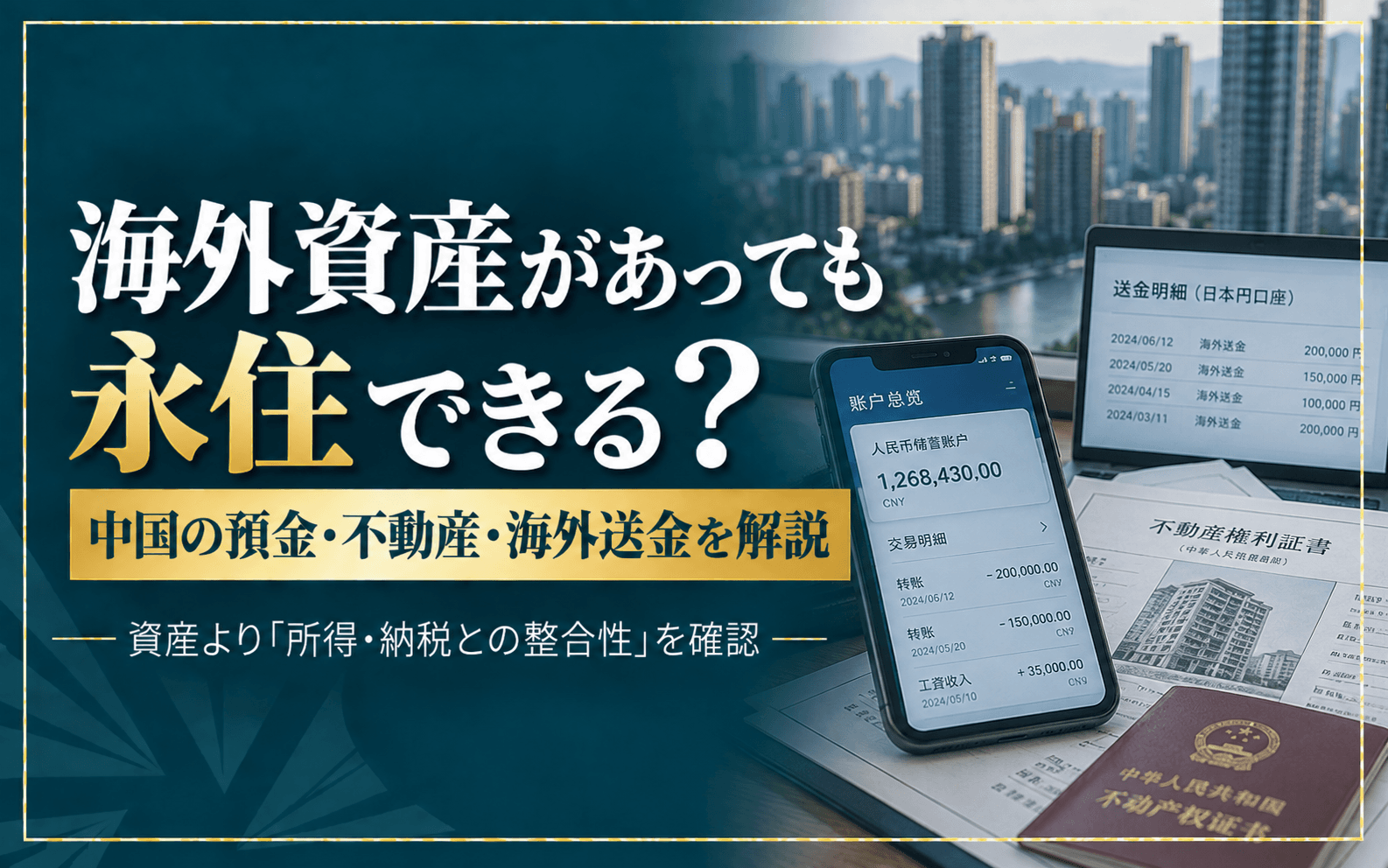
“I have substantial savings in China.”
“I own an apartment overseas and receive rent.”
“I regularly transfer money from my overseas account to Japan.”
“Does foreign income matter if I never send it to Japan?”
Overseas assets are not inherently negative for PR.
The ordinary PR framework includes the requirement that the applicant have sufficient:
assets or skills to maintain an independent livelihood.
However, two questions must be kept separate:
How much overseas wealth does the applicant have?
and:
Have any applicable Japanese tax obligations been properly fulfilled?
Large Overseas Assets Do Not Cure a Tax-Compliance Problem
An applicant might own substantial property and savings overseas.
If taxable foreign income should have been reported in Japan but was not, the value of those assets does not automatically resolve the separate tax issue.
1. Can an Overseas Bank Deposit Count as an Asset?
A genuine overseas deposit owned and controlled by the applicant may potentially help demonstrate financial resources.
However, Immigration does not publish a fixed rule stating that:
¥X in overseas savings guarantees PR.
Employment, income, household circumstances, and overall future stability remain relevant.
2. Must Every Foreign Bank Account Be Disclosed to Immigration?
The standard PR document list does not generally require every applicant to submit a complete list of all foreign bank accounts.
However, where overseas assets are relied on to explain livelihood or significant foreign transfers appear in the case, supporting evidence may become useful.
This can include:
Balance certificates
Transaction histories
Evidence explaining the source of funds
3. Can You Own Property Abroad and Still Obtain PR?
Yes.
There is no general rule preventing a PR applicant from owning a home or investment property overseas.
The more significant issue may be whether that property generates income and how that income is treated for Japanese tax purposes.
4. Overseas Rental Income
Rental income from property in another country can create Japanese tax issues depending on the applicant’s tax-residency classification.
“Non-Permanent Resident” Under Tax Law Is Not the Same as Japanese Permanent Residence
Japanese income-tax law uses the term:
non-permanent resident.
This is a tax classification.
It does not mean simply:
“a foreign national who has not yet obtained Japanese Permanent Residence.”
The two concepts should not be confused.
5. Long-Term Residents of Japan May Be Taxable on Worldwide Income
A Japanese tax resident who is not classified as a non-permanent resident is generally subject to Japanese income tax on income arising both inside and outside Japan.
Foreign rental income, dividends, investment gains, or business income can therefore require Japanese tax review.
6. Paying Tax Overseas Does Not Automatically Eliminate Japanese Filing Obligations
Where the same income is taxed abroad, Japan’s foreign tax credit system may help address double taxation.
However:
tax paid overseas does not automatically mean nothing needs to be filed in Japan.
7. Applicants With Shorter Japanese Residence Histories Require Special Tax Review
A foreign national who meets the statutory definition of a tax-law non-permanent resident may be subject to different rules concerning foreign-source income and remittances into Japan.
This can be particularly relevant to people using shorter PR routes such as HSP or spouse exceptions.
8. An Overseas Transfer Is Not Automatically Income
Moving old savings from one’s own foreign account to one’s Japanese account is different from transferring newly earned foreign rental income.
Applicants should be able to explain the nature of significant transfers.
9. Money Received From Parents Overseas
Funds sent by parents for housing, living expenses, or other purposes are different from salary income.
Depending on the circumstances, Japanese gift-tax rules may also require consideration.
A parental transfer should not simply be presented as the applicant’s recurring annual income.
10. Income From a Foreign Company
A person living in Japan may work remotely for a foreign company and receive payment into an overseas account.
This can require review of both:
Japanese taxation
Whether the work is consistent with the applicant’s current immigration status
Tax compliance and immigration authorization are separate issues.
11. Foreign Investments and Dividends
Owning foreign stocks is not itself a PR problem.
However, taxable dividends, interest, or capital gains should be properly reviewed from the Japanese tax perspective.
12. Overseas Assets Exceeding ¥50 Million
A Japanese resident other than a tax-law non-permanent resident who owns overseas assets exceeding:
¥50 million in total as of December 31
may be required to submit a:
Statement of Overseas Assets.
This Is a Tax Filing, Not a Standard PR Document
The statement is filed with the tax authorities rather than Immigration.
Nevertheless, PR review places importance on proper fulfillment of public obligations, so applicants with substantial foreign wealth should check that their tax obligations are up to date.
13. Assets Below ¥50 Million Can Still Produce Taxable Income
The ¥50 million threshold concerns the overseas-asset reporting regime.
It does not mean foreign income below that asset level is automatically irrelevant for income-tax purposes.
14. Should You Submit All Overseas Assets With Your PR Application?
Not necessarily.
Applicants should first prepare the standard official PR documents.
Additional overseas-asset evidence is most useful where it has a clear purpose—for example, to explain livelihood, an unusual income pattern, or substantial foreign transfers.
15. How Should Overseas Real Estate Be Valued?
Immigration does not publish a universal PR valuation method for overseas property.
Where the property is relied upon as an asset, ownership documents, purchase records, valuation evidence, and outstanding debt may all be relevant.
16. Overseas Mortgages and Other Debt
An overseas property worth ¥40 million with a ¥35 million remaining mortgage should not simply be presented as ¥40 million of net financial strength.
Assets and liabilities should be viewed together.
17. Foreign-Language Evidence May Need Japanese Translation
If foreign bank, real-estate, lease, or tax documents are submitted to Immigration, Japanese translations will generally need to be prepared as appropriate.
18. Cases That Particularly Deserve Pre-Filing Review
Careful review is useful where the applicant:
Holds substantial bank deposits overseas
Owns overseas real estate
Receives foreign rental income
Has foreign investment income
Is paid by an overseas company
Regularly transfers money into Japan
Has unusually large transfers into a Japanese account
Receives large transfers from parents
Holds more than ¥50 million of overseas assets
Has never filed an overseas-asset statement
Has not included foreign income in Japanese tax filings
Pays tax in another country
Is applying through an HSP or spouse exception before ten years in Japan
Frequently Asked Questions
Q. I Have ¥10 Million in an Overseas Account. Does That Help My PR Application?
It may serve as one piece of evidence concerning financial resources, but PR is not decided by savings alone.
Q. I Own Property in China.
Foreign property ownership does not itself prevent PR. Rental income may require separate tax review.
Q. I Never Remit the Foreign Income to Japan.
The tax treatment depends in part on whether the applicant is a tax-law non-permanent resident. Individual review may be necessary.
Q. I Already Paid Tax Overseas.
Japanese filing obligations may still apply, with foreign tax credits potentially relevant.
Q. My Parents Sent Me ¥5 Million.
That is not the same as salary income. The nature of the transfer and possible gift-tax issues should be checked.
Q. I Own More Than ¥50 Million of Overseas Assets.
Certain Japanese tax residents may be required to file a Statement of Overseas Assets.
For PR Applicants With Overseas Wealth, Consistency Matters More Than the Size of the Asset
The key is to make sure that:
Japanese income + foreign income + overseas assets + foreign transfers + Japanese tax records
tell a consistent story.
Enlight Administrative Scrivener’s Office reviews the immigration side of overseas assets and foreign income together with Japanese PR documentation and identifies tax questions that may require confirmation with a tax professional.
The initial Permanent Residence eligibility check is free of charge.
Permanent Residence support is generally limited to applicants within the jurisdiction of the Tokyo Regional Immigration Services Bureau.
References
Immigration Services Agency: Guidelines for Permission for Permanent Residence
Immigration Services Agency: Permanent Residence Application 3
National Tax Agency: Individuals Subject to Japanese Income Tax
National Tax Agency: Foreign Tax Credit for Residents
National Tax Agency: Taxation of Overseas Real Estate
National Tax Agency: Statement of Overseas Assets