Column
Column
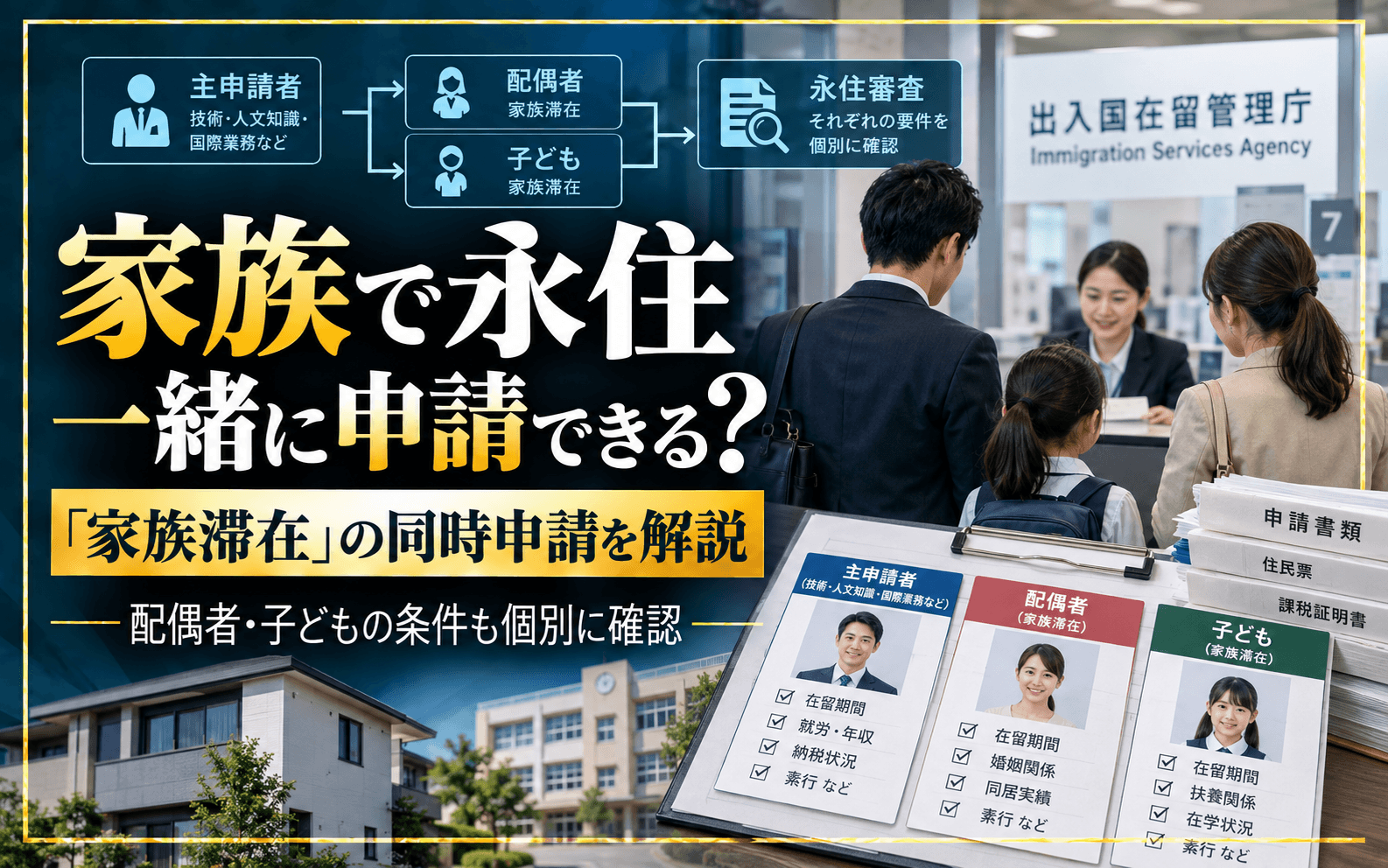
“My husband is applying for PR. Can I apply at the same time under Dependent status?”
“Our child has only lived in Japan for two years. Do they need ten years?”
“Should the principal applicant obtain PR first?”
A family may want to obtain Permanent Residence together, but:
PR is granted to each individual applicant.
A household does not receive one collective Permanent Residence permission.
Dependent Status Is Included in the Official PR Application Categories
The Immigration Services Agency’s Permanent Residence Application 3 expressly covers both:
work-related statuses
and
Dependent status.
Therefore, holding Dependent status does not itself make a person unable to apply for PR.
However, Dependent status exists because the spouse or child is being supported by a qualifying foreign resident.
The principal applicant’s situation therefore remains highly relevant.
Simultaneous Family Applications May Be Possible
A common family structure is:
Principal applicant: Engineer/Specialist in Humanities/International Services
Spouse: Dependent
Child: Dependent
In appropriate cases, the family may consider filing PR applications at the same time.
However:
filing on the same day does not automatically satisfy the requirements for every family member.
Each person’s circumstances still need to be reviewed.
The current PR guidelines provide a ten-year residence exception for spouses of Japanese nationals, Permanent Residents, and Special Permanent Residents where there has been:
at least three years of genuine married life
and:
at least one year of continuous residence in Japan.
Where the principal applicant is not yet a Permanent Resident and the family is considering simultaneous filing, the published national guideline does not provide a simple automatic rule covering every possible scenario.
In practice, however, the marriage period and the spouse’s residence period in Japan are important points to review.
The Principal Applicant’s 10 Years Do Not Automatically Transfer to the Spouse
For example:
Principal applicant: 12 years in Japan
Spouse: 8 months in Japan
Marriage: 2 years
The principal applicant may satisfy the ordinary residence-duration requirement.
That does not automatically mean the spouse qualifies merely because the applications are filed together.
The current guideline provides a residence-duration exception for qualifying children of Japanese nationals, Permanent Residents, and Special Permanent Residents who have continuously resided in Japan for at least one year.
Accordingly, the child’s:
Arrival date
Place of birth
Current status
Actual residence history
can matter.
A Newly Born Child Requires Individual Review
Parents may have lived in Japan for more than ten years while their child is only several months old.
The parents’ eligibility does not automatically establish the newborn child’s PR eligibility.
Simultaneous Filing Still Means Separate Individual Review
If the spouse has an issue involving:
Unauthorized outside-status work
Taxes
Long absences
Immigration-status compliance
that issue can be relevant to the spouse’s application even where the principal applicant has a strong case.
A Refusal of the Principal Applicant Can Significantly Affect the Family Strategy
Where the spouse’s and child’s applications are structured on the expectation that the principal applicant will become a Permanent Resident, refusal of the principal application can remove that foundation.
The principal applicant’s:
Tax history
Pension
Residence period
Income
Conduct
Current immigration-status compliance
should therefore be carefully reviewed before family filing.
Problems Affecting a Dependent Family Member Can Also Matter
For example, a spouse under Dependent status may believe they are working within the permitted outside-status limit but actually exceed it.
This can raise issues not only for the spouse’s PR application but also for the consistency of the family’s residence and financial records.
Working Spouses Under Dependent Status Require Particular Care
Dependent status is for spouses and children who are financially supported by the principal resident.
Where a spouse has permission for outside-status activity, the common comprehensive permission generally allows work within:
28 hours per week.
If the spouse is working substantially beyond the permitted scope, a higher household income does not solve the immigration-compliance issue.
More Spouse Income Is Not Automatically Better
Permanent Residence considers household financial stability.
At the same time, very substantial independent employment may raise a separate question as to whether the individual’s actual circumstances remain consistent with Dependent status.
There is no simple nationwide rule saying that earning a fixed amount automatically terminates Dependent eligibility.
The actual work, hours, income, and support relationship need to be reviewed.
Household Income Matters
No nationwide official minimum income figure is published for a family of three or four.
Relevant considerations can include:
Principal applicant’s income
Spouse’s income
Dependents
Historical income
Employment stability
Overall household finances
Five Years of Resident-Tax Records Are Generally Required
Under Permanent Residence Application 3, the standard requirement generally includes the most recent:
five years
of income and resident-tax records for the applicant and the person supporting the applicant.
A working dependent spouse’s own tax record may therefore be relevant.
Pension and Health Insurance Are Generally Reviewed for Two Years
Public pension and health-insurance documentation is generally required for the most recent:
two years.
The review can include both the applicant and the supporting person.
Being a Health-Insurance Dependent Is Not Itself a Problem
A spouse or child may properly be covered as a dependent under the principal applicant’s employee health insurance.
The important issues include whether coverage was continuous and whether there were periods during which National Health Insurance should have been obtained.
The Principal Applicant Can Also Apply First
Simultaneous filing is not the only option.
Where the principal applicant is fully ready but the spouse or child has not yet reached an appropriate residence milestone, a staged approach may be considered.
What Happens to Dependent Status After the Principal Applicant Becomes a Permanent Resident?
Dependent status is designed for family members of certain work, study, and other specified status holders.
Permanent Resident is not included among the sponsor statuses for Dependent status.
Accordingly, where the principal applicant becomes a Permanent Resident first, the spouse or child may need to change to an appropriate family-based status depending on the relationship and circumstances.
It should not be assumed that Dependent status can simply continue unchanged indefinitely.
This Is Why “Simultaneous or Staged?” Is an Important Strategic Question
Where all family members satisfy the relevant conditions, simultaneous filing may allow the household to stabilize its immigration position at the same time.
Where one family member has a residence-history, outside-status work, tax, pension, or other issue, filing everyone together may not always be the best approach.
HSP 70/80 Points Do Not Automatically Transfer to Family Members
A principal applicant may use the:
80-point one-year route
or
70-point three-year route.
Those points belong to the principal applicant.
The spouse and child do not automatically receive the same HSP score.
Their own family relationship, residence history, and current status still need to be reviewed when considering simultaneous filing.
Long Overseas Absences Must Be Reviewed Person by Person
The principal applicant may have lived continuously in Japan while the spouse or child spent substantial periods abroad.
Each person’s travel and residence history therefore matters.
Current Statuses Must Still Be Renewed While PR Is Pending
Filing a PR application does not automatically extend the current period of stay.
If any family member’s present status expires while PR is being examined, the appropriate extension or other residence procedure must still be completed.
From October 1, 2026, the PR Permission Fee Is ¥200,000 per Applicant
For PR applications accepted on or after October 1, 2026, the permission fee is:
¥200,000 per applicant.
Because each family member receives a separate PR permission, a three-person family in which all three applications are approved would generally pay:
¥600,000 in PR permission fees.
Applications accepted by September 30, 2026 remain subject to the pre-amendment fee even if permission is issued after October 1.
The fee change is important, but it should not be used as a reason to file before the family’s eligibility is ready.
Cases That Particularly Deserve Pre-Filing Review
Professional review can be particularly useful where:
Only the principal applicant has lived in Japan for ten years
The spouse has lived in Japan for less than one year
The marriage is less than three years old
A child recently moved to Japan
There is a newly born child
The Dependent spouse works part time
The spouse may exceed the permitted outside-status hours
The spouse earns more than the principal applicant
The spouse has late tax or pension payments
A family member had National Health Insurance periods
A family member has long overseas absences
The principal applicant uses the HSP 70- or 80-point route
The family is considering principal-first rather than simultaneous filing
Three or more family members plan to apply after October 2026
The central questions are:
who should apply, when, and under which basis?
Frequently Asked Questions
Possibly. The marriage period, spouse’s residence history, public obligations, and outside-status activity should be reviewed.
Not necessarily under the ordinary ten-year framework. Applicable family-based exceptions and simultaneous-filing treatment should be reviewed.
The child does not necessarily need to wait ten years, but the child’s own residence circumstances still matter.
Outside-status permission, working hours, duties, and the actual support relationship should be checked.
Not automatically. Household income matters, but it must remain consistent with the spouse’s immigration status and actual circumstances.
Yes, that can be considered in some cases. The family members’ appropriate immigration statuses after the principal becomes a Permanent Resident must then be addressed.
No. His HSP points do not automatically transfer to the spouse.
For applications accepted from October 1, 2026, if all three are approved, the PR permission fees would generally total ¥600,000.
Simultaneous Filing Is Not Always Automatically the Best Family Strategy
It is understandable for a family to want everyone to obtain Permanent Residence together.
But even within one household,
each person’s eligibility can be different.
Marriage duration, children’s residence history, outside-status activity, taxes, pension, income, and overseas absences may change whether the family should file simultaneously or in stages.
Enlight Administrative Scrivener’s Office reviews each family member’s circumstances together and determines whether simultaneous filing or a staged application strategy is more appropriate.
The initial Permanent Residence eligibility check is free of charge.
Permanent Residence support is generally limited to applicants within the jurisdiction of the Tokyo Regional Immigration Services Bureau.
Immigration Services Agency: Guidelines for Permission for Permanent Residence, revised February 24, 2026
Immigration Services Agency: Permanent Residence Application 3 — Work Status / Dependent
Immigration Services Agency: Overview of Documents Required for Permanent Residence
Immigration Services Agency: Status of Residence — Dependent
Immigration Services Agency: Permanent Residence Application 1
Immigration Services Agency: Revision of Residence Permission Fees Effective October 1, 2026
Related
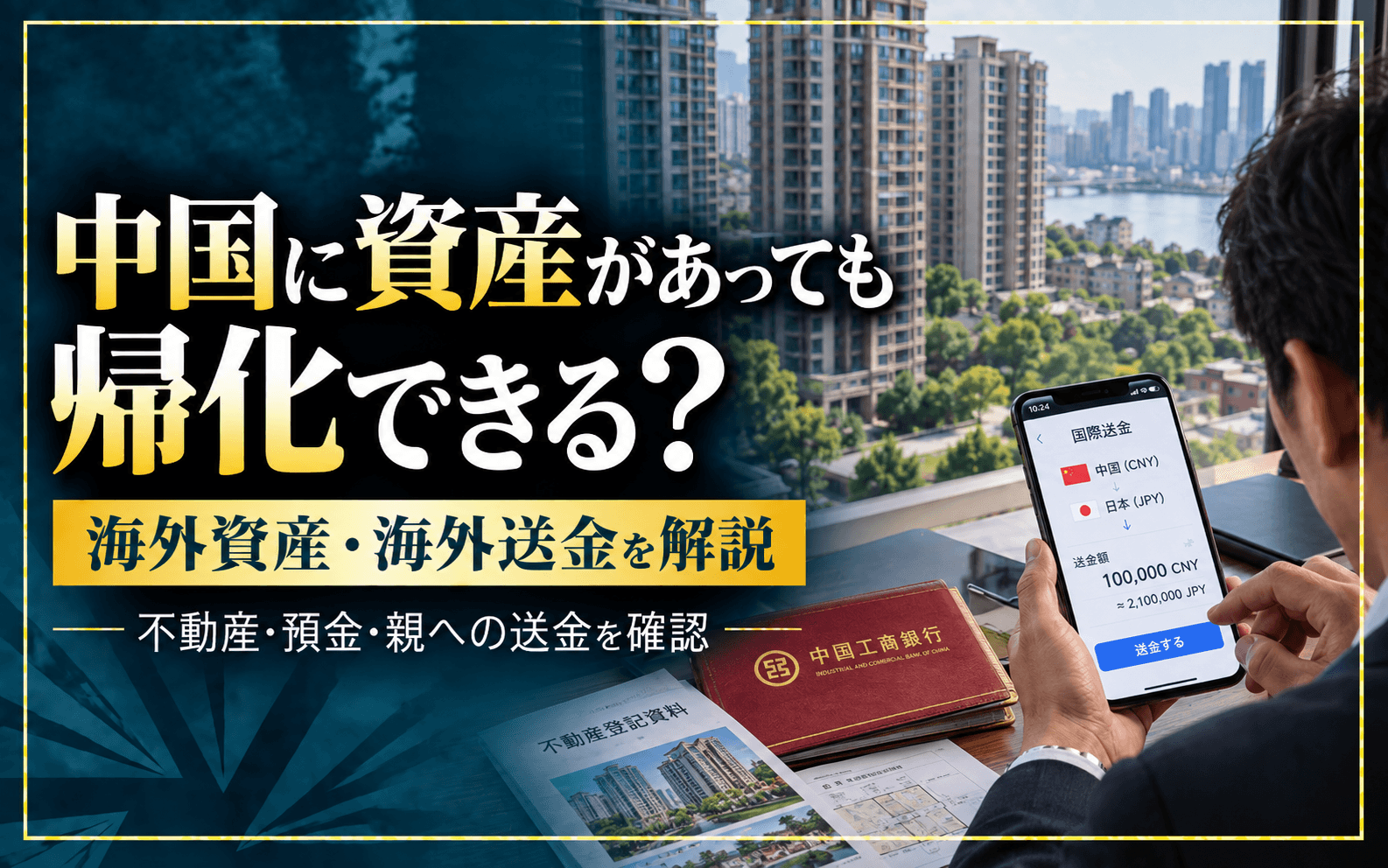
Can a Chinese national apply for Japanese naturalization while owning property or bank savings in China, supporting parents abroad, or receiving income from China? Overseas assets are not automatically a problem. The more important issue is whether overseas assets, income, remittances, Japanese tax records, and household finances are consistent with one another.
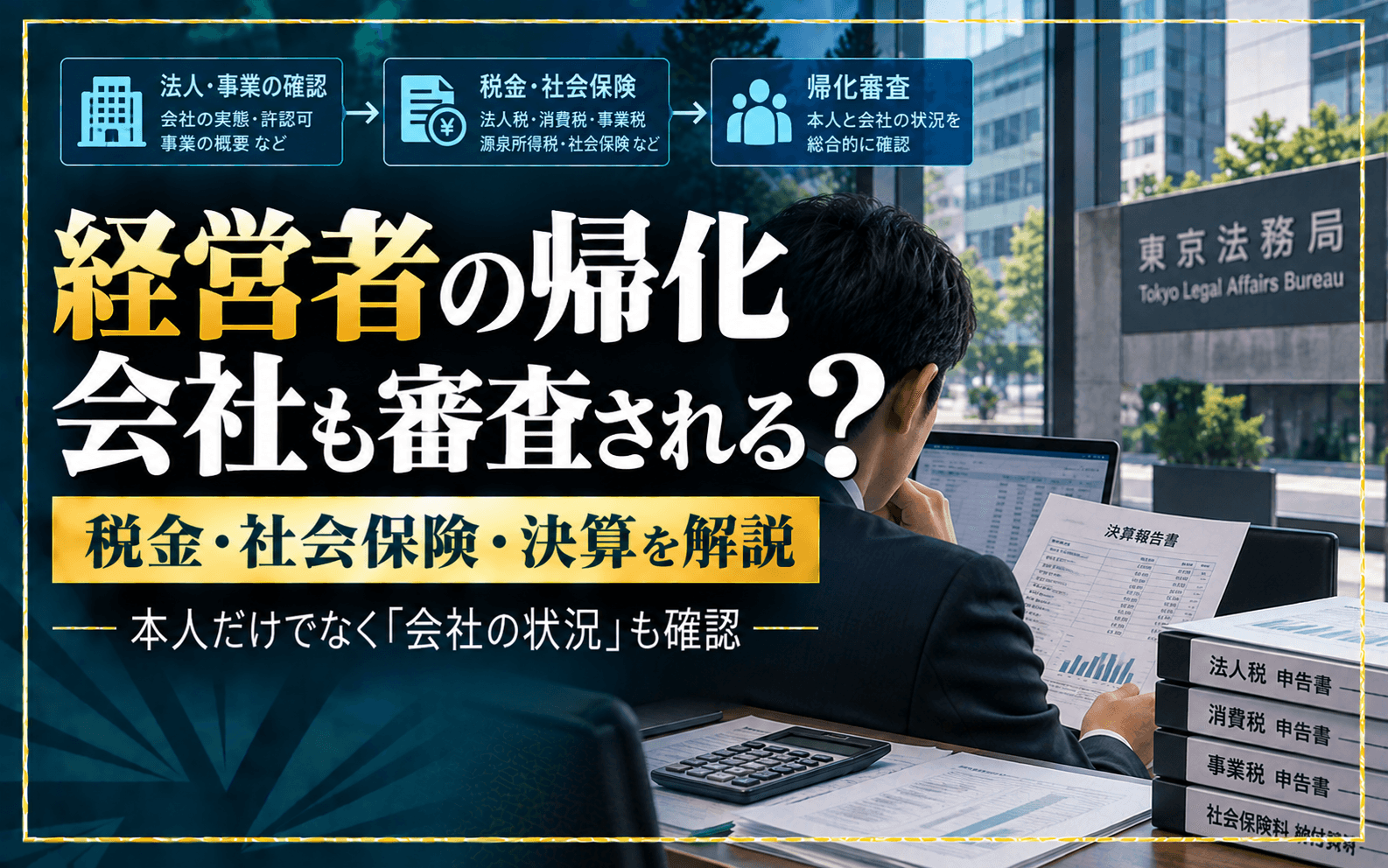
Read MoreCan a company owner or sole proprietor apply for Japanese naturalization? Business-owner cases involve more than the applicant’s personal income and taxes. Corporate taxes, consumption tax, business tax, withholding tax, company social insurance, financial statements, licensing, and the actual business operation can also require review.
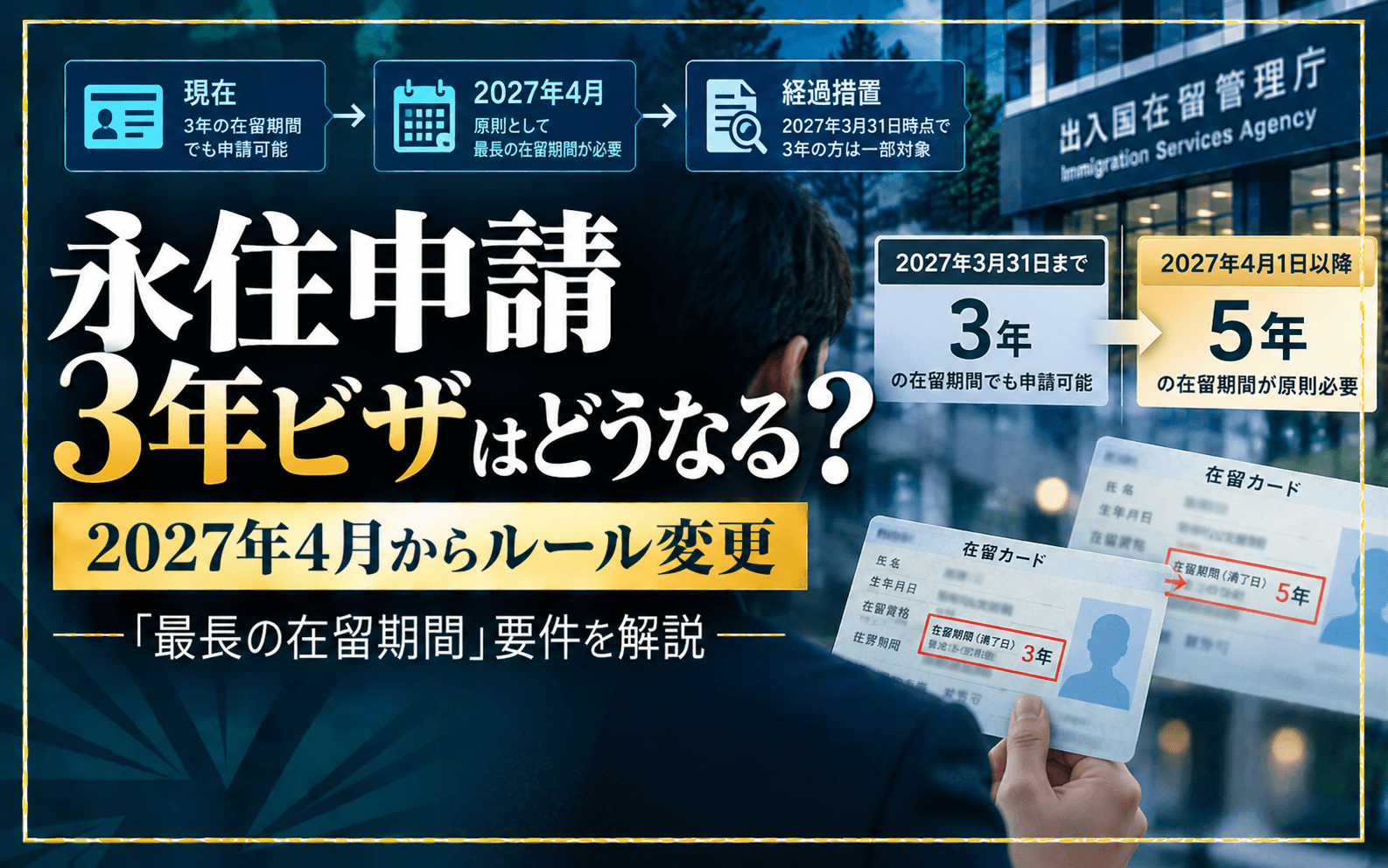
Read MoreA three-year period of stay can currently satisfy the “maximum period of stay” requirement for Japanese Permanent Residence, but the general transitional treatment ends on March 31, 2027. From April 2027, applicants will generally need the actual maximum period available for their current status. A separate transitional rule, however, applies to certain people who still hold a three-year period on March 31, 2027.
Read MoreLet's Start
Our scrivener carefully answers your visa and naturalization questions. Online consultations are available.