Column
Who Can Be Your Guarantor for Japanese Permanent Residence? Eligibility, Responsibility, and Required Documents 【2026 Update】
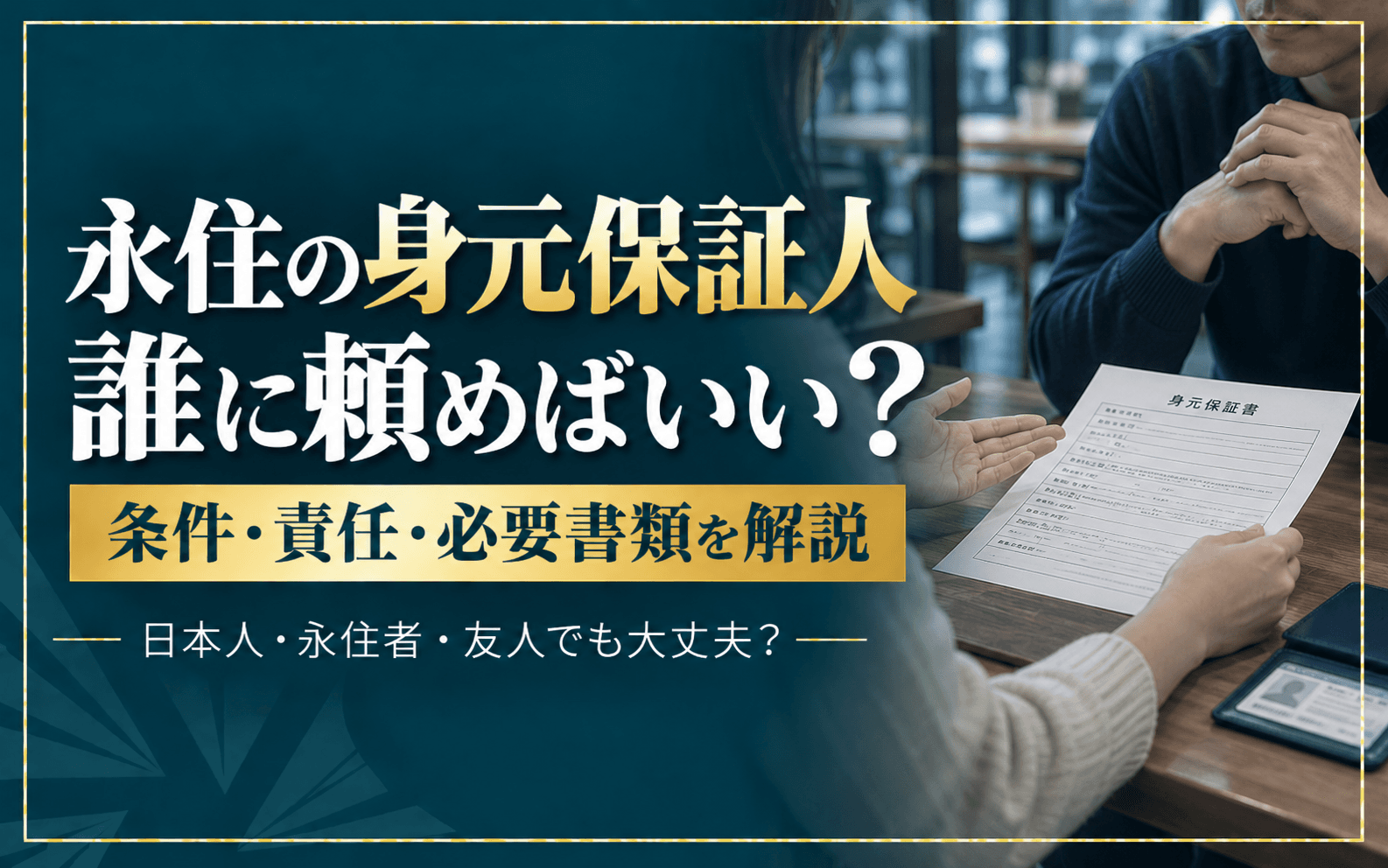
“Who should I ask to be my PR guarantor?”
“Can a Japanese friend do it?”
“Does it have to be my company president?”
“Does the guarantor need a high annual income?”
“Will the guarantor become responsible for my debts or unpaid tax?”
The first point to understand is:
a guarantor for a Permanent Residence application is not the same as a joint and several guarantor for a loan or lease.
The Guarantor Is Normally a Japan-Resident Japanese National, Permanent Resident, or Special Permanent Resident
Current Immigration Services Agency guidance normally identifies:
Japanese nationals residing in Japan
Permanent Residents residing in Japan
Special Permanent Residents residing in Japan
as PR guarantors.
Possible candidates can therefore include a spouse, friend, colleague, supervisor, or other person who meets the relevant status requirements.
There is no general rule requiring the guarantor to be the applicant’s employer or relative.
1. What Does the Guarantor Guarantee?
The current PR guarantee form states that the guarantor will provide necessary support so that the applicant:
complies with Japanese laws and properly fulfills public obligations while residing in Japan.
Public obligations can include matters such as tax, pension, health insurance, and immigration-related duties.
This Is Not the Same as Guaranteeing the Applicant’s Debts
The Immigration Services Agency explains that the immigration guarantee does not carry ordinary legal enforcement against the guarantor.
It is characterized primarily as a:
moral responsibility.
The form does not turn the guarantor into an ordinary joint guarantor for the applicant’s private debts.
2. Does That Mean Anyone Can Sign Casually?
No.
The guarantor makes a commitment to the Minister of Justice.
The Immigration Services Agency explains that failure to fulfill the promised role can affect that person’s future credibility and suitability as an immigration guarantor.
The arrangement should therefore reflect a genuine relationship rather than merely borrowing a stranger’s name.
3. Must the Guarantor Be Japanese?
No.
A Permanent Resident or Special Permanent Resident residing in Japan can also normally serve.
A foreign friend who already holds Permanent Resident status can therefore be a possible candidate.
4. What About a Japanese National Living Overseas?
Current guidance refers to a Japanese national or qualifying resident living in Japan.
A person with an actual residence base in Japan is therefore the standard choice.
5. Who Normally Guarantees a Japanese Spouse Applicant?
Where the applicant is the spouse of a Japanese national, current official guidance normally expects:
the Japanese spouse
to act as guarantor.
There is generally no need to replace the spouse merely because another friend has a higher income.
6. What About the Spouse of a Permanent Resident?
The same practical approach applies.
Where the applicant is married to a Permanent Resident, the Permanent Resident spouse will normally act as guarantor.
7. Does a Work-Status Applicant Need the Company President?
No nationwide rule requires this.
Depending on the circumstances, an applicant under Engineer/Specialist in Humanities/International Services may ask an appropriate:
Japanese friend
Japanese colleague
Japanese supervisor
Permanent Resident friend
Permanent Resident colleague
to serve.
What if You Do Not Want Your Employer to Know About the PR Application?
The guarantor is not limited to someone at the applicant’s company.
A suitable friend or other qualifying acquaintance can therefore be considered.
Separate employment documents required for the PR application are another matter.
8. Is There a Minimum Income Requirement for the Guarantor?
The Immigration Services Agency does not publish a nationwide rule requiring the guarantor to earn:
¥X million per year.
Under the current standard PR document lists, the guarantor is not uniformly required to submit:
Tax certificates
Tax-payment certificates
Employment certificates
Bank-balance certificates
The standard guarantor documents are:
the Guarantee Form
and:
documentation identifying the guarantor.
9. Can an Unemployed Japanese Spouse Serve?
There is no published uniform salary threshold for the guarantor.
An unemployed or non-working Japanese spouse is therefore not automatically excluded merely because that person has no employment income.
However, the applicant’s own livelihood requirement is a separate issue.
10. Can a Retired Person Receiving Pension Be a Guarantor?
There is no published blanket rule excluding pensioners.
The person’s actual residence in Japan and genuine relationship with the applicant remain relevant considerations.
11. Can a Friend Serve?
There is no general published rule limiting guarantors to relatives.
A qualifying friend can therefore be considered.
The guarantee form asks the guarantor to state the actual:
relationship to the applicant.
That relationship should be described truthfully.
12. Is It Better to Have a Company President or Senior Executive?
No published rule states that PR becomes easier simply because a company president acts as guarantor.
The applicant’s residence history, livelihood, taxes, pension, insurance, conduct, and immigration compliance remain the substantive PR issues.
13. What if the Guarantor Changes Jobs During Processing?
A job change alone does not have a published rule automatically invalidating the PR application.
However, major changes such as moving abroad or a significant change in immigration status may justify checking whether updated information is required.
14. Can the Guarantor Be Changed After Filing?
If the guarantor can no longer cooperate after filing, the applicant should contact the Immigration office handling the case rather than simply leaving the issue unresolved.
Updated guarantor documents may be requested depending on the circumstances.
15. What Documents Does the Guarantor Need?
Current standard PR documentation requires:
1. One Guarantee Form
2. A document showing the guarantor’s identity
The Immigration Services Agency gives a copy of a driver’s license as an example.
The current guarantee form asks for information including:
Name
Address
Telephone
Occupation and employer
Nationality or region
Immigration status where applicable
Relationship to the applicant
The guarantor’s name is handwritten.
16. Is a Registered Seal or Seal Certificate Required?
The current guarantee form uses a handwritten-name format.
A registered seal and seal-registration certificate are not listed as standard mandatory guarantor documents.
Applicants should use the current official form rather than an outdated version found online.
17. Will an Administrative Scrivener Become the Guarantor?
Hiring an administrative scrivener for a PR application does not mean that the professional automatically becomes the applicant’s guarantor.
Preparing and handling an immigration application and personally acting as guarantor are separate matters.
18. What if You Cannot Find a Guarantor?
Consider whether there is an appropriate:
Spouse
Relative
Friend
Current or former colleague
Supervisor
Permanent Resident acquaintance
who meets the standard criteria.
Applicants sometimes overlook Permanent Resident foreign friends because they mistakenly believe that only Japanese nationals can serve.
If there truly is no appropriate person, the issue should be confirmed before filing.
Be Careful With Paid “Guarantor Services”
Using a completely unrelated stranger for payment can raise questions if the relationship described on the application is not genuine.
The guarantee form requires the actual relationship to the applicant.
Accuracy should come before convenience.
19. What if the Guarantor Has a Tax Issue?
The current standard document list does not subject every guarantor to the same multi-year tax-document review imposed on the applicant.
Nevertheless, where there are obvious reasons to question whether a person is an appropriate guarantor, another genuine candidate may be preferable.
20. A Strong Guarantor Does Not Replace the Applicant’s PR Requirements
Even if the guarantor is a high-income Japanese professional, problems concerning the applicant’s:
Taxes
Pension
Residence period
Income
Conduct
Immigration compliance
remain separate issues.
Likewise, an ordinary salaried employee serving as guarantor does not itself make an otherwise qualified PR application weak.
Frequently Asked Questions
Q. Must My Guarantor Be Japanese?
No. Current guidance normally includes Japanese nationals, Permanent Residents, and Special Permanent Residents residing in Japan.
Q. Can a Japanese Friend Be My Guarantor?
Yes, a qualifying friend can be a candidate. There is no general requirement that the guarantor be a relative.
Q. Does It Have to Be My Company President?
No.
Q. Does the Guarantor Need a Minimum Salary?
No nationwide fixed minimum guarantor income is published.
Q. Does the Guarantor Need to Submit Tax Certificates?
Under the current standard document list, the core guarantor documents are the Guarantee Form and identification documentation.
Q. Will the Guarantor Have to Pay My Debts?
The Immigration Services Agency characterizes the guarantee as primarily a moral responsibility without ordinary legal enforcement against the guarantor.
Q. Can My Chinese Friend Who Has Japanese PR Be My Guarantor?
A Permanent Resident residing in Japan is included in the category normally identified by the Immigration Services Agency.
PR Is Not About Finding the Richest or Most Senior Guarantor
The goal is not to find the applicant’s highest-ranking acquaintance.
The important point is to select a genuine and appropriate guarantor within the categories normally recognized by Immigration and submit accurate guarantor documentation.
The applicant’s own PR requirements remain the central part of the examination.
Enlight Administrative Scrivener’s Office reviews the guarantor documents together with the applicant’s income, taxes, pension, health insurance, residence history, and other PR requirements.
The initial Permanent Residence eligibility check is free of charge.
Permanent Residence support is generally limited to applicants within the jurisdiction of the Tokyo Regional Immigration Services Bureau.
References
Immigration Services Agency: Permanent Residence Application
Immigration Services Agency: Permanent Residence Application 1
Immigration Services Agency: Permanent Residence Application 2
Immigration Services Agency: Permanent Residence Application 3
Immigration Services Agency: Guarantee Form for Permanent Residence Applications
Immigration Services Agency: Immigration and Residence Examination Q&A