Column
Can You Apply for Permanent Residence in Japan While Unemployed? Job Loss, Unemployment Benefits and Financial Stability 【2026 Guide】
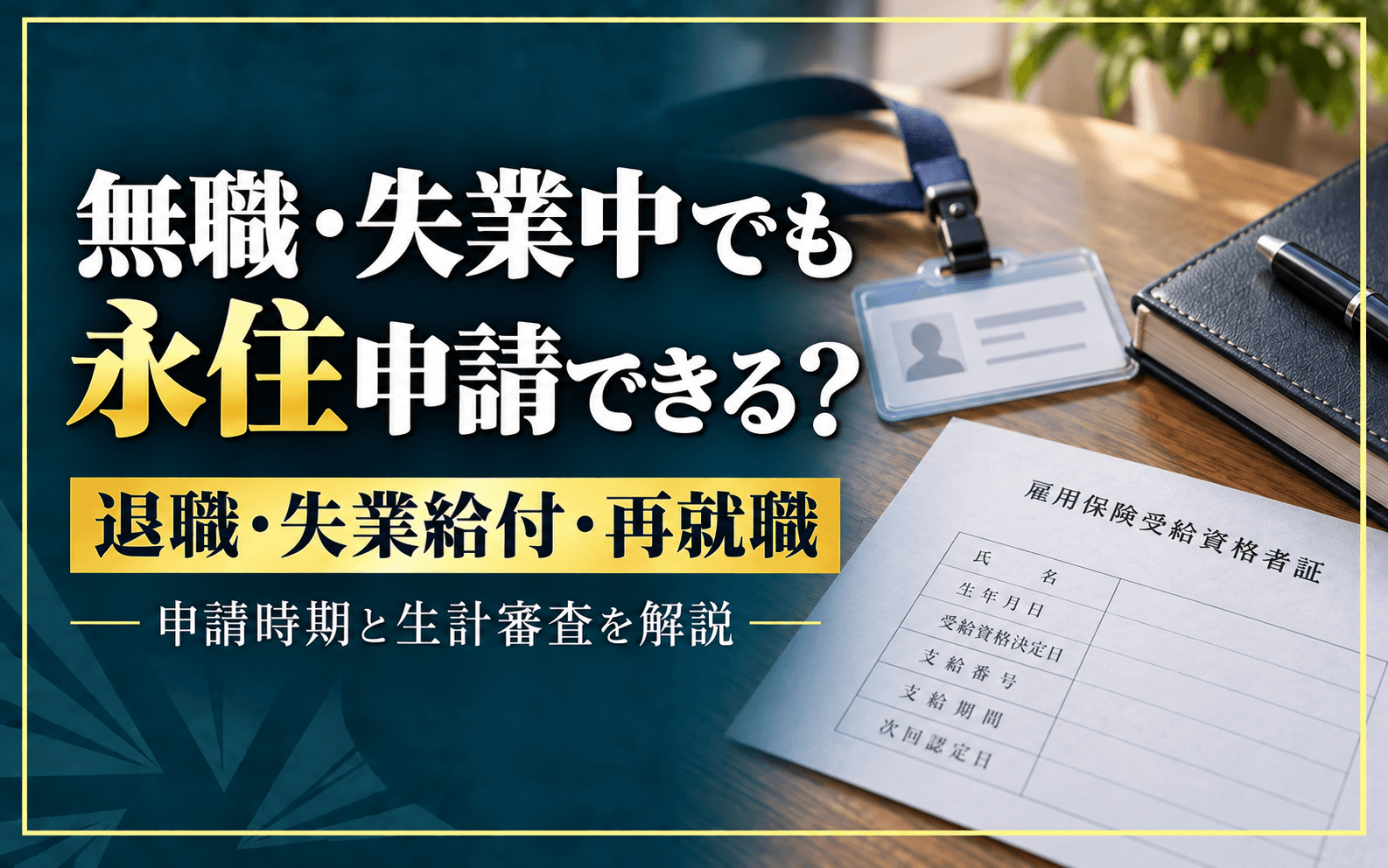
“I left my company and am currently unemployed. Can I still apply for Permanent Residence?”
“I am receiving unemployment benefits. Will they be treated as sufficient income?”
“My spouse is working. Does it matter if I personally have no job?”
“My next job has not been decided yet. Should I wait until I am re-employed?”
Current employment and income are important issues in many Japanese Permanent Residence applications.
Applicants who have recently left a job therefore often assume:
“If I am unemployed, I cannot even apply for PR.”
That is not the rule.
Being unemployed does not, by itself, prevent a Permanent Residence application from being filed.
The Immigration Services Agency’s own document list expressly addresses cases in which both the applicant and spouse are unemployed and instructs them to submit a written explanation of that situation.
However, ordinary PR applications are generally subject to an important requirement:
the applicant’s future living situation must be financially stable.
The length and reason for unemployment, household income, savings, past earnings and prospects of re-employment can therefore become important.
Can an unemployed person apply for Permanent Residence?
The current Permanent Residence guidelines generally require the applicant to possess:
sufficient assets or skills to maintain an independent livelihood.
The guideline explains this as a situation in which the applicant is not dependent on public support in ordinary life and, based on their assets, skills and circumstances,
a stable life can be expected in the future.
Importantly, the law does not simply state:
“The applicant must be employed by a company on the filing date.”
The official PR document list distinguishes between:
employees;
self-employed applicants; and
other circumstances requiring a written occupational explanation.
It specifically notes that an explanation should also be submitted where both applicant and spouse are unemployed.
Accordingly:
Unemployed ≠ unable to apply.
The real question becomes:
how future financial stability can be demonstrated without a current salary.
Being eligible to file and being well positioned to file are different
An application may be accepted while the applicant is unemployed.
That does not mean every period of unemployment is an equally good time to apply.
For example:
the applicant left work only recently;
the spouse has substantial stable earnings;
the household has meaningful savings; and
a new position has already been secured
is very different from a case where:
unemployment has continued for a long time;
the spouse is also unemployed;
savings are limited; and
there is no clear re-employment plan.
The analysis therefore goes beyond:
“Current salary: JPY 0.”
The more important question is:
how the household will continue supporting itself.
What if you are receiving unemployment benefits?
Some applicants receive Employment Insurance basic allowance after leaving a job.
Japan’s Ministry of Health, Labour and Welfare explains that the basic allowance is intended to help stabilize a person’s life while unemployed and facilitate their search for new employment.
There is no published PR rule stating:
“Receiving unemployment benefits makes a person ineligible for Permanent Residence.”
However, unemployment benefits are generally temporary.
The independent-livelihood requirement is concerned with:
whether stable living can reasonably continue into the future.
It may therefore be necessary to consider:
how long benefits will continue;
whether the applicant is actively job hunting;
prospects of re-employment;
spouse or household income; and
savings and other assets.
What if your spouse works but you do not?
This can materially change the assessment.
The official PR document lists require not only the applicant’s employment and income documentation but also documentation for:
a person who financially supports the applicant.
For example:
Applicant: unemployed
Spouse: full-time employee earning JPY 5 million
is very different from:
Applicant: unemployed
Spouse: unemployed.
Relevant information can include:
the spouse’s employment certificate;
spouse income;
household size;
household living costs; and
savings.
However,
there is no universal rule that a working spouse automatically guarantees approval.
The entire household situation must still be reviewed.
Can substantial savings compensate for unemployment?
Savings are one form of asset that may be submitted in a PR application.
The Immigration Services Agency lists materials such as:
bank-account records;
real-estate registration certificates; and
comparable asset evidence
as proof of assets.
For someone who has only recently left employment, substantial savings may therefore help explain how the household can continue meeting living expenses.
However, Japan does not publish a rule such as:
“JPY X in savings is enough for an unemployed applicant.”
PR screening looks beyond a one-day bank balance and considers:
whether the living arrangement appears sustainable going forward.
Can you apply immediately after resigning?
There is no nationwide rule requiring an applicant to wait a fixed period after leaving employment.
Nevertheless, depending on the circumstances,
waiting until after re-employment may produce a stronger and clearer application.
This can be particularly relevant where the applicant is:
single;
not financially supported by a spouse or family member;
without a confirmed next position;
holding limited savings; and
relying primarily on unemployment benefits.
By contrast, where:
a job offer has already been accepted;
the start date is fixed; and
employment terms have been issued,
the applicant may be able to explain expected future earnings even though they are temporarily unemployed.
What documents help if you already have a job offer?
Where the next position is already confirmed, useful evidence may include:
an offer letter;
notice of hiring;
employment contract;
employment-conditions notice;
documentation showing the start date; and
documentation showing expected salary.
The objective is to establish:
“The applicant is currently between jobs, but employment with this company begins on this date.”
However, before the start date there is still no actual employment history or salary record at the new employer.
Where timing is flexible,
waiting until employment has actually started may make the situation easier to document.
Does voluntary resignation differ from redundancy or dismissal?
There is no rule stating:
Voluntary resignation = refusal
Company redundancy = approval.
Nevertheless, the reason for unemployment can form part of the factual background.
Examples include:
company closure;
redundancy;
expiration of a fixed-term contract;
voluntary resignation;
family circumstances; or
relocation.
The central issue is less the label attached to the resignation and more:
whether the present unemployment is temporary and whether there is a credible plan for future employment and living expenses.
Work-status holders have a separate immigration issue
Applicants holding an employment-based status such as Engineer/Specialist in Humanities/International Services need to consider something separate from the PR livelihood requirement:
whether their current status of residence is being properly maintained.
For certain work statuses, termination of the employment or contractual relationship generally requires a notification to the Immigration Services Agency within 14 days.
Separately, a person holding a status listed in Table I of the Immigration Control Act may become subject to status-revocation procedures if they fail, without a justifiable reason, to perform the activity corresponding to that status continuously for three months.
Where there is a justifiable reason, the status is not automatically subject to revocation on that basis.
A prolonged period of unemployment can therefore raise:
a current-status issue as well as a PR issue.
Keep evidence of genuine job-search activity
A person actively seeking a new job may wish to keep records such as:
Hello Work registration;
job applications;
interview invitations;
communications with recruiters;
offer letters; and
a chronology of job-search activity.
There is no published PR rule stating that these documents automatically improve an application.
However, they may help explain that:
the unemployment period is temporary and that the applicant is genuinely seeking re-employment.
Resident tax needs particular attention after leaving employment
While employed, resident tax is often withheld directly from salary.
After resignation, collection may switch to:
ordinary collection, requiring the individual to make the payments directly.
For ordinary employment-based PR applications, the Immigration Services Agency requests resident-tax and payment records covering the prescribed past period, including evidence of timely payment for periods not collected through payroll withholding.
Applicants should therefore be careful not to overlook tax payment slips after leaving a company.
In some cases,
late tax payment after leaving employment can create a more serious PR issue than the temporary unemployment itself.
Pension and health-insurance changes also matter
After leaving employment, a person previously enrolled in Employees’ Pension and employer health insurance may need to move to systems such as:
National Pension; and
National Health Insurance.
PR applications generally require evidence of public pension and public health-insurance payment status for the relevant recent period.
Applicants should therefore avoid:
forgetting to complete the transition after resignation
or simply leaving pension and health-insurance obligations unresolved.
If payment is difficult due to unemployment, the appropriate public office should be consulted about any procedures or relief measures that may lawfully be available.
What if you were unemployed in the past but now have a job?
A past period of unemployment is different from being unemployed on the filing date.
There is no published rule stating that having once been unemployed automatically prevents Permanent Residence.
However, ordinary employment-based PR applications review historical income and tax records, so a period of unemployment may result in lower income for one of the relevant years.
The relevant questions may then include:
why income fell;
how long the unemployment lasted;
when re-employment occurred; and
whether current earnings are stable.
An applicant who is now stably employed therefore presents a materially different case from someone who is currently unemployed.
Spouses and children of Japanese or Permanent Residents are different
Where the applicant is the spouse or child of:
a Japanese national;
a Permanent Resident; or
a Special Permanent Resident,
the Immigration Control Act provides that the ordinary:
good-conduct and independent-livelihood requirements do not need to be satisfied.
Current unemployment therefore has a different legal significance in these cases than it does in an ordinary employment-based PR application.
However, employment, income, tax and social-insurance documentation may still be requested, and other PR considerations remain relevant.
The applicant’s PR route should therefore be identified before assessing the effect of unemployment.
Cases where waiting may be worth considering
It may be sensible to review the timing carefully where:
the applicant is currently unemployed;
there is no other household income;
the next job has not been secured;
income after unemployment benefits end is unclear;
savings are limited;
historical income is also low;
unemployment has become prolonged;
the applicant has not performed the activity underlying their work status for a long period;
pension or health-insurance procedures after resignation remain unresolved; or
there have been late tax payments.
PR timing should not be based only on:
“What is the earliest date I can file?”
It should also consider:
“At what point can I most clearly demonstrate future stability?”
Cases where unemployment may not prevent filing
Temporary unemployment does not necessarily mean an applicant should abandon a PR application where, for example:
resignation was recent;
the next employer has already been confirmed;
the start date and salary are fixed;
the spouse has substantial stable income;
the household has sufficient savings or assets;
historical earnings are stable;
tax, pension and health-insurance obligations have been properly fulfilled; and
the applicant can clearly explain the unemployment and future living plan.
No single factor guarantees approval.
The application must be reviewed as a whole.
Frequently Asked Questions
Q. Will Immigration accept a PR application if I am currently unemployed?
Unemployment itself does not prevent an application from being filed.
Official document instructions expressly address cases in which both applicant and spouse are unemployed.
Q. Are unemployment benefits enough to satisfy the income requirement?
Employment Insurance basic allowance supports life during unemployment and job seeking, but it is generally temporary.
Future employment prospects, household income and assets should also be considered.
Q. My spouse is a full-time employee. Can I apply while unemployed?
The income and occupation of a person financially supporting the applicant can form part of the PR evidence.
The adequacy of that income still depends on the household’s circumstances.
Q. Can I apply if I already have a job offer?
An offer letter or employment contract may help demonstrate expected future employment and earnings.
In some cases, however, it may be clearer to wait until actual employment has begun.
Q. Does my work visa automatically disappear after three months of unemployment?
No.
However, certain activity-based statuses can become subject to revocation where the required activity has not been performed for three months without a justifiable reason.
Q. How many months must I work after re-employment before applying?
Japan does not publish a nationwide rule requiring a fixed number of months after re-employment.
The appropriate timing depends on present and historical income, household circumstances and the reason for unemployment.
Conclusion: unemployment does not automatically prevent PR, but future stability must be explained
Being unemployed does not, by itself, make a Permanent Residence application impossible.
Official Immigration Services Agency materials expressly contemplate situations in which the applicant and spouse are unemployed.
However, ordinary PR applications generally require evidence that:
a stable life can reasonably be expected in the future.
Relevant factors can therefore include:
unemployment benefits;
spouse income;
savings;
historical earnings;
prospects of re-employment;
a confirmed job offer;
job-search activity;
taxes;
pension;
health insurance; and
the applicant’s current status of residence.
One of the most important questions is often:
whether to apply now or wait until after re-employment.
Enlight Administrative Scrivener Office reviews income history, household support, assets, public obligations and current immigration status when advising unemployed applicants on PR timing.
Initial eligibility assessment is free.
Enlight Administrative Scrivener Office
Administrative Scrivener: Shiki Miyajima
Tel: 03-5284-7981
Office hours: Weekdays 10:00–18:00
Online consultations are available throughout Japan, including via WeChat.
References
Immigration Services Agency of Japan, “Guidelines for Permanent Residence Permission, revised February 24, 2026”
Immigration Services Agency of Japan, “Permanent Residence Application 3”
Immigration Services Agency of Japan, “Permanent Residence Permission Application”
Immigration Services Agency of Japan, “Notification Concerning Affiliated/Contracting Organization”
Immigration Services Agency of Japan, “Revocation of Status of Residence”
Ministry of Health, Labour and Welfare, “Basic Allowance”
Ministry of Health, Labour and Welfare, “Q&A for Workers: Basic Allowance and Re-employment Allowance”
※Japan does not publish a nationwide rule under which PR approval is mechanically determined by a specific unemployment period, savings balance or unemployment-benefit amount. The appropriate filing timing must be assessed individually based on the applicant’s status of residence, household income, historical earnings and compliance with public obligations.