Column

Column
“My parent is Japanese. Can I naturalize immediately?”
“I was born in Japan. Do I still need five years of residence?”
“I used to be a Japanese national. Do the ordinary naturalization requirements still apply to me?”
“Does simplified naturalization remove the income and age requirements?”
When researching Japanese naturalization, applicants sometimes encounter the expression:
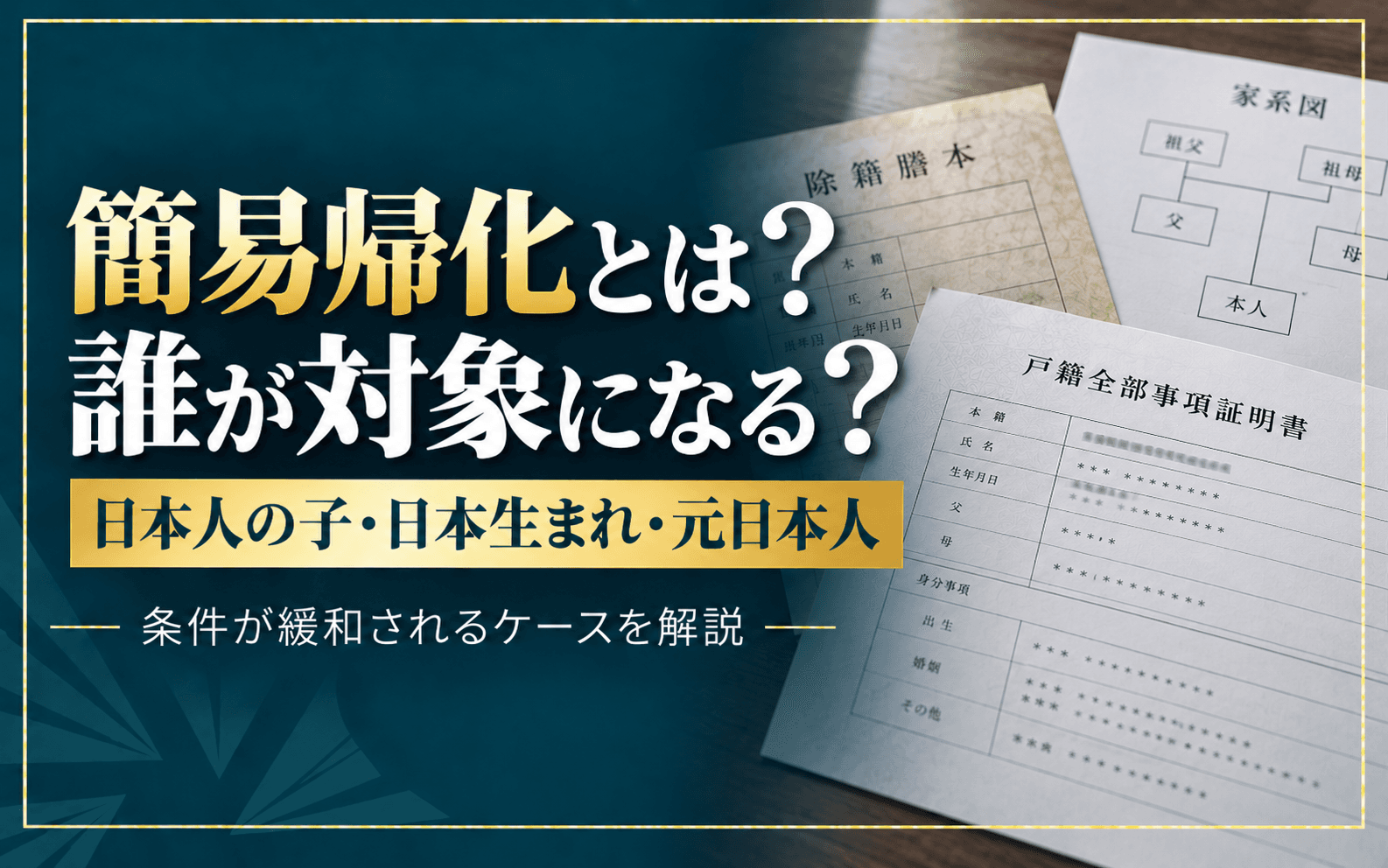
“simplified naturalization.”
This is not the formal name of a separate procedure created by the Nationality Act.
Rather, the term is commonly used to describe:
the relaxation of certain ordinary naturalization requirements under Articles 6 to 8 of Japan’s Nationality Act for foreign nationals who have particular ties to Japan.
Potential categories include:
children of Japanese nationals;
certain people born in Japan;
spouses of Japanese nationals;
former Japanese nationals;
certain adopted children of Japanese nationals; and
certain stateless persons born in Japan.
However,
“simplified” does not mean that the examination is easy, that very few documents are required, or that approval is automatic.
First, understand the ordinary naturalization requirements
Ordinary naturalization is generally examined under Article 5 of the Nationality Act.
The principal requirements include:
domicile;
legal capacity;
good conduct;
livelihood;
prevention of dual nationality; and
constitutional compliance.
For ordinary naturalization, the Ministry of Justice explains that the applicant generally needs:
five or more consecutive years of domicile in Japan.
Age, financial stability, compliance with taxes and laws, and the ability to lose the prior nationality are also relevant.
Articles 6 to 8 create exceptions for certain foreign nationals with special connections to Japan by allowing naturalization even where some of those ordinary requirements are not satisfied.
“Simplified naturalization” does not give everyone the same exemption
This distinction is essential.
Even among cases commonly described as simplified naturalization,
the requirements relaxed depend on whether the applicant falls under Article 6, 7 or 8.
Broadly:
Article 6 mainly relaxes the domicile requirement.
Article 7 provides special treatment for certain spouses of Japanese nationals and can relax the domicile and capacity requirements.
Article 8 can relax the:
domicile, capacity and livelihood requirements
for certain categories.
Accordingly, it is incorrect to assume:
“I qualify for simplified naturalization, so all ordinary requirements disappear.”
Article 6|Cases where the domicile requirement may be relaxed
Article 6 allows certain foreign nationals to naturalize even without satisfying the ordinary five-year domicile requirement.
The principal categories include the following.
A biological child of a person who was formerly a Japanese national may qualify where the applicant:
has had domicile or residence in Japan continuously for three years or more and currently has domicile in Japan.
Adopted children are excluded from this particular provision.
Importantly:
a child of a former Japanese national is not the same category as a biological child of a person who is currently Japanese.
A biological child of a current Japanese national may instead fall under Article 8(1).
A foreign national born in Japan may qualify where the person:
has had domicile or residence in Japan continuously for three years or more,
or where:
the applicant’s father or mother, excluding adoptive parents, was also born in Japan.
However,
being born in Japan does not by itself automatically make someone a Japanese national.
Japan does not generally grant nationality solely because a person was born on Japanese territory.
Article 6 also covers a person who:
has continuously maintained residence in Japan for ten years or more.
Article 7|Spouses of Japanese nationals
A separate rule applies to foreign spouses of Japanese nationals.
In qualifying cases,
the ordinary domicile and capacity requirements
may be relaxed.
For example, the provision can apply where a foreign spouse of a Japanese national:
has continuously had domicile or residence in Japan for three years or more and currently has domicile in Japan,
or where:
three years have passed since the marriage and the person has continuously had domicile in Japan for at least one year.
Because Japanese-spouse naturalization is covered separately in another article, this guide does not examine it in detail.
Article 8|Cases with broader relaxation
Article 8 can allow naturalization without satisfying the ordinary:
domicile, capacity and livelihood requirements.
This is a broader relaxation than Article 6.
However, requirements relating to good conduct, nationality status and other matters do not automatically disappear.
What about biological children of Japanese nationals?
Article 8(1) applies to:
a biological child of a Japanese national, excluding an adopted child, who has domicile in Japan.
In such a case, the ordinary:
five-year domicile requirement;
capacity requirement; and
livelihood requirement
may be relaxed.
However,
having a Japanese parent does not necessarily mean that naturalization is the correct procedure.
Depending on the parent’s nationality at birth, timing of legal recognition and whether nationality was retained, the person may already have acquired Japanese nationality by birth or may qualify to acquire nationality by notification.
The first question should therefore be:
“Is naturalization actually necessary?”
Former Japanese nationals seeking Japanese nationality again
Article 8(3) provides special treatment for:
a person who lost Japanese nationality and currently has domicile in Japan.
However,
a person who acquired Japanese nationality through naturalization and later lost it
is excluded from this particular provision.
Examples may include a person who once held Japanese nationality but later lost it because of:
failure to retain nationality;
voluntary acquisition of a foreign nationality; or
another nationality-law event.
In some circumstances, the correct procedure may not be naturalization at all.
A person may instead qualify to reacquire Japanese nationality by notification under Article 17.
Therefore, a former Japanese national should first determine which nationality procedure actually applies.
Adopted children of Japanese nationals also have a special rule
Article 8(2) covers certain adopted children of Japanese nationals where the person:
has had domicile in Japan continuously for one year or more and was a minor under the law of their original country at the time of the adoption.
Relevant facts include:
the date of adoption;
the person’s age at that time;
the age of majority under the relevant foreign law; and
the period of domicile in Japan.
Being adopted by a Japanese national does not, by itself, establish eligibility.
Stateless persons born in Japan may also qualify
Article 8(4) provides special treatment for a person who:
was born in Japan, has been stateless since birth and has continuously had domicile in Japan for three years or more from birth.
This is different from the ordinary situation of:
“a foreign national who happened to be born in Japan.”
The person must have been stateless from birth.
Being born in Japan does not remove every naturalization requirement
This is a common misunderstanding.
Even where a Japan-born applicant benefits from the domicile relaxation under Article 6,
other requirements such as conduct, livelihood and nationality status do not automatically disappear.
Being born in Japan does not mean:
“income will not be reviewed,”
“taxes and pension do not matter,”
or:
“traffic or legal violations are irrelevant.”
The correct analysis is:
which specific provision applies, and which requirement does that provision actually relax?
In 2026, qualifying for a statutory exception does not always mean you should file immediately
As of 2026, naturalization screening involves not only the statutory requirements but also:
the applicant’s integration into Japanese society.
The Tokyo Legal Affairs Bureau explains both that Articles 6 to 8 relax certain requirements for persons with special ties to Japan and that matters such as Japanese-language ability and residence in Japan are relevant to social integration.
Accordingly, simply satisfying an express threshold such as:
“three years,”
“one year,”
or:
“current domicile in Japan”
does not necessarily mean that:
the application should automatically be filed immediately or will automatically be approved.
Applicants should also review matters such as:
length of residence in Japan;
Japanese-language ability;
actual life in Japan;
taxes and social insurance;
family relationships; and
employment circumstances.
Important requirements still remain
The word “simplified” can be misleading.
Depending on the applicable provision, issues such as the following can remain important:
conduct;
taxes and social insurance;
traffic and other legal violations;
ability to lose the previous nationality;
Japanese-language ability;
actual life in Japan; and
proof of family and civil status.
Cases involving children of Japanese nationals, former Japanese nationals, adoptees or Japan-born applicants can sometimes require:
more complicated civil-status documentation than an ordinary case.
Birth records, Japanese family registers, removed family registers and foreign civil-status documents may need to be traced across several generations.
The key question is which Article applies to you
The first question should not simply be:
“Do I qualify for simplified naturalization?”
It should be:
“Which provision of the Nationality Act applies to my case?”
For example, “a child of a Japanese person” could mean:
a biological child of a current Japanese national,
a child of a former Japanese national,
or an adopted child of a Japanese national.
Different provisions may apply.
Similarly, “born in Japan” requires further questions about:
whether only the applicant was born in Japan,
whether a parent was also born in Japan,
and whether the applicant was stateless from birth.
Frequently Asked Questions
Articles 6 to 8 can relax the ordinary five-year domicile requirement for qualifying applicants.
However, current Legal Affairs Bureau practice and the applicant’s broader integration into Japanese society should also be considered when deciding timing.
A biological child of a current Japanese national who has domicile in Japan may fall under Article 8(1).
However, first confirm whether Japanese nationality was already acquired by birth or can be acquired by notification.
No.
Different provisions may apply depending on residence history, the birthplace of the parents and whether the applicant was stateless from birth.
If Article 8(3) applies, the livelihood requirement may be among the requirements relaxed.
Other matters such as conduct and nationality status remain relevant.
Article 8(2) requires additional conditions, including at least one year of domicile in Japan and that the person was a minor under the relevant home-country law at the time of adoption.
Not necessarily.
Proving Japanese parentage, former Japanese nationality, adoption or birth circumstances may make civil-status documentation more complex than in an ordinary naturalization case.
Conclusion|“Simplified” naturalization does not mean every requirement is simplified
What is commonly called simplified naturalization allows:
certain foreign nationals with special ties to Japan to benefit from relaxation of some ordinary naturalization requirements.
However, the rules differ among:
children of Japanese nationals,
Japan-born applicants,
spouses of Japanese nationals,
former Japanese nationals,
adopted children of Japanese nationals, and
stateless persons born in Japan.
The important question is therefore:
which provision applies to the applicant, which requirements are relaxed and which requirements remain.
In 2026, applicants should also consider Japanese-language ability, actual life in Japan, tax and social-insurance compliance and broader integration into Japanese society.
Enlight Administrative Scrivener Office reviews the applicant’s nationality history, place of birth, parent-child relationships and residence history to determine whether the correct route is ordinary naturalization, a statutory exception, acquisition of nationality by notification or reacquisition of nationality.
Initial eligibility assessment is free.
Enlight Administrative Scrivener Office
Administrative Scrivener: Shiki Miyajima
Tel: 03-5284-7981
Office hours: Weekdays 10:00–18:00
Online consultations are available throughout Japan, including via WeChat.
References
Ministry of Justice of Japan, “Nationality Q&A”
Ministry of Justice of Japan, “Nationality Act”
Tokyo Legal Affairs Bureau, “Naturalization”
Legal Affairs Bureau, “Guide to Naturalization Applications”
※“Simplified naturalization” is not a formal statutory name. It is a commonly used expression for the relaxation of certain naturalization requirements under Articles 6 to 8 of the Nationality Act. The applicable provision depends on the applicant’s birth, parentage, former nationality and residence history.
Related
Can you apply for Japanese Permanent Residence after leaving your job and while currently unemployed? This guide explains how unemployment benefits, a spouse’s income, savings, a pending job offer, taxes, pension and health insurance can affect the financial-stability assessment and the timing of a PR application.
Read MoreWhat happens to Chinese nationality when a Chinese citizen naturalizes in Japan? China does not recognize dual nationality, and a Chinese citizen who meets the conditions under Article 9 of China’s Nationality Law automatically loses Chinese nationality upon voluntarily acquiring foreign nationality. This guide explains Chinese passports, household registration, ID cards and travel to China after Japanese naturalization.
Read MoreCan you apply for Japanese Permanent Residence with a 3-year period of stay? In 2026, a 3-year period is still treated as satisfying the “maximum period of stay” requirement, but the rule changes from April 1, 2027. This guide explains the treatment of 1-, 3- and 5-year periods, transitional measures and visa renewals while PR is pending.
Read MoreLet's Start
Our scrivener carefully answers your visa and naturalization questions. Online consultations are available.