Column
Column
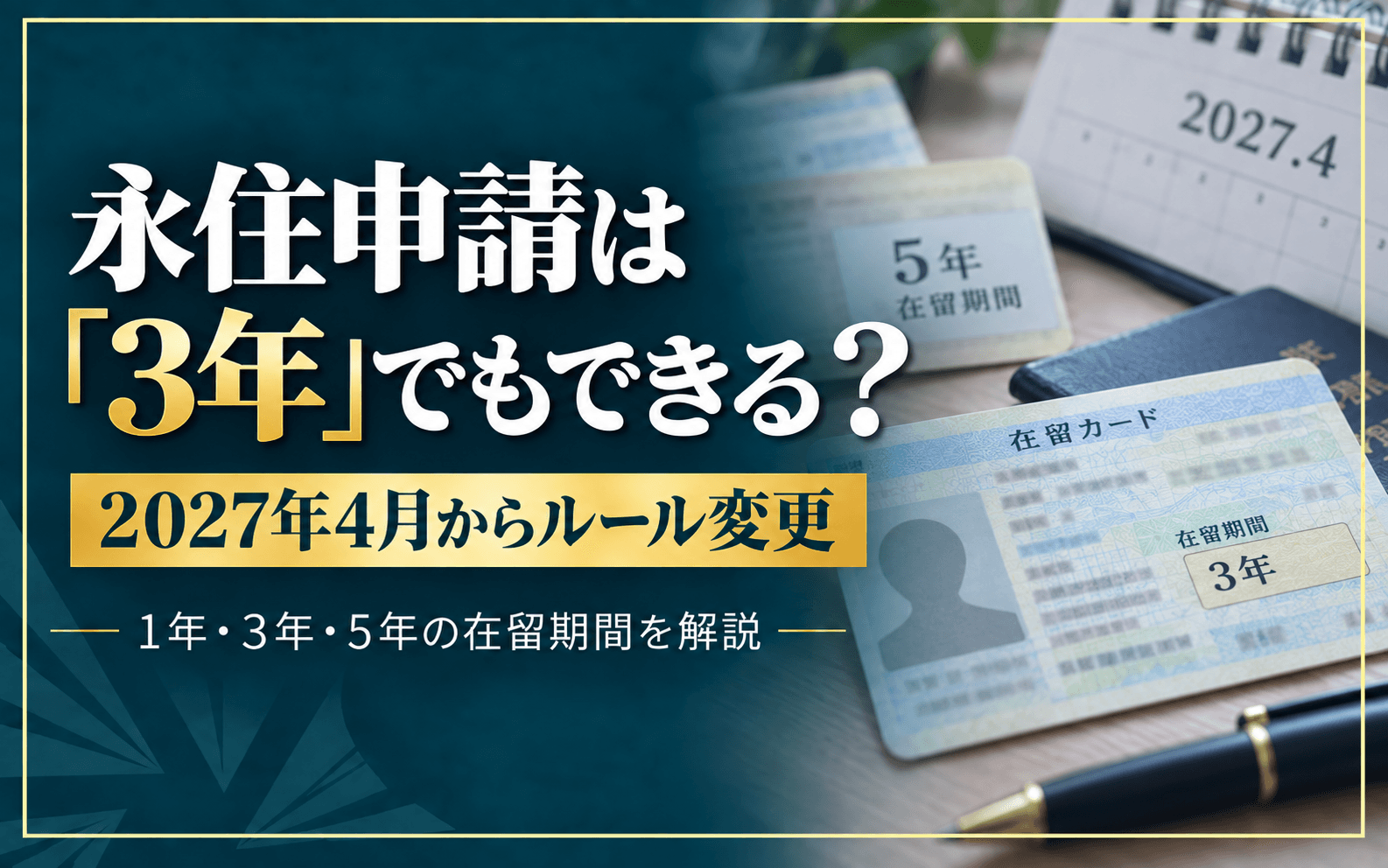
“My current period of stay is three years. Can I apply for Permanent Residence?”
“I heard that I will need a five-year period to apply for PR.”
“Is the rule really changing in April 2027?”
“I currently have three years. Should I wait until I receive five years?”
For people considering Permanent Residence in Japan, one issue deserves particular attention between 2026 and 2027:
the period of stay granted under your current status of residence.
As of September 2026,
a person holding a three-year period of stay is still treated as satisfying the Permanent Residence requirement concerning the “maximum period of stay.”
However, this treatment will not continue indefinitely.
The Immigration Services Agency has announced that the current treatment of a three-year period as the maximum period will change from April 1, 2027.
Applicants currently holding three years should therefore consider:
whether they can apply now or whether the timing of their next residence-status renewal matters.
Permanent Residence requires the “maximum period of stay”
Japan’s Permanent Residence Guidelines include, as one of the requirements connected with Japan’s interests, that the applicant:
currently holds the maximum period of stay provided for the relevant status of residence.
Many work-related and family-related statuses have several possible periods, such as:
1 year;
3 years; and
5 years.
For many statuses, five years is the statutory maximum.
At present, however, a transitional rule allows a three-year period to be treated as satisfying this requirement.
In 2026, a three-year period can still satisfy the requirement
The Permanent Residence Guidelines revised on February 24, 2026 state that:
until March 31, 2027, a person holding a three-year period of stay will be treated as holding the maximum period of stay.
Accordingly, in 2026 it is not correct to say:
“You cannot apply for PR because you only have three years.”
This does not mean that a three-year period automatically results in PR approval.
Other requirements still need to be reviewed, including:
residence history;
income and livelihood;
taxes;
pension;
health insurance;
immigration notification obligations; and
conduct.
The point is simply that:
under the current transitional treatment, three years can satisfy the maximum-period requirement.
What changes on April 1, 2027?
April 1, 2027 is the important date.
The Immigration Services Agency has announced that the current special treatment of a three-year period will be revised.
The general approach will return to requiring:
the actual maximum period provided for the applicant’s particular status of residence.
Accordingly, where the statutory maximum for a status is five years,
the current assumption that:
“three years is treated as the maximum anyway”
will no longer continue in the same way.
This is an important change for applicants who currently hold three years.
There is a transitional measure for people holding three years on March 31, 2027
The change does not mean that every person holding three years immediately fails the requirement on April 1.
The Guidelines contain a transitional measure.
A person who holds a three-year period of stay as of March 31, 2027 may, for the first decision made within that same period of stay, continue to be treated as satisfying the maximum-period requirement.
This means the rule is not simply:
“Submit the PR application before March 31 and you are automatically safe.”
The expiry date of the current period of stay and the period actually held on March 31, 2027 can matter.
Filing before March 31 does not by itself settle the issue
The transitional rule is easy to misunderstand.
A person who still holds three years on March 31, 2027 may benefit from the transitional treatment.
However, the fact that:
“I submitted my PR application before March 31”
does not necessarily mean:
the three-year treatment will remain unaffected regardless of what happens to my current residence status afterwards.
PR examinations can take a significant amount of time.
If your current period of stay expires while PR is pending, you must separately apply to renew your current status.
It is therefore important to review together:
your current expiry date;
your next renewal timing;
your planned PR filing date; and
the period of stay you will hold on March 31, 2027.
What if your current period is only one year?
Applicants sometimes ask:
“All my other PR conditions are satisfied, but my period of stay is only one year.”
For many statuses, one year is not the statutory maximum.
Accordingly,
a one-year period will generally not satisfy the Permanent Residence Guidelines’ maximum-period requirement.
Ten years of residence in Japan or a strong income does not automatically replace this separate requirement.
The current status and period of stay need to be checked first.
Does a five-year period mean there is no problem?
Where five years is the statutory maximum for the applicant’s current status and the applicant actually holds five years,
the maximum-period issue itself is generally much clearer.
However,
five years does not equal automatic PR approval.
Applicants must still satisfy other requirements involving:
residence history;
public obligations;
livelihood;
conduct; and
compliance with the current status of residence.
The period of stay is only one part of the PR assessment.
Does the requirement also matter for spouses of Japanese or Permanent Residents?
Spouses of Japanese nationals, Permanent Residents and Special Permanent Residents may qualify for special residence-history rules.
For example, certain applicants may qualify based on at least three years of genuine marriage and at least one continuous year of residence in Japan.
However, this does not mean:
“If I qualify under the spouse exception, the length of my current period of stay does not matter.”
The residence-history exception and the maximum-period requirement are separate issues.
Applicants using a spouse route should therefore still check their current period of stay.
What about Highly Skilled Professional applicants with 70 or 80 points?
The Highly Skilled Professional PR routes can shorten the required residence period to:
generally 3 years for 70 points or more; and
generally 1 year for 80 points or more.
However, these rules primarily:
shorten the residence-history requirement.
Other requirements and documents depend on the applicant’s current status and PR route.
Applicants should therefore avoid assuming:
“I have 80 points, so my current period of stay is irrelevant.”
This is particularly important for applications planned around April 2027.
What happens if your current status expires while PR is pending?
This is extremely important.
Filing a Permanent Residence application does not automatically extend your current period of stay.
If your current status expires before the PR decision is issued,
you must separately submit:
an application for extension of your current period of stay.
For example:
Current status: 3-year Engineer/Specialist in Humanities/International Services
PR application: December 2026
Current status expires: May 2027
If PR has not been decided by May 2027, you still need to renew the current work status.
Do not miss a residence-status renewal simply because a PR application is pending.
What if your renewal changes your period from three years to one year?
This may become particularly important around 2027.
If you renew your current status while PR is pending and the result changes from:
three years to one year,
the relationship with the PR maximum-period requirement needs to be reviewed.
Conversely, if the result changes from:
three years to five years,
the maximum-period issue becomes clearer.
The period of stay is not simply the expiry date printed on the residence card.
It can directly affect a PR requirement.
If a new residence card is issued while PR is pending, the latest period of stay should be taken into account.
Why do I keep receiving only three years?
Applicants cannot freely choose whether they receive one, three or five years.
Immigration determines the period based on the relevant status of residence, activities in Japan, residence record, compliance with public obligations and other circumstances.
Simply asking:
“Please give me five years next time”
does not guarantee a five-year period.
Applicants planning for PR should therefore consider:
both the PR requirements and the history of renewals under their current status of residence.
Should you apply now while you still have three years?
There is no universal answer that:
“Everyone with three years should apply immediately,”
or:
“Everyone should wait until they receive five years.”
For example, an applicant may already have:
sufficient residence history;
stable income;
proper tax, pension and health-insurance records;
a current three-year period; and
no apparent issue with the other PR requirements.
In such a case, an application may be considered under the current transitional treatment.
On the other hand, if the applicant has:
late tax payments;
pension issues;
a very recent job change;
unstable income; or
immigration-status concerns,
rushing to file solely because the three-year transitional treatment still exists may not be appropriate.
Application timing should be assessed using the PR requirements as a whole.
Cases that deserve particular attention in 2026–2027
Individual review is especially useful where:
your current period of stay is three years;
your status expires around 2027;
the PR examination may continue beyond March 31, 2027;
you do not know whether your next renewal will result in five years;
you currently have only a one-year period;
you plan to use a spouse-related PR exception;
you plan to apply through the 70- or 80-point Highly Skilled route; or
your current status will need renewal while PR is pending.
The April 2027 change is not simply:
“three years becomes five years.”
It needs to be considered together with your expiry date, filing date and the transitional measure.
Frequently Asked Questions
Yes.
Until March 31, 2027, a three-year period is treated as satisfying the maximum-period requirement.
You must still satisfy the other PR requirements.
The rule is based on the statutory maximum period for the particular status of residence.
For many statuses the maximum is five years, but the applicant’s actual status should be checked.
The filing date alone does not settle the issue.
The period held on March 31, 2027, the current expiry date and the transitional rule should all be reviewed.
Residence history alone is not enough.
The Permanent Residence Guidelines also contain a separate maximum-period requirement.
Yes.
If your current period of stay expires while PR is pending, you must separately apply for an extension.
Five years may make the maximum-period issue clearer, but the overall timing should also consider income, taxes, pension, residence history and the other PR requirements.
Conclusion: review your timing in light of the April 2027 change
As of September 2026,
a three-year period of stay is still treated as satisfying the Permanent Residence maximum-period requirement.
However, that treatment changes from April 1, 2027.
There is also a transitional measure for certain applicants who still hold three years on March 31, 2027.
Applicants should therefore avoid assuming:
“Three years means I cannot apply.”
“Filing before the end of March automatically solves the issue.”
“I absolutely must wait until I receive five years.”
Instead, review:
your current period of stay;
its expiry date;
your next renewal timing;
your planned PR filing date;
your status as of March 31, 2027; and
the other PR requirements.
Enlight Administrative Scrivener Office can review applications from people currently holding a three-year period of stay by considering both the April 2027 rule change and the transitional arrangements.
We can assess:
whether applying now is possible or whether waiting for the next residence-status renewal is more appropriate.
If you are concerned because:
“you are unsure whether to apply while the current three-year treatment remains available,”
“your status expires in 2027,”
or:
“you may need to renew your current visa while PR is pending,”
please contact us before filing.
Initial eligibility assessment is free.
Enlight Administrative Scrivener Office
Administrative Scrivener: Shiki Miyajima
Tel: 03-5284-7981
Office hours: Weekdays 10:00–18:00
Online consultations are available throughout Japan, including via WeChat.
References
Immigration Services Agency of Japan, “Guidelines for Permanent Residence Permission” (revised February 24, 2026)
Immigration Services Agency of Japan, “Permanent Residence”
Immigration Services Agency of Japan, “Application for Permanent Residence”
※This article is based on official information available as of September 2026. Transitional arrangements apply to the maximum-period requirement from April 1, 2027, so the applicant’s current period of stay, expiry date and filing timing should be reviewed individually.
Related
What should you do if you change jobs, resign, move, marry, divorce, have a child, renew your status of residence or travel overseas while your Japanese naturalization application is under review? This guide explains the changes that should be reported promptly to the Legal Affairs Bureau and when additional documents may be required.
Read MoreCan freelancers and self-employed professionals qualify for Permanent Residence in Japan? This guide explains how Immigration reviews contract-based work, Engineer/Specialist in Humanities/International Services status, tax returns, resident tax, National Pension and National Health Insurance.
Read MoreIs there a minimum income of JPY 3 million or JPY 4 million for Japanese naturalization? Japan does not publish a nationwide fixed income threshold. The livelihood requirement is assessed on a household basis, taking into account spouse income, dependents, housing costs, savings and employment stability.
Read MoreLet's Start
Our scrivener carefully answers your visa and naturalization questions. Online consultations are available.