Column
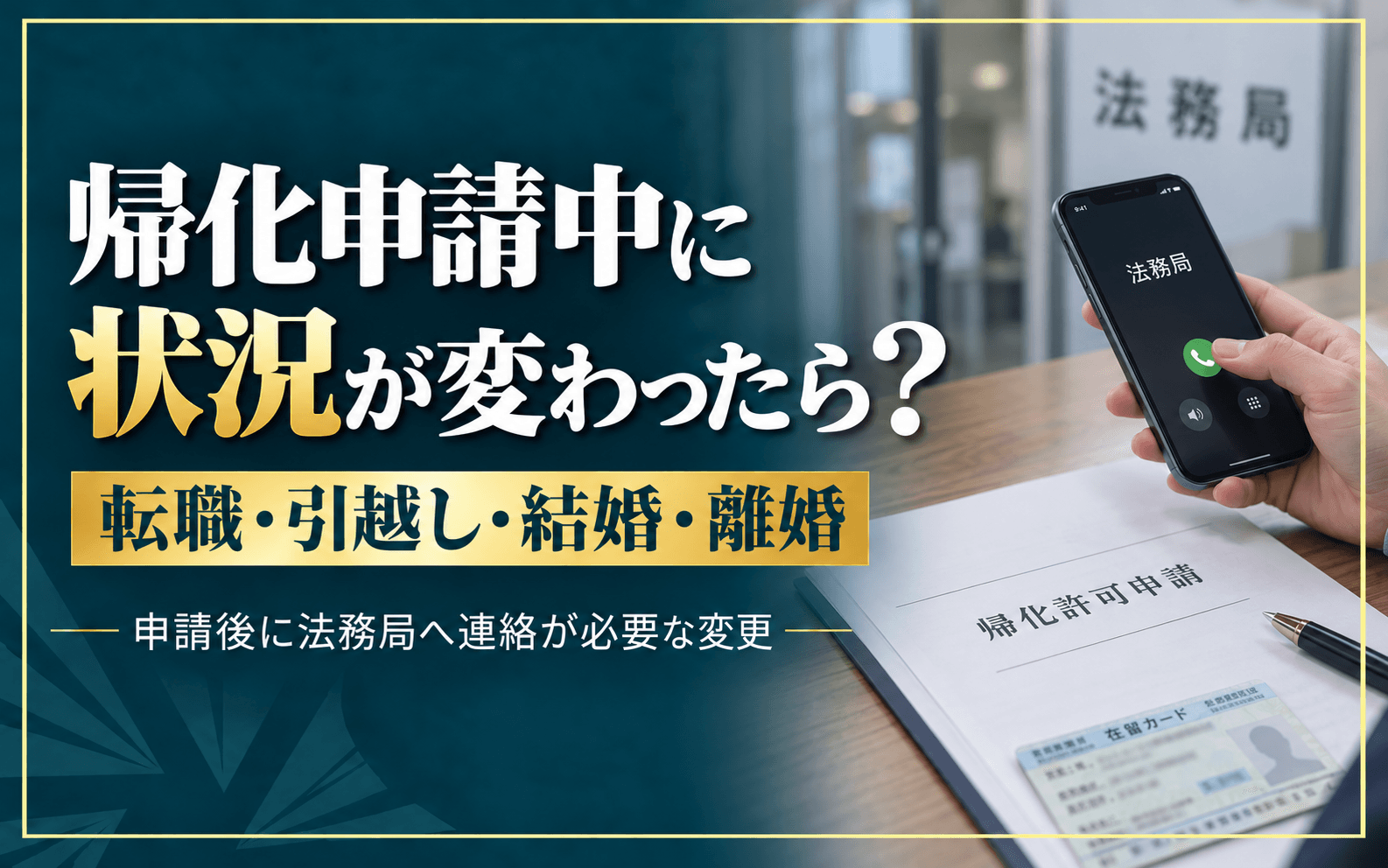
Changed Jobs, Moved, Married or Divorced While Your Japanese Naturalization Application Is Pending? What to Report 【2026 Guide】
“I changed jobs after my naturalization application was accepted.”
“Can I move while the application is still being examined?”
“Do I need to tell the Legal Affairs Bureau if I marry or divorce?”
“Can I travel overseas while my naturalization application is pending?”
Once a Japanese naturalization application has been formally accepted, applicants sometimes assume:
“Now I only need to wait for the result.”
That is not quite the case.
If your employment, address, family circumstances, immigration status or other important facts change during the examination, you should promptly contact the Legal Affairs Bureau officer handling your application.
The Legal Affairs Bureau’s naturalization guidance specifically lists a number of changes that applicants are expected to report after filing.
This article explains which changes should be reported and how they may affect the ongoing examination.
Filing the application does not mean there is nothing more to do
The examination continues after the naturalization application has been accepted.
During that period, circumstances involving your:
employment;
address;
family relationships;
status of residence;
travel history;
conduct;
income and household situation
may change.
Legal Affairs Bureau guidance instructs applicants to:
promptly contact the officer in charge
when information in the application or matters previously explained to the officer change, or when new relevant plans arise.
The important point is not simply that circumstances have changed.
It is also important to avoid:
allowing a material change to remain unreported.
Changes that should be reported to the Legal Affairs Bureau
The official guidance gives examples including:
change of address or contact details;
marriage, divorce, birth, acknowledgment of parentage or death;
adoption or dissolution of an adoption;
change or renewal of status of residence or period of stay;
plans to leave Japan;
re-entry after leaving Japan;
violations of law, including traffic violations;
change of employer, resignation or other employment changes;
a proposed change to the name or registered domicile to be used after naturalization; and
other circumstances that should be brought to the Bureau’s attention.
This does not mean:
every one of these events is automatically negative for the application.
The purpose is to allow the authorities to continue examining the case on the basis of the applicant’s current circumstances.
Changing jobs or resigning while the application is pending
Changing jobs during a naturalization examination is not unusual.
There is no published nationwide rule stating that:
a job change during the examination automatically results in refusal.
However, naturalization review includes the applicant’s livelihood, current occupation and stability of life in Japan.
A job change may affect matters such as:
employer;
employment type;
salary;
probationary period;
social insurance; and
whether the work is consistent with the current status of residence.
The Legal Affairs Bureau may therefore request updated documents such as:
a new certificate of employment;
employment contract;
recent payslips; or
social-insurance records.
What if I resign before finding my next job?
A temporary period without employment does not automatically determine the result.
However, the authorities may need to reassess:
how you are currently supporting your household.
Spouse income, savings and realistic re-employment plans may all become relevant.
Moving to a new address
A change of address is also something that should be reported.
Naturalization documents contain numerous items connected with the applicant’s residence, including:
current address;
resident record;
family information; and
household-finance information.
If you move after filing, tell the officer handling your application your new address.
Depending on the circumstances, you may be asked for updated documents such as:
a new resident record;
documents confirming the new address; or
a lease agreement.
Do not assume that moving means you should independently restart the application at another Legal Affairs Bureau.
Contact the officer currently handling the application first.
Marriage, divorce, birth and other family changes
Family relationships are important in naturalization review.
The official guidance specifically identifies changes including:
marriage;
divorce;
birth;
acknowledgment of parentage;
death;
adoption; and
dissolution of adoption.
For example, marriage may change:
spouse information;
household composition;
household income; and
family relationships.
The birth of a child may change the number of dependents and the household’s financial situation.
Divorce may affect not only civil-status records but also:
household finances, family relationships and, in some cases, the legal basis on which certain naturalization conditions were relaxed.
What if you divorce while relying on the Japanese-spouse special rules?
Particular care is needed where an applicant is relying on the statutory relaxation available to certain spouses of Japanese nationals.
Marriage to a Japanese national can, in qualifying cases, relax some of the ordinary naturalization requirements.
Accordingly,
if that marriage ends while the application is still under examination, the basis on which the application was being assessed may change.
Do not assume:
“I was still married when I filed, so a later divorce cannot matter.”
If divorce is planned or occurs, explain the circumstances to the officer and confirm how the application will be assessed under the applicant’s current situation.
Renewal or change of status of residence
Even after filing a naturalization application,
you remain a foreign national until Japanese nationality is actually acquired.
You must therefore continue to complete any required immigration procedures while the application is pending.
The Legal Affairs Bureau also instructs applicants to report changes or renewals involving:
status of residence; and
period of stay.
Examples may include:
renewing Engineer/Specialist in Humanities/International Services;
changing to a spouse status;
changing to Business Manager; or
receiving a different period of stay.
If a new residence card is issued, make sure the Legal Affairs Bureau receives the updated information.
Travelling overseas while the application is pending
A pending naturalization application does not automatically prohibit overseas travel or business trips.
However, the official guidance lists both:
plans to leave Japan
and:
re-entry after leaving Japan
as matters to be reported.
Particular attention may be needed for:
extended overseas business trips;
long stays in the applicant’s home country;
overseas assignments; or
frequent travel.
Such circumstances may also raise questions about the continuity of the applicant’s life and residence in Japan.
Do not assume a trip is too short to matter. Follow the instructions of the officer handling the case.
Traffic violations or other violations of law
A traffic violation occurring after filing should also be reported.
The official guidance expressly includes:
violations of law, including traffic violations.
Examples may include:
speeding;
failure to stop;
using a mobile phone while driving;
violations resulting in licence suspension; or
criminal matters.
A violation does not automatically mean that naturalization will be refused.
However, it may be relevant to the good-conduct requirement.
Information that appears unfavorable should not be concealed.
Changing your intended name or registered domicile after filing
Naturalization applications include the name and registered domicile the applicant intends to use after acquiring Japanese nationality.
An applicant may later decide:
“I want to use a different name.”
or:
“I want a different registered domicile.”
If that happens,
contact the Legal Affairs Bureau before permission is granted.
These details are relevant to the Japanese family register that will be created after naturalization.
Additional documents may be requested after a change
Once a change is reported, additional documents may be required depending on the circumstances.
For example:
Job change
new certificate of employment;
salary records;
documents showing employment conditions.
Move
updated resident record;
documents confirming the new address.
Marriage or divorce
documents confirming the marriage or divorce;
documents relating to the spouse;
foreign civil-status documents where necessary.
Birth of a child
birth-related documents;
documents showing the updated household composition.
However,
the required documents differ depending on the change and the Legal Affairs Bureau handling the case.
Rather than sending a large set of documents on your own initiative, first report the change and confirm what the officer actually requires.
Is there a 14-day deadline for reporting changes to the Legal Affairs Bureau?
This is often confused with immigration notification rules.
For changes during a naturalization application, Legal Affairs Bureau guidance says that applicants should contact the officer:
promptly.
This is separate from Immigration Services Agency rules that may, for example, require certain changes involving affiliated or contracting organisations to be reported within 14 days.
Therefore:
reporting a change to the Legal Affairs Bureau and making a statutory immigration notification are not necessarily the same procedure.
In some cases, both may be required.
What if you forgot to report a change?
If a relevant change occurred and you did not report it,
contact the officer once you realize the omission.
It is not advisable to continue withholding information because you are worried that reporting it late may look unfavorable.
Changes may also become apparent through updated resident records, tax records, social-insurance records, residence cards or family-status documents.
When contacting the Bureau, organize:
what changed;
when it changed;
why it was not reported earlier; and
your current circumstances.
Then explain the facts accurately.
Frequently Asked Questions
Q. Will changing jobs after filing cause refusal?
There is no published blanket rule stating that a job change automatically results in refusal.
However, income, employment stability, immigration status and social insurance may change, so the new circumstances should be reported.
Q. Do I need to report a move within the same city?
Yes.
A change of address is listed as a matter to be reported. The guidance does not distinguish based on the distance of the move.
Q. What if I marry during the examination?
Marriage is a change in civil status that should be reported.
The Legal Affairs Bureau may also request updated information about the spouse and household.
Q. Does divorce automatically cancel my application?
Not necessarily.
However, if the application relies on rules applicable to spouses of Japanese nationals, divorce may affect the basis of the examination and should be reviewed promptly.
Q. Do I need to report an ordinary overseas holiday?
The official guidance lists planned departure from Japan and subsequent re-entry as matters to be reported.
Confirm the procedure with the officer handling the application.
Q. I renewed my period of stay. Do I still need to tell the Legal Affairs Bureau?
Yes.
Changes or renewals to status of residence and period of stay are specifically listed among the matters to be reported.
Conclusion: do not leave changes unreported during a naturalization application
Even after your application has been accepted, you should promptly report matters such as:
changing jobs or resigning;
moving;
marriage or divorce;
birth of a child;
renewal or change of immigration status;
overseas departure and re-entry;
traffic or other legal violations; and
changes to your intended name or registered domicile.
The key is not to assume:
“If something changes, naturalization is impossible.”
The important point is to ensure that:
the Legal Affairs Bureau is examining the application on the basis of your current and accurate circumstances.
Some changes may have little effect, while others may affect livelihood, good conduct, family relationships or a statutory relaxation used in the application.
Enlight Administrative Scrivener Office can review not only eligibility before filing, but also changes that arise after filing, including job changes, divorce and relocation.
If:
“you changed jobs and are unsure whether your new income is sufficient,”
“you are planning to divorce your Japanese spouse,”
or:
“you have already experienced a change but have not yet informed the Legal Affairs Bureau,”
please contact us for an individual review.
Initial eligibility assessment is free.
Enlight Administrative Scrivener Office
Administrative Scrivener: Shiki Miyajima
Tel: 03-5284-7981
Office hours: Weekdays 10:00–18:00
Online consultations are available throughout Japan, including via WeChat.
References
Tokyo Legal Affairs Bureau, “Guide to Applications for Permission to Naturalize”
Saitama Legal Affairs Bureau, “Guide to Applications for Permission to Naturalize”
Ministry of Justice, “Application for Permission to Naturalize”
Tokyo Legal Affairs Bureau, “Documents to Be Attached to Naturalization Applications for Chinese Nationals”
※Naturalization decisions are made individually based on both the circumstances at filing and developments during the examination. The effect of a change and any additional documents required will depend on the individual application, so follow the instructions of the Legal Affairs Bureau handling your case.