Column

Column
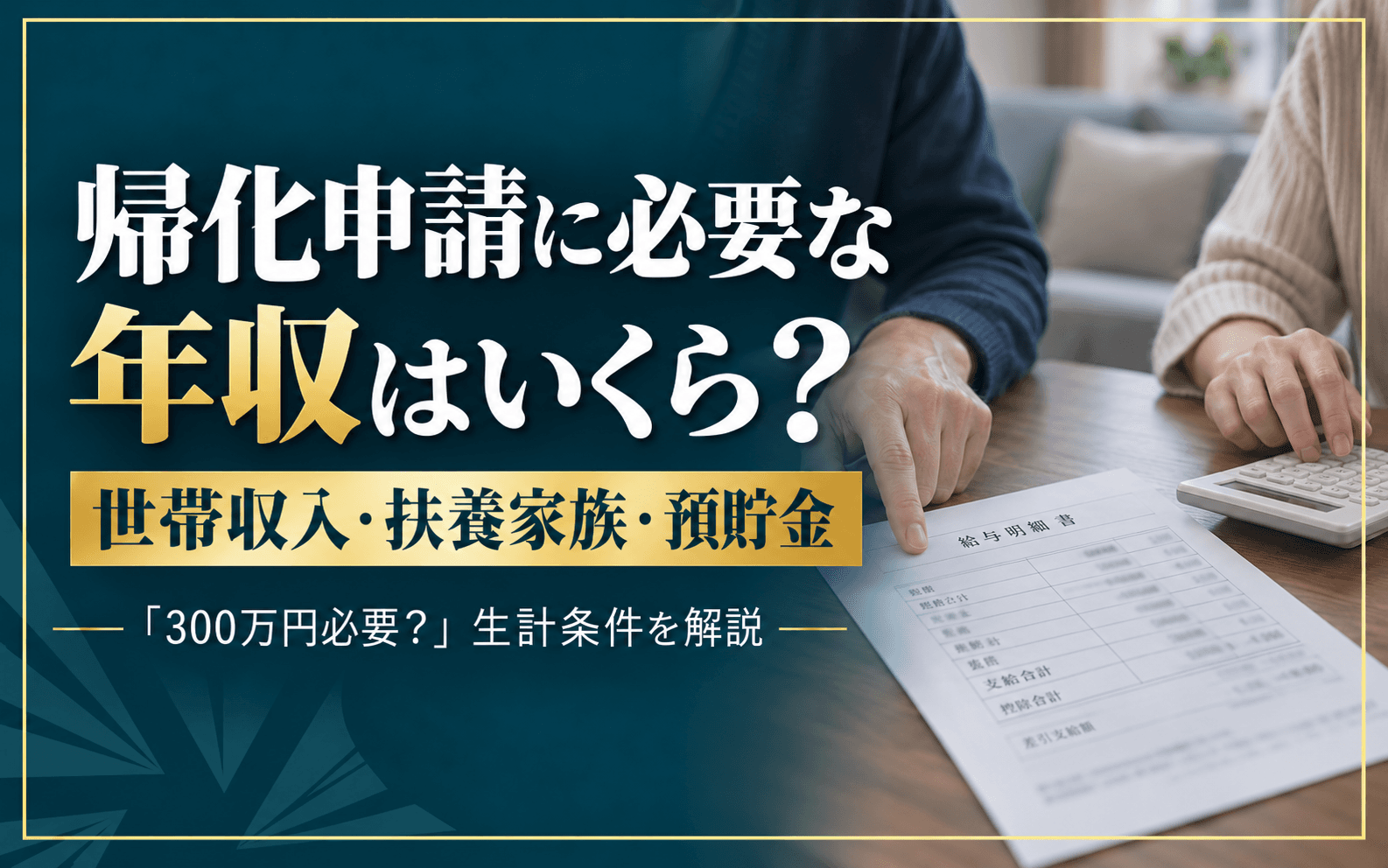
“Do I need to earn at least JPY 3 million a year to naturalize in Japan?”
“My income is relatively low, but my spouse has a stable job. Is that enough?”
“We have two children. Does having more dependents make naturalization difficult?”
“My income is not very high, but I have savings.”
Income is one of the most common concerns among people considering Japanese naturalization.
Online, you may see statements such as:
“You need at least JPY 3 million in annual income.”
or:
“You need an additional fixed amount for every dependent.”
However, as of 2026,
Japan does not publish a nationwide fixed minimum annual income for naturalization.
One of the general statutory requirements for naturalization is the livelihood requirement.
The Ministry of Justice explains that an applicant must be able to live in Japan without financial difficulty.
Importantly, this requirement is assessed:
not only on the applicant individually, but on the basis of relatives who share the same household economy.
This means that relevant factors may include:
the applicant’s income;
the spouse’s income;
total household income;
number of dependents;
rent or mortgage payments;
savings and other assets;
employment stability; and
monthly household expenses.
There is no published nationwide rule requiring a specific annual income
The first point to understand is that there is no official nationwide rule stating:
“If you earn more than JPY 3 million, naturalization is automatically fine,”
or:
“If you earn less than JPY 3 million, you cannot naturalize.”
The livelihood requirement is not determined by one number alone.
For example:
Annual income: JPY 3.5 million
Single household
Rent: JPY 70,000 per month
is very different from:
Annual income: JPY 3.5 million
Non-working spouse
Three children
Mortgage payments
Even though annual income is identical, the financial position of the two households is not.
Likewise, a relatively low personal income does not necessarily mean the requirement is not met where:
the spouse has stable income;
total household income is sufficient;
housing costs are low; or
the household has savings.
The more important question is:
whether the household can realistically maintain a stable life in Japan with its current income and expenses.
The livelihood requirement is assessed on a household basis
The Ministry of Justice expressly states that the livelihood requirement is assessed on the basis of relatives who share the same household economy.
Accordingly, the applicant personally does not necessarily need to be the main income earner.
For example:
Husband: employee, annual income JPY 5 million
Wife: full-time homemaker, no employment income
If the wife applies for naturalization, the fact that she earns no salary does not by itself mean that she fails the livelihood requirement.
If the husband’s income allows the household to maintain a stable life, that household position can be taken into account.
The same principle may apply where the household is supported by the assets or earning capacity of a spouse, parent or another relative sharing the same household economy.
Can a full-time homemaker apply for naturalization?
Yes.
Having no salary of your own does not automatically prevent naturalization.
The Ministry of Justice confirms that an applicant may satisfy the livelihood requirement where a spouse or another relative sharing the household has sufficient assets or earning capacity to support a stable life.
For a full-time homemaker, relevant matters may include:
the spouse’s annual income;
stability of the spouse’s employment;
total household expenses;
number of dependents;
savings; and
rent or mortgage payments.
However, if the applicant has no income and the spouse’s financial position is also unstable, application timing may deserve closer review.
What if you have several dependents?
Applicants often ask:
“How much income do I need if I have two children?”
There is no published nationwide formula stating:
“Add JPY X for every dependent.”
However, more dependents generally mean higher household expenses.
Relevant factors therefore include:
household size;
number of children;
housing costs;
education expenses;
spouse income; and
overall household cash flow.
An annual income of JPY 4 million may represent a very different financial position for a single person than for a household supporting a spouse and three children.
The question is therefore not simply:
“How much do I earn?”
but:
“Is this income realistically sufficient for this household?”
Can savings compensate for lower income?
Savings and other assets can be relevant to the livelihood requirement.
The Nationality Act itself refers to the assets or skills of the applicant or relatives sharing the same household economy.
Accordingly, factors such as:
substantial savings;
owning a home with low housing costs; or
assets held by a spouse
may contribute to the overall financial picture.
However, there is no published rule stating:
“If you have JPY 5 million in savings, it does not matter whether you currently have income.”
Naturalization assumes that the applicant will continue living in Japan.
Therefore, the review should also consider:
current income;
expected future employment;
monthly expenses;
household size; and
how sustainable the current financial position is.
What if your income fell after changing jobs?
Income records can be difficult to interpret immediately after a job change.
For example:
Previous year: JPY 5.5 million
Current year: changed jobs
Current salary: JPY 300,000 per month
The latest tax certificate may still reflect the previous higher income, while the applicant may not yet have a long salary record at the new employer.
The reverse can also happen.
An applicant may have been a student or earned very little in the previous year but now hold a stable full-time position.
In these cases,
neither the previous tax certificate nor one current payslip tells the whole story.
It may be necessary to review:
previous income;
current salary;
employment type;
probationary status;
continuity of employment; and
expected future income.
Do bonuses and overtime count?
Annual employment income may include:
base salary;
bonuses;
overtime; and
certain allowances.
However, for the livelihood requirement, it is useful to consider whether income is likely to continue.
If annual income was unusually high in one year because of substantial overtime or a one-off bonus, it may not be appropriate to assume that the same figure will continue every year.
Current salary structure and employment circumstances also matter.
How important is a spouse’s income?
Where spouses share the same household economy, spouse income can be very important.
This is particularly relevant where the applicant:
has low personal income;
is not currently employed;
is primarily responsible for childcare or household duties; or
has recently changed jobs.
In these cases, stable spouse income may demonstrate that the household as a whole can maintain a stable life.
However, this does not mean:
“A high-income spouse satisfies every naturalization requirement for the applicant.”
The applicant’s own:
immigration history;
taxes;
pension;
social insurance;
conduct; and
Japanese-language ability
remain separate considerations.
Household-based assessment applies specifically to the livelihood requirement.
When household income and living expenses do not appear to match
Naturalization applications include documentation describing the household’s financial situation.
This may involve organizing:
monthly income;
rent;
food expenses;
utilities;
education expenses; and
loan repayments.
For example:
Household income: JPY 250,000 per month
Rent: JPY 150,000
Three dependents
Additional loan repayments
may require further explanation as to:
how the household is actually meeting its living expenses.
By contrast, a household with a modest annual income may still be relatively stable if:
housing costs are low;
the spouse also works;
there are few dependents; and
savings are substantial.
What if you receive regular financial support from overseas?
If parents or other relatives overseas regularly send money to the household, it may be necessary to understand how that money fits into the family finances.
Particular care may be needed where:
the applicant and spouse’s own income does not appear sufficient to cover living expenses and the household relies heavily on overseas remittances.
Relevant issues may include:
who sends the money;
whether the support is likely to continue;
the purpose of the remittance; and
any relevant tax treatment.
Overseas assets and remittances are addressed separately in another article.
Should you wait to apply if your income is low?
This cannot be decided by annual income alone.
For example:
Applicant income JPY 2.8 million + spouse income JPY 5 million
is very different from:
Applicant income JPY 2.8 million + non-working spouse + three children.
Where several issues overlap—such as:
recent unemployment;
a substantial income drop after changing jobs;
unstable household income;
large monthly debt repayments; and
limited savings,
it may be more appropriate in some cases to wait until employment and income become more stable.
The key question is not only:
“Can I submit an application?”
but also:
“Is this the right time to apply?”
Situations where the livelihood requirement deserves particular attention
An individual review is especially useful where:
the applicant’s income is low;
the applicant is unemployed;
the applicant is a full-time homemaker;
there are several dependents;
the spouse also has low income;
the applicant recently changed jobs;
current income differs substantially from the previous year;
the household is living mainly from savings;
the household relies heavily on overseas support;
monthly loan repayments are high; or
living expenses are high relative to household income.
In such cases, the important issue is:
the stability of the household as a whole, rather than the applicant’s annual income in isolation.
Frequently Asked Questions
There is no published nationwide rule requiring a minimum annual income of JPY 3 million.
The livelihood requirement is assessed using the income and assets of the applicant and relatives sharing the same household economy.
There is no published rule automatically excluding applicants below JPY 3 million.
Household size, spouse income, housing expenses, savings and other circumstances also matter.
No personal salary does not automatically mean that the livelihood requirement is not met.
A stable household supported by the income or assets of a spouse or another relative may satisfy the requirement.
Savings can be relevant, but there is no fixed savings balance that automatically satisfies the requirement.
Future income, expenses and household circumstances should also be considered.
The number of children does not by itself determine the result.
However, more dependents generally increase household expenses, so the balance between income and household costs becomes important.
Yes. The livelihood requirement is assessed on a household basis, so spouse income and assets may be highly relevant.
Conclusion: for naturalization, household stability matters more than one annual-income number
Japanese naturalization does not have a published nationwide rule stating:
“Earn JPY X per year and you qualify.”
As the Ministry of Justice explains, the livelihood requirement is assessed on the basis of relatives sharing the same household economy.
The relevant picture may therefore include:
applicant income;
spouse income;
dependents;
housing costs;
savings;
monthly living expenses; and
employment stability.
A person with relatively low personal income may still have a stable household.
Conversely, an apparently adequate salary may require closer review where there are many dependents or substantial household expenses.
Enlight Administrative Scrivener Office reviews the livelihood requirement by looking not only at the applicant’s annual salary, but also at total household income, dependents, expenses and assets.
If you are unsure whether:
“my income is too low,”
“my spouse’s income can be taken into account,”
or:
“I should apply now or wait until my income becomes more stable,”
we can review your circumstances before you file.
Enlight Administrative Scrivener Office
Administrative Scrivener: Shiki Miyajima
Tel: 03-5284-7981
Office hours: Weekdays 10:00–18:00
Online consultations are available throughout Japan, including via WeChat.
Ministry of Justice, Nationality Q&A
Nationality Act
Tokyo Legal Affairs Bureau, Naturalization
Ministry of Justice, Main Documents Required for Naturalization
※Naturalization is assessed individually based on income, household structure, assets, occupation, taxes, social insurance, conduct and the applicant’s overall circumstances in Japan. Always confirm the latest instructions of the competent Legal Affairs Bureau before filing.
Related
Can you apply for Japanese Permanent Residence with a 3-year period of stay? In 2026, a 3-year period is still treated as satisfying the “maximum period of stay” requirement, but the rule changes from April 1, 2027. This guide explains the treatment of 1-, 3- and 5-year periods, transitional measures and visa renewals while PR is pending.
Read MoreWhat should you do if you change jobs, resign, move, marry, divorce, have a child, renew your status of residence or travel overseas while your Japanese naturalization application is under review? This guide explains the changes that should be reported promptly to the Legal Affairs Bureau and when additional documents may be required.
Read MoreCan freelancers and self-employed professionals qualify for Permanent Residence in Japan? This guide explains how Immigration reviews contract-based work, Engineer/Specialist in Humanities/International Services status, tax returns, resident tax, National Pension and National Health Insurance.
Read MoreLet's Start
Our scrivener carefully answers your visa and naturalization questions. Online consultations are available.