Column
Can Freelancers and Self-Employed Professionals Apply for Permanent Residence in Japan? Contracts, Taxes and Social Insurance 【2026 Guide】
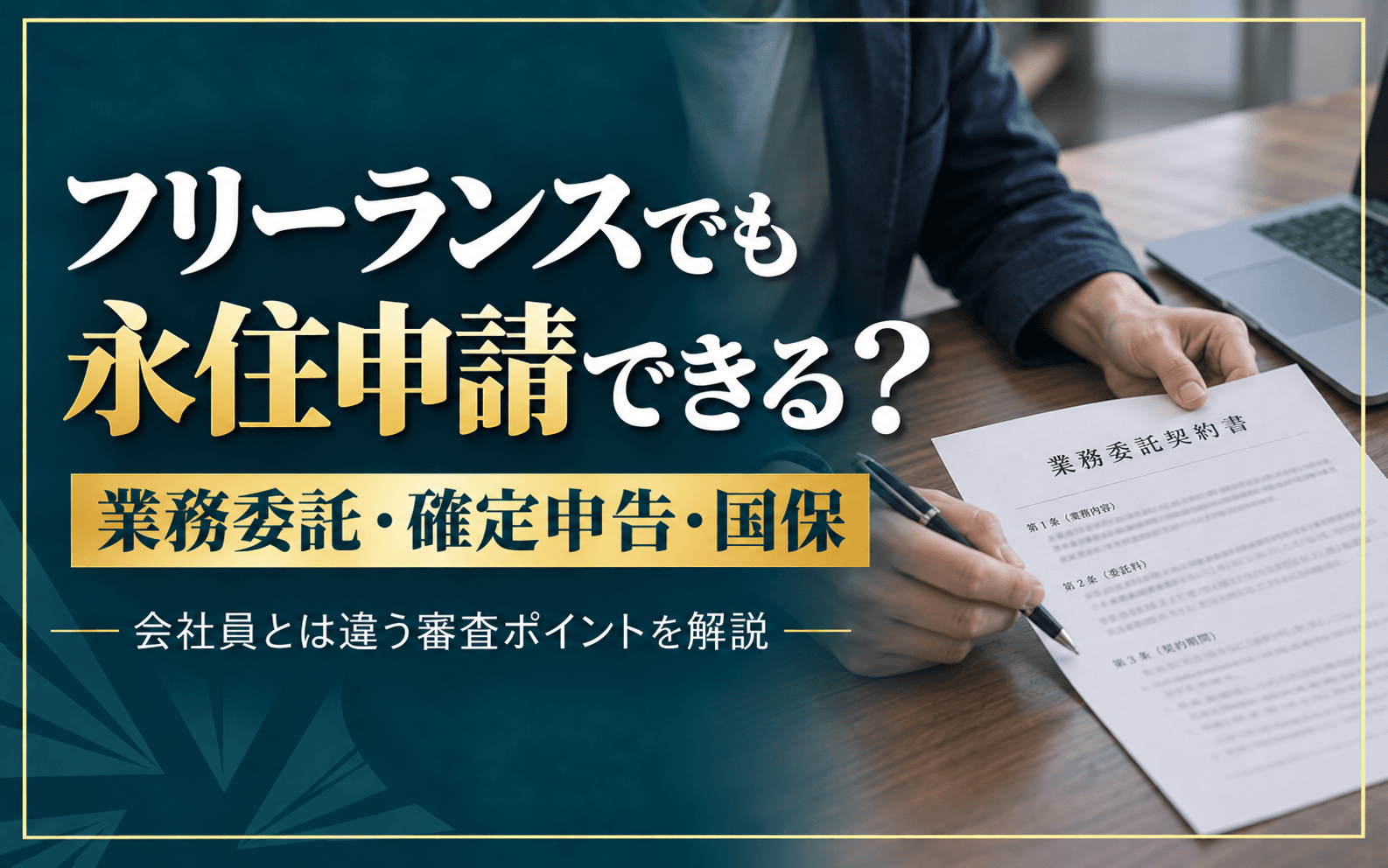
“I left my company and became a freelancer. Can I still apply for Permanent Residence?”
“I have an Engineer/Specialist in Humanities/International Services status but now work under service contracts.”
“My business revenue is high, but my taxable income is much lower after expenses.”
“I pay National Pension and National Health Insurance myself. Is that a disadvantage?”
Freelancers and self-employed professionals often have these concerns when considering Permanent Residence in Japan.
The starting point is simple:
being a freelancer or self-employed professional does not by itself prevent you from applying for Permanent Residence.
The Immigration Services Agency also provides documentation requirements for self-employed applicants, including copies of tax returns and, where applicable, business licences.
However, freelancers often need to manage their own:
immigration status, client contracts, income, tax filings, resident tax, pension and health insurance.
As a result, there are usually more issues to verify than for a conventional employee.
Freelancers can apply for Permanent Residence
Japan’s Permanent Residence Guidelines require applicants to have sufficient assets or skills to support an independent livelihood and circumstances indicating that a stable life can be expected in the future.
There is no requirement that an applicant must be a permanent employee.
For occupational evidence, Immigration distinguishes between:
employees, who normally submit a certificate of employment;
self-employed applicants, who may submit a copy of their tax return and relevant business licence; and
other cases, where an explanation of the occupation and supporting evidence may be required.
The important question is therefore not simply whether you are an employee or freelancer, but whether:
your work is lawful, continuing and capable of supporting a stable life.
“Freelancer” is not an immigration status
Freelancing is a working arrangement, not a Japanese status of residence.
For example, an individual holding Engineer/Specialist in Humanities/International Services must perform qualifying professional activities based on a contract with a public or private organisation in Japan.
Importantly, such a contract does not necessarily have to be an employment contract.
Mandate, outsourcing and similar contractual arrangements may also qualify.
Therefore:
moving from employment to contract-based work does not automatically make the existing work status invalid.
The actual duties and contractual structure still need to fit the status of residence.
Remaining on an Engineer/Specialist status after becoming self-employed
IT engineers, designers, marketers, translators and similar professionals sometimes leave employment and continue working through service contracts with several companies.
The key issue is:
whether the actual activity still falls within the scope of Engineer/Specialist in Humanities/International Services.
A professional providing specialist services to several companies under continuing contracts may be in a different position from someone whose primary activity has become operating a business, hiring employees or managing a commercial organisation.
Where the substance of the activity has shifted toward business management, it may be necessary to consider whether the existing status still reflects the actual activity.
Do not forget Immigration notifications when contracts change
For statuses including Engineer/Specialist in Humanities/International Services, certain changes involving contracting organisations generally need to be reported within 14 days.
These may include:
termination of a contract;
entering into a new contract; and
certain changes involving the contracting organisation.
Freelancers frequently have more than one client, so these notification requirements can be easier to overlook.
Permanent Residence screening also considers whether the applicant has properly complied with notification obligations under immigration law.
A person may therefore have perfectly legitimate work but still need to address whether past contract changes were properly reported.
Business revenue is not the same as employment income
A self-employed applicant may say:
“My annual revenue is JPY 8 million.”
However, revenue is not the same as personal income.
For example:
Revenue: JPY 8 million
Business expenses: JPY 4.5 million
does not represent the same financial position as an employee earning a salary of JPY 8 million.
PR applications use tax certificates and related records to confirm income and tax compliance.
Accordingly, it is important to look not only at gross sales, but also at:
income remaining after business expenses and whether that income has been stable over time.
Particular care may be needed where:
revenue is high but taxable income is low;
income fluctuates considerably;
there have been loss-making years; or
the business has only recently started.
What if you only recently became a freelancer?
Published Immigration guidance does not set a nationwide rule requiring a person to remain self-employed for a fixed number of years before applying for PR.
However, future financial stability remains part of the assessment.
A person with a long professional history and several continuing contracts immediately after becoming independent is therefore different from someone who has just resigned and has not yet established stable clients or income.
For newly independent applicants, the relevant question is not only:
“Can I submit an application?”
but also:
“Is this the right time to apply?”
Tax returns are particularly important
Employees often have their annual tax adjustment handled by their employer.
Freelancers and sole proprietors usually need to manage their own tax returns.
Immigration specifically lists a copy of the tax return as evidence of occupation for self-employed PR applicants.
Applicants should therefore verify that:
business income has been fully declared;
required income tax returns have been filed;
other taxable income has not been omitted; and
resident-tax records are consistent with the tax return.
Discovering undeclared income immediately before filing a PR application may require more than simply submitting a corrected return; the resulting tax-payment history also needs to be reviewed.
National taxes are also reviewed
For the ordinary work-status PR route, Immigration reviews national tax compliance, including categories such as:
withholding income tax and reconstruction special income tax;
self-assessed income tax and reconstruction special income tax;
consumption tax and local consumption tax;
inheritance tax; and
gift tax.
For self-employed applicants, taxes such as self-assessed income tax—and consumption tax where applicable—are often managed directly by the applicant.
It is therefore important to verify:
not only whether there is currently any unpaid tax, but whether the relevant taxes were properly declared and paid.
Be especially careful with resident tax paid personally
Employees commonly have resident tax withheld from salary.
A freelancer may instead pay resident tax directly under the ordinary collection system.
Where resident tax was not withheld from salary during a relevant period, Immigration may require evidence that it was paid at the proper time.
Examples may include:
bank debit records;
payment receipts; and
online banking transaction histories.
Paying the entire balance eventually does not necessarily remove the relevance of late payment.
Freelancers should therefore pay particular attention to resident-tax due dates.
Watch the transition to National Pension and National Health Insurance
After leaving employment, a freelancer may move from company social insurance to:
National Pension; and
National Health Insurance.
PR applications generally review recent payment records for public pension and public medical insurance.
One common risk is:
the transition period immediately after leaving employment.
If enrolment is delayed and several months of premiums are paid later in a lump sum, the timing of those payments may need closer review.
Is a service contract alone enough?
A service agreement may help demonstrate the nature and continuity of the work.
However, self-employed applicants generally need to substantiate their occupation themselves.
Depending on the case, relevant supporting evidence may include:
service agreements;
continuing client contracts;
invoices;
payment records;
tax returns;
business licences; and
documents explaining the business activity.
The appropriate evidence depends on the actual working arrangement.
Cases that deserve particular attention
Additional review is especially useful where:
you recently left employment to become a freelancer;
you remain on Engineer/Specialist status while working for several clients;
contract changes were not reported to Immigration;
revenue is high but taxable income is low;
you have loss-making years;
income fluctuates substantially;
you are unsure whether previous tax returns were correct;
you pay resident tax through ordinary collection;
you recently moved from Employees’ Pension and company health insurance to National Pension and National Health Insurance; or
you intend to incorporate the business.
These cases should be reviewed as a whole:
immigration status + income + taxes + social insurance.
Frequently Asked Questions
Q. Is PR harder for freelancers?
Freelancing itself is not a ground for refusal.
However, freelancers often need to demonstrate and manage their occupation, income, taxes, pension and health insurance directly, so the documentation can be more complex.
Q. Can I work under service contracts while holding Engineer/Specialist status?
The required contract is not limited to employment and may include mandate, outsourcing and similar arrangements.
However, the activities must fall within the permitted scope of the status, and the continuity of the contractual relationship should also be checked.
Q. Can I have several clients?
Having contracts with several organisations is not automatically prohibited.
However, the nature of the work, continuity of contracts and Immigration notification requirements need to be checked.
Q. Is high revenue enough for PR?
No.
Taxable income, historical income stability, household circumstances, taxes and social insurance also matter.
Q. I became self-employed six months ago. Can I apply?
There is no published nationwide rule requiring a fixed waiting period after becoming self-employed.
However, where income and client relationships are still unstable, the timing of the application may need closer consideration.
Q. Is it a problem if I am enrolled in National Pension and National Health Insurance?
Being enrolled in National Pension and National Health Insurance is not itself a problem.
What matters is whether the required enrolment procedures were completed and the premiums were paid properly and on time.
Conclusion: freelancer PR applications require more than an income check
Freelancers and self-employed professionals can apply for Permanent Residence in Japan.
The key difference from a conventional employee is that the applicant often needs to explain and prove more of the overall picture personally.
Important points include:
whether the work fits the current status of residence;
whether client contracts are stable;
whether required Immigration notifications were made;
whether tax returns are accurate;
whether income is sufficiently stable;
whether resident tax was paid on time; and
whether pension and health-insurance contributions are up to date.
Enlight Administrative Scrivener Office reviews freelancer and self-employed PR cases by considering the applicant’s status of residence, client contracts, tax filings, taxes, pension and health insurance together.
We can also assess whether:
applying now or waiting until the independent business has become more stable
is more appropriate for the circumstances.
If you are concerned that:
“I only recently became a freelancer,”
“I am working under service contracts while remaining on Engineer/Specialist status,”
or:
“My revenue is good, but my taxable income is relatively low,”
you can consult us before filing.
Enlight Administrative Scrivener Office
Administrative Scrivener: Shiki Miyajima
Tel: 03-5284-7981
Office hours: Weekdays 10:00–18:00
Online consultations are available throughout Japan, including via WeChat.
References
Immigration Services Agency of Japan, “Guidelines for Permanent Residence Permission”
Immigration Services Agency of Japan, “Application for Permanent Residence”
Immigration Services Agency of Japan, “Engineer/Specialist in Humanities/International Services”
Immigration Services Agency of Japan, “Immigration and Residence Examination Q&A”
Immigration Services Agency of Japan, “Notification Concerning the Affiliated/Contracting Organisation”
※Actual treatment varies depending on the applicant’s current status of residence, work activities, contract structure, income, tax compliance and social-insurance history. The latest official guidance and individual circumstances should be checked before filing.