Column
Does Japanese Permanent Residence Require Japanese Ability? B1, JLPT and Exceptions from April 2027 【2026 Update】
Japan’s new permanent residence guidelines consider B1-equivalent Japanese ability from April 2027. Understand why passing JLPT N3 is not always B1, the exceptions for certain highly skilled applicants, school histories and children, and how to prepare records without confusing test scores with immigration evidence.
“Will I need JLPT N3 to apply for permanent residence?” “Do spouses of Japanese nationals, highly skilled applicants and children face the same rule?” Japanese ability is an important preparation question for applications planned from April 2027.
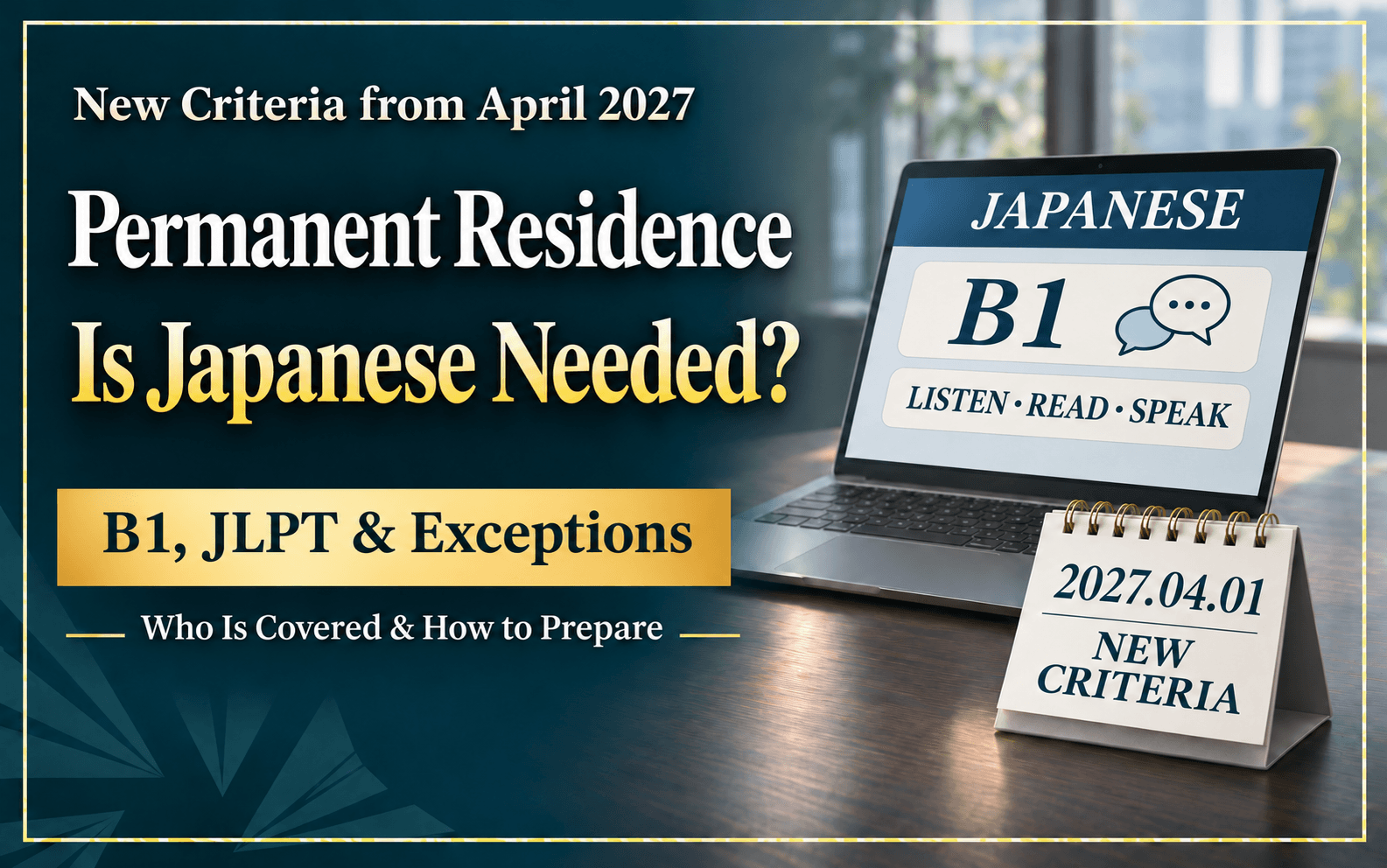
The guidelines revised on October 1, 2026 identify B1-equivalent or higher ability under Japan’s Reference Framework for Japanese-Language Education as a consideration. They do not simply direct every applicant to take one identical test, and they describe situations where this factor is not considered.
Using official information checked as of November 19, 2026, this article separates timing, B1 and JLPT, exceptions and preparation. A test’s reference level and the evidence accepted for permanent residence are different questions.
When does the B1 consideration begin?
The revised guidelines as a whole apply in principle to applications made on or after April 1, 2027. Do not confuse the Japanese-language provision with income-related provisions that apply earlier.
Check the guidance applicable to your filing date. Japanese ability is one part of an overall assessment; filing before the new B1 provision applies does not remove the need to satisfy the other conditions.
B1 describes what you can do in Japanese
The Reference Framework describes ability through language activities. B1 is an independent-user level, involving matters such as understanding key points on familiar subjects and giving a reasonably connected account of experiences and ideas.
It is not measured simply by counting known kanji or study hours. Alongside reading and listening, practise explaining and interacting in everyday and work situations. These are preparation suggestions, not a claim that particular study hours or materials constitute accepted immigration evidence.
Passing JLPT N3 is not automatically B1
Under the JLPT’s official CEFR reference indication, successful N3 candidates with total scores of 95–103 receive A2, while those with 104 or more receive B1. The fact of passing N3 alone does not establish a B1 indication.
The indication is for successful candidates, so a total score alone is insufficient if the JLPT pass conditions are not met. Review the level, total score, result and test date together.
A JLPT reference indication is not the immigration evidence rule
The JLPT indication relates to the language knowledge, reading and listening that the test measures. It does not certify every skill, including speaking, writing and interaction that the JLPT does not test.
The permanent residence guideline sets out the B1-equivalent consideration. That provision alone does not settle every accepted test, score, treatment of older results or detailed verification procedure.
Do not assume “N3 with 104 points guarantees the permanent residence language assessment” or transfer evidence rules from another residence procedure without checking. Confirm the latest instructions specifically for permanent residence.
Highly skilled applicants and school-history exceptions
The guideline identifies certain highly skilled foreign nationals under Part 3, items 6–8 and their families, and people with at least six cumulative years of primary or secondary education prescribed by the School Education Act, among situations where language ability is not considered.
Check the relevant category and facts, including points and residence history, rather than relying only on the name of your current status. For education, identify the institution, course and dates; six years at university or a Japanese-language school should not simply be treated as the stated primary-or-secondary category.
This concerns the language factor. It does not waive all other permanent residence conditions or guarantee permission.
Children born in Japan and spouses of Japanese nationals
For a Permanent Resident’s child, the example requires birth in Japan and B1-equivalent or higher Japanese ability of a parent raising the child. Being a child, or being born in Japan, does not by itself establish identical treatment for everyone.
Nor does marriage to a Japanese national alone establish that the language factor is excluded. Exceptions concerning conduct, livelihood or years of residence are separate from language treatment. Review any relevant school history or other circumstances as well.
Older JLPT results and certificates without CEFR indications
CEFR reference indications apply to successful candidates taking the test from December 2025 onward; results from July 2025 or earlier do not show them. Absence of the indication does not itself invalidate an earlier pass or establish a lack of ability.
The JLPT says its certification has no expiry date. That is separate from the dates and forms of evidence requested for permanent residence. Keep records showing the test date, level and score and check the receiving authority’s instructions.
Do not edit a score document to add your own CEFR indication. Using an older score and a correspondence chart as a learning reference is different from obtaining an official result certificate.
Understanding life rules is a separate consideration
The revised guidelines separately consider understanding of Japanese systems and rules. An exception for the language factor should not be assumed to exclude the other considerations as well.
Exposure to Japanese used for housing, work, taxes, insurance and daily procedures can support preparation. Check official instructions for the particular method used to confirm understanding of systems and rules.
Records and learning you can prepare now
Start with your planned filing date, current status, residence history, possible highly skilled category, education and family circumstances. Assess any potential exception before deciding what preparation you need.
Organize test dates, levels, results and scores, and school names, courses and enrollment or completion dates. These are consultation-preparation examples, not a direction for everyone to order every possible certificate immediately.
Alongside test preparation, practise asking questions, explaining key points and reading and responding to everyday notices. Do not assume a course-completion certificate or self-assessment alone satisfies the immigration evidence requirements.
Choose a filing date after reviewing the other conditions too
Do not rush an application, or give up automatically, because of the language provision alone. Review residence years and period of stay, income, taxes, pension, health insurance, notifications and family circumstances together.
For a filing from April 2027 onward, revisit official document and operational guidance before submission as well as when preparation starts. Check your possible exception and the required proof separately.
Frequently Asked Questions (FAQ)
Q1. Does the new B1 provision apply to an application filed during 2026?
The revised guidelines as a whole apply in principle from April 1, 2027. Distinguish this from earlier application of income-related provisions and check the guidance for your filing date.
Q2. Does an N3 pass always mean B1?
No. The official reference indication for successful N3 candidates is A2 at 95–103 and B1 at 104 or higher. A pass alone does not establish B1.
Q3. Will N3 with 104 points guarantee permanent residence?
No. The test indication and immigration evidence rules differ, and the other permanent residence conditions are also assessed.
Q4. Does holding Highly Skilled Professional status mean no Japanese test is needed?
Check the actual categories under Part 3, items 6–8 and the family treatment. The name of the current status alone should not replace that review.
Q5. Do six years at a Japanese university or language school establish the education exception?
The stated example concerns six cumulative years of primary or secondary education under the School Education Act. University or language-school years cannot simply be substituted.
Q6. Is a spouse of a Japanese national automatically exempt from the language consideration?
The guideline does not establish a blanket exclusion based on marriage alone. Separate the language question from conduct, livelihood and residence-period exceptions.
Q7. Is an old pass certificate invalid because it has no CEFR indication?
No. Absence of the indication does not itself invalidate the pass. Separately confirm the age and form of evidence requested for permanent residence.
Q8. Can I use a language-class completion certificate or self-assessment?
The guideline reviewed for this article does not establish blanket acceptance of those documents. Keep learning records and check the formal permanent residence submission instructions.
Conclusion
From April 2027, B1-equivalent Japanese ability is a consideration in permanent residence applications, with situations where the factor is not considered. An N3 pass, a B1 reference indication and immigration evidence requirements are different matters. Organize your filing date and personal history and prepare in line with current official guidance.
Consult us about permanent residence
Enlight Administrative Scrivener Office can help organize your intended filing date, residence history, highly skilled category, education and family circumstances, and identify matters to confirm for permanent residence. The initial consultation is free. Questions about language treatment can be reviewed alongside the other application conditions.
Enlight Administrative Scrivener Office | Administrative Scrivener 宮島 詩卉
Telephone: 03-5284-7981 | Weekdays 10:00–18:00
Free consultation and enquiries
Related articles
References
Immigration Services Agency: permanent residence guidelines revised October 1, 2026
Immigration Services Agency: permanent residence and application timing
Japan Foundation: CEFR reference indications for JLPT results
MEXT: key points of the Reference Framework for Japanese-Language Education
※This general explanation is based on public information checked as of November 19, 2026. The revised guidelines as a whole, including the B1 provision, apply in principle to applications from April 1, 2027. A test’s reference indication and immigration evidence requirements are not identical. Check current document and operational guidance. No individual exception, acceptance or permission is guaranteed.