Column
Can You Apply for Japanese Permanent Residence After Long or Frequent Trips Abroad? Understanding “Continuous Residence” 【2026 Update】
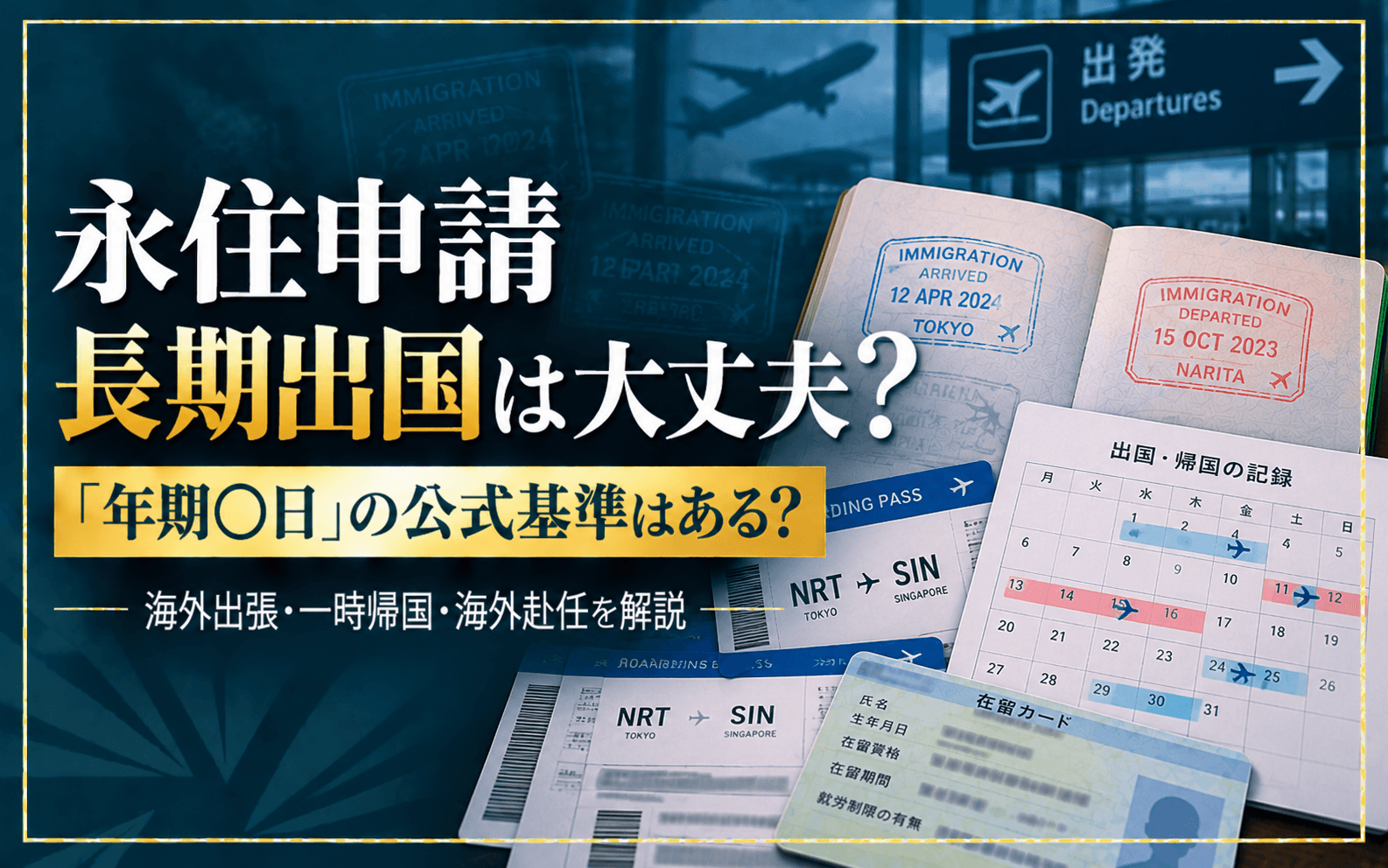
“I travel overseas frequently for work. Can I still apply for PR?”
“I once stayed in my home country for almost six months.”
“I had re-entry permission. Does that mean my residence period was uninterrupted?”
The important point is:
there is no published nationwide PR rule setting one fixed maximum number of days abroad per year.
There Is No Official “X Days Abroad Is Safe” Rule
Online sources sometimes refer to particular numbers of days abroad.
However, the current Permanent Residence guidelines do not publish a uniform rule saying:
“If you spend fewer than X days overseas, continuous residence is automatically satisfied.”
Relevant circumstances can include:
Length of each absence
Frequency of travel
Total time overseas
Reason for travel
Employment in Japan
Residence maintained in Japan
Where the family lived
Actual center of daily life
1. The General Rule Requires 10 Consecutive Years
Ordinary work-status applicants generally need:
at least 10 consecutive years of residence in Japan
including:
at least five consecutive years under an eligible work or residential status.
The analysis therefore involves more than simply counting ten years from the date of first arrival.
A Temporary Trip Abroad Does Not Automatically Reset Everything
Leaving Japan temporarily does not mean that all previous residence history necessarily disappears immediately.
Japan has re-entry permission and special re-entry permission systems that allow eligible residents to leave and return.
However:
the right to re-enter Japan
and
the PR assessment of continuous residence
are not identical questions.
Does Re-Entry Permission Mean You Can Live Abroad for a Long Time?
Not necessarily.
Re-entry permission concerns the ability to return to Japan while maintaining the relevant immigration framework.
Permanent Residence also requires consideration of the applicant’s actual connection to life in Japan.
A person who technically maintains status but spends most of the year living abroad may therefore require closer review.
2. Frequent Overseas Business Trips
Frequent work travel does not automatically prevent PR.
Relevant matters may include whether:
The applicant remains employed by a Japanese company
Salary continues from the Japanese employer
A residence remains in Japan
The family remains in Japan
Japan continues to be the applicant’s primary work and living base
A business trip ordered by a Japanese employer may present different circumstances from effectively relocating overseas.
3. Overseas Assignments
Long-term overseas assignments can require more careful review than ordinary business travel.
For example, where an applicant moves abroad with the entire family and establishes a home there for several years, the actual center of life may need to be examined carefully.
Holding a valid residence card alone does not resolve that question.
Long Visits to Your Home Country Also Depend on the Circumstances
Long absences may occur because of:
Caring for family members
Childbirth
Family emergencies
Funerals
Extended leave
The reason and surrounding circumstances matter.
4. Returning Home for Childbirth
A person may return to their country of nationality for childbirth and remain there for several months.
That does not automatically mean PR is impossible.
Relevant matters can include:
Departure and re-entry dates
Where the spouse lived
Whether a home was maintained in Japan
Reason for the absence
Life after returning to Japan
Keeping a Japanese Resident Record Is Not Automatically Enough
A registered address in Japan is one piece of information.
It does not by itself establish that the applicant’s actual life remained continuously based in Japan.
The real living circumstances also matter.
5. Family Remaining in Japan
Where the applicant travels or works overseas while a spouse, children, and the family home remain in Japan, the circumstances differ from a full family relocation overseas.
However, there is no rule stating that family remaining in Japan makes any length of absence automatically acceptable.
6. Long Absences for Single Applicants
Single applicants can still establish strong life ties to Japan through matters such as:
Employment
Housing
Salary
Taxes
Social insurance
Reason for travel
Employment after returning
Marital status alone does not determine the outcome.
Taxes, Pension, and Health Insurance May Also Need Review
Long overseas stays can affect:
Resident tax
Pension
Health insurance
Employee social-insurance enrollment
Permanent Residence also reviews proper fulfillment of public obligations.
Applicants should therefore avoid assuming that these matters are irrelevant simply because they were physically outside Japan.
7. Resigning From a Japanese Job During the Overseas Period
A long absence combined with resignation from the Japanese employer can create additional issues.
The review may need to cover:
The five-year work/residential-status requirement
Current immigration status
Pension and health insurance
Affiliated-organization notifications
Continuity of life in Japan
Passport Travel Dates Alone Do Not Answer the Question
Travel records are important, but simply totaling the number of days abroad may not be enough.
Ninety days accumulated through many short business trips may reflect a different living pattern from one continuous 90-day stay abroad.
The reasons for travel also differ.
Highly Skilled Routes Still Require Continuity
Highly Skilled Professional routes can shorten the general residence requirement to three years at 70 points or one year at 80 points.
However, the official framework still refers to carrying out qualifying highly skilled activity continuously for the relevant period.
A high point score therefore does not make overseas residence irrelevant.
Spouse Routes Also Have a One-Year Japan Requirement
Certain spouses of Japanese nationals, Permanent Residents, and Special Permanent Residents can use the three-year marriage / one-year Japan exception.
The one-year element requires continuous residence in Japan.
Long absences during that period may therefore require review.
Focus on the Actual Residence History, Not a Rumored Day Limit
Before applying, review:
First arrival in Japan
Complete travel history
Reasons for long absences
Employment in Japan
Housing in Japan
Family location
Tax and social insurance
Life after returning
For applicants with significant overseas travel, the central question is not:
“Am I below an unofficial safe number of days?”
but:
“Does my overall residence history satisfy the current PR framework?”
Cases That Particularly Deserve Pre-Filing Review
Professional review may be particularly useful where the applicant:
Spent several consecutive months overseas
Regularly spends substantial time abroad
Travels internationally very frequently
Had an overseas assignment
Returned home for childbirth or medical reasons
Moved overseas with the entire family
Resigned from a Japanese employer while abroad
Uses the HSP one-year or three-year route
Is close to the spouse-route one-year Japan threshold
Frequently Asked Questions
Q. Does Spending More Than 100 Days Abroad Per Year Prevent PR?
The official Permanent Residence guidelines do not publish a nationwide 100-day rule.
Q. Does a Three-Month Absence Reset the 10 Years?
No uniform published three-month reset rule appears in the current guidelines.
Q. I Had Re-Entry Permission.
Re-entry permission does not by itself guarantee satisfaction of the PR continuous-residence requirement.
Q. I Travel Overseas Frequently for Work.
That does not automatically prevent PR. The frequency, duration, and continuing life base in Japan need to be reviewed.
Q. I Spent Six Months Abroad for Childbirth.
The six-month figure alone is not enough to determine eligibility. The reason and overall circumstances should be reviewed.
Q. I Kept My Resident Registration in Japan.
Resident registration alone does not automatically establish continuous residence for PR purposes.
Q. Do Overseas Absences Matter for the 80-Point HSP Route?
Yes. The shortened route does not eliminate the need to review continuity of qualifying residence and activity.
Long Absences Should Not Be Judged by Day Count Alone
Permanent Residence requires continuous residence in Japan, but the current official guidelines do not provide one simple nationwide limit such as:
“No more than X days abroad per year.”
Applicants with business travel, overseas assignments, long visits home, childbirth abroad, or family-related absences should review the entire residence history and actual life base in Japan.
Enlight Administrative Scrivener’s Office can review travel history, reasons for long absences, employment, housing, family circumstances, taxes, social insurance, and eligibility under the HSP or spouse routes before filing.
The initial Permanent Residence eligibility check is free of charge.
Permanent Residence support is generally limited to applicants within the jurisdiction of the Tokyo Regional Immigration Services Bureau.
References
Immigration Services Agency: Guidelines for Permission for Permanent Residence, revised February 24, 2026
Immigration Services Agency: Immigration and Residence Examination Q&A
Immigration Services Agency: Re-Entry Permission
Immigration Services Agency: Special Re-Entry Permission
Immigration Services Agency: Preferential Immigration Treatment for Highly Skilled Foreign Professionals