Column
Do Traffic Violations Affect Japanese Permanent Residence? Penalty Payments, Criminal Fines, and License Suspension Explained 【2026 Update】
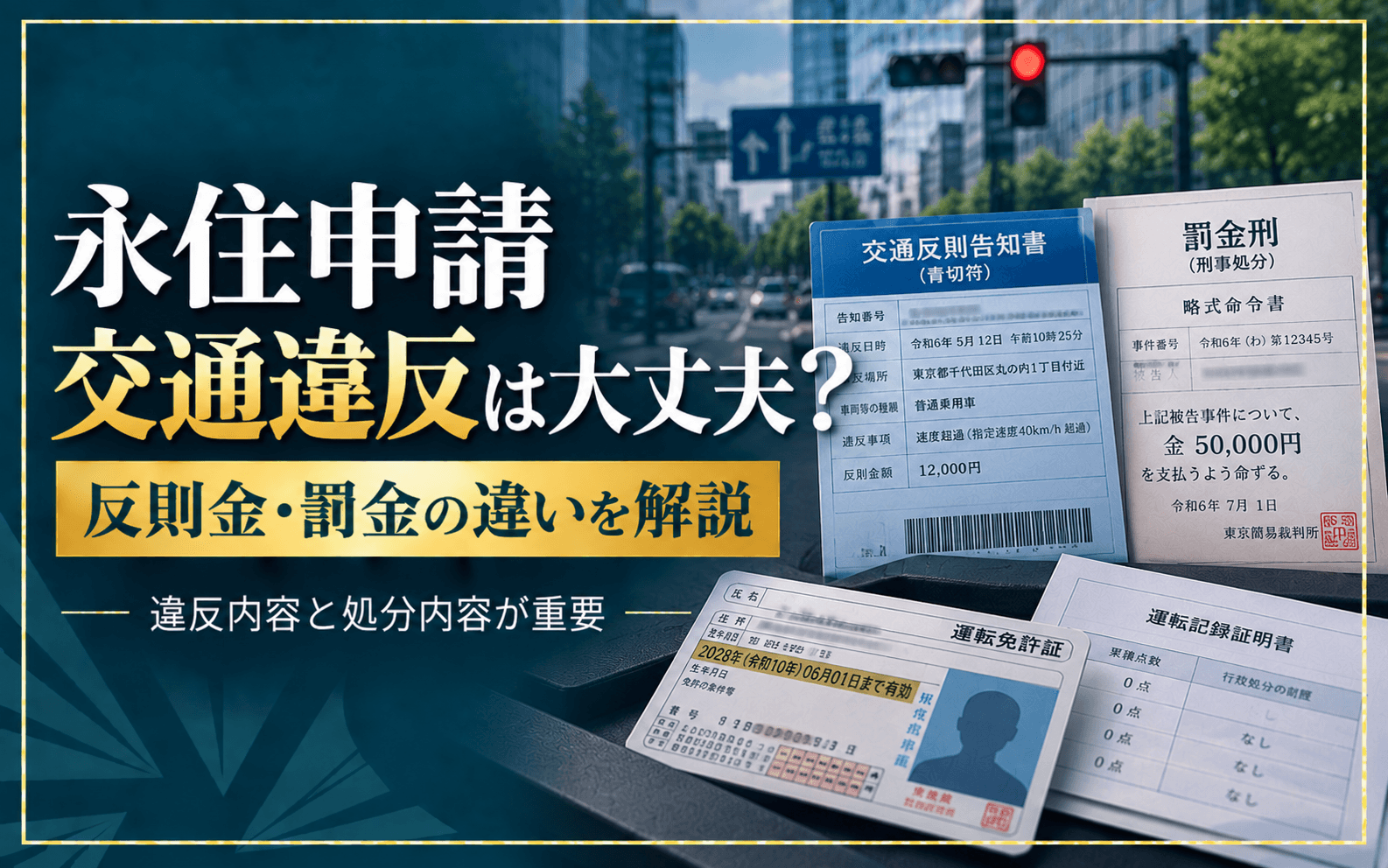
“I received a blue traffic ticket. Can I still apply for Permanent Residence?”
“I once paid a fine for a traffic offense.”
“My license was suspended. Will that affect PR?”
The first important distinction is between:
a traffic penalty payment
and
a criminal fine.
They are not legally the same thing.
Does One Traffic Violation Automatically Prevent Permanent Residence?
No nationwide rule states that one traffic violation automatically results in refusal.
Relevant circumstances can include:
Nature of the violation
Type of disposition
Number of incidents
When they occurred
Repeated conduct
Whether criminal punishment was imposed
Traffic Penalty Payments and Criminal Fines Are Different
1. Blue-Ticket Traffic Penalty Payments
Certain relatively minor traffic violations can be handled through Japan’s Traffic Infraction Notification System.
When the prescribed penalty payment is made within the required period, the case generally does not proceed to criminal prosecution.
Accordingly:
a blue-ticket penalty payment is not the same as a court-imposed criminal fine.
Bicycle Blue Tickets From April 2026
From April 1, 2026, the traffic infraction system also applies to certain bicycle violations committed by persons aged 16 or older.
Where the penalty payment is properly made, the case generally does not proceed through the criminal process.
2. Criminal Fines
Serious traffic violations may instead proceed through the criminal justice system.
Where a court imposes a criminal fine, this is materially different from a routine blue-ticket penalty payment.
The current Permanent Residence guidelines expressly state that an applicant should not have received criminal fines or custodial sentences and similar punishment.
Drunk Driving and Driving Without a License Require Particular Care
Examples of more serious traffic conduct include:
Drunk driving
Driving under the influence
Unlicensed driving
Dangerous obstruction
Serious traffic offenses involving accidents
Where such conduct resulted in criminal punishment, the case should not be treated like a minor blue-ticket violation.
What About License Suspension?
License suspension and revocation are administrative measures under the driver-licensing system.
A suspension does not by itself prove that a criminal sentence was imposed.
However, the underlying conduct that caused the suspension matters.
Do You Need a Gold Driver’s License?
No official Permanent Residence requirement says that applicants must hold a gold driver’s license.
There is also no published nationwide numerical rule such as:
“X points means refusal”
or:
“X traffic violations are acceptable.”
Repeated Minor Violations Can Be Different From a Single Incident
Permanent Residence includes a good-conduct assessment.
Repeated violations over a short period may therefore require closer consideration than a single isolated incident.
No nationwide official threshold specifying an acceptable number of violations has been published.
What About Parking Violations?
Parking-related cases can be handled under different legal mechanisms.
A traffic penalty payment, a vehicle-owner payment, and criminal proceedings should not be treated as identical.
The actual disposition needs to be checked.
What About Bicycle Violations?
Since April 2026, certain bicycle violations can result in blue tickets.
Paying the prescribed traffic penalty under that system does not itself result in a criminal conviction.
However, repeated dangerous conduct can still be relevant to an overall good-conduct assessment.
Traffic Offenses With and Without Criminal Convictions
A useful distinction is:
Blue ticket + timely traffic penalty payment
Generally resolved without criminal prosecution.
Criminal proceedings + criminal fine or other sentence
A criminal punishment has been imposed.
This distinction matters because the current Permanent Residence guidelines expressly refer to criminal fines and custodial sentences.
What If You Caused a Traffic Accident?
An accident cannot be assessed simply from the fact that an accident occurred.
Relevant circumstances can include:
Property damage or bodily injury
Degree of negligence
Criminal disposition
Administrative license action
Conduct after the accident
How Many Years Should You Wait After a Traffic Offense?
The Immigration Services Agency does not publish a nationwide fixed waiting period such as:
“X years after a blue ticket”
or:
“X years after a criminal fine.”
Informal rules found online should therefore not be treated as official approval standards.
The actual offense, sentence, timing, frequency, and subsequent conduct need to be reviewed.
Do Not Hide Serious Traffic or Criminal History
Permanent Residence applications must be based on accurate information.
Where Immigration asks for information about past violations or criminal dispositions, applicants should provide accurate explanations.
Cases involving criminal punishment should be reviewed before filing.
Remember the Other Permanent Residence Requirements
Traffic history is only one part of the application.
Authorities also review matters such as:
Residence history
Employment and income
Resident tax
National tax
Pension
Health insurance
Immigration notifications
Current period of stay
Compliance with the current status of residence
Pre-Application Traffic Checklist
Review:
Date of violation
Type of violation
Blue-ticket or criminal proceeding
Traffic penalty or criminal fine
License suspension or revocation
Traffic accidents
Criminal sentence
Any later violations
Frequently Asked Questions
Q. I Have One Blue Ticket. Can I Apply?
No published rule automatically refuses an application because of one blue-ticket violation.
Q. What Is the Difference Between a Traffic Penalty and a Criminal Fine?
A traffic penalty is part of an administrative shortcut for certain minor traffic violations.
A criminal fine is a criminal sentence imposed through the criminal justice system.
Q. I Received a Criminal Fine for a Traffic Offense.
Current Permanent Residence guidelines expressly refer to applicants not having received criminal fines and similar punishment. The individual disposition and timing should be reviewed carefully.
Q. My License Was Suspended.
Review the conduct that caused the suspension and whether criminal punishment was also imposed.
Q. I Have Two Speeding Violations.
No published nationwide rule determines PR solely from a fixed number of violations.
Q. I Have a Criminal Fine for Drunk Driving.
This should be treated as a serious traffic offense involving criminal punishment and reviewed carefully.
Q. How Long Must I Wait?
No uniform nationwide waiting period has been officially published.
Q. Does a Bicycle Blue Ticket Create a Criminal Record?
Where the case is resolved through the Traffic Infraction Notification System by paying the prescribed penalty, it does not itself result in a criminal conviction.
The Key Question Is the Actual Legal Disposition
For Permanent Residence, do not stop at asking:
“Have I ever had a traffic violation?”
The more useful questions are:
Was it a traffic penalty or a criminal fine? Was the offense minor or serious? Was it isolated or repeated?
Enlight Administrative Scrivener’s Office can review traffic history, criminal dispositions, and the applicant’s other Permanent Residence requirements before filing.
The initial Permanent Residence eligibility check is free of charge.
Permanent Residence support is generally limited to applicants within the jurisdiction of the Tokyo Regional Immigration Services Bureau.
References
Immigration Services Agency: Guidelines for Permission for Permanent Residence, revised February 24, 2026
Immigration Services Agency: Permanent Residence Application
National Police Agency: Traffic Infraction Notification System
National Police Agency: New Bicycle Traffic Rules
National Police Agency: Bicycle Traffic Enforcement