Column

Column
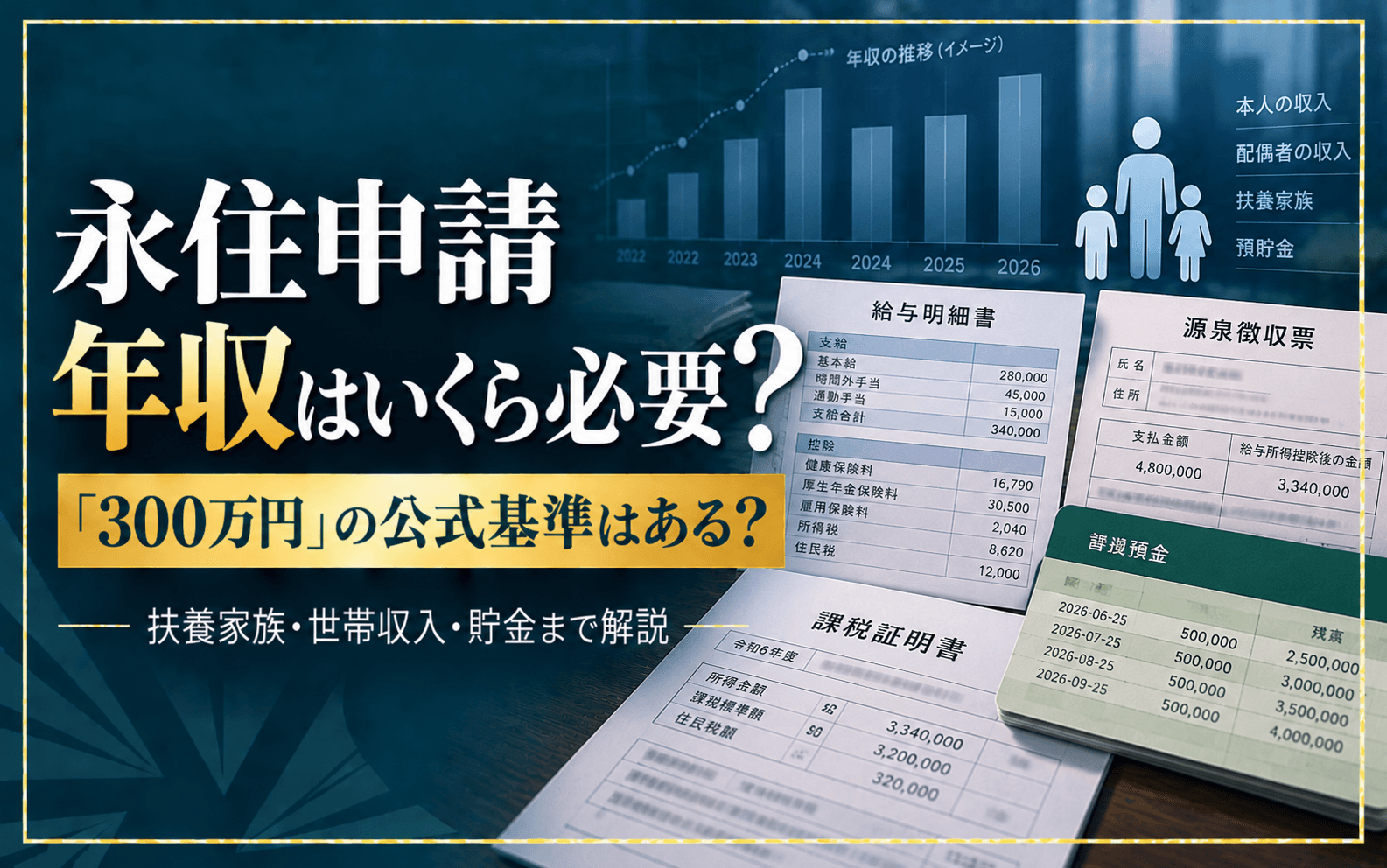
“Do I need at least ¥3 million a year for Permanent Residence?”
“How much income do I need if I support a spouse and children?”
“My own salary is not high, but my spouse also works.”
“Can substantial savings compensate for lower income?”
The key point is:
Japan does not publish a nationwide fixed minimum annual income for Permanent Residence.
There Is No Official “¥X Million Minimum Income” Rule
One of the general Permanent Residence requirements is that the applicant have sufficient assets or skills to maintain an independent livelihood.
The current guidelines explain this as a situation in which the applicant is not a public burden and can be expected to maintain a stable life in the future.
They do not publish fixed national figures such as:
¥3 million for a single applicant
or
¥5 million for a family of four.
Income therefore cannot be assessed in isolation.
What Is Considered?
Relevant circumstances may include:
Current income
Income over recent years
Employment stability
Job changes
Spouse’s income
Number of dependents
Overall household finances
Savings and assets
Tax declarations
Likelihood of continued income
The same annual salary can therefore present a different financial picture depending on household circumstances.
Dependents Matter
An applicant living alone and an applicant supporting a spouse and two children do not have the same household expenses.
The assessment focuses on whether the household can continue maintaining a stable life.
There is no officially published nationwide formula adding a fixed amount for each dependent.
Can a Spouse’s Income Be Considered?
Yes.
The standard PR document requirements contemplate income and tax records not only for the applicant but also, where applicable, for the person supporting the applicant.
A dual-income household can therefore be considered based on its broader household finances.
What If the Spouse Does Not Work?
A non-working spouse does not automatically prevent Permanent Residence.
The question is whether the household can be sustainably supported by the available income and resources.
Is One High-Income Year Enough?
Ordinary work-status applicants generally submit five years of resident-tax income records.
The authorities can therefore see income changes over several years rather than only the current salary.
One lower-income year does not automatically mean refusal; the reason and subsequent circumstances matter.
Income Increased After a Job Change
Where an applicant’s current salary is substantially higher than the income shown on the latest tax certificate, current evidence may include:
Employment certificate
Employment contract
Payslips
Evidence of expected annual remuneration
The stability of the new employment still needs to be considered.
Income Decreased After a Job Change
The reverse also matters.
A high income shown on last year’s tax certificate does not necessarily represent the applicant’s current financial position.
Permanent Residence looks toward future stability as well as past income.
What About Bonuses and Overtime?
Bonuses and overtime actually received form part of reported income.
However, an uncertain future bonus should not be treated as guaranteed income.
Where a household relies heavily on highly variable overtime, the overall stability of compensation may also be worth reviewing.
Can Savings Compensate for Lower Income?
Applicants can submit asset evidence such as:
Bank records
Online bank statements
Real-estate records
Savings can therefore help explain the applicant’s financial foundation.
However:
substantial savings do not automatically replace the need for sustainable future finances.
Current employment, ongoing income, household income, and dependents still matter.
What About Real Estate?
Real estate is an asset and can be documented where relevant.
Owning property does not itself guarantee Permanent Residence, particularly where significant mortgage obligations also exist.
Business Owners and the Self-Employed
Company revenue is not the same as the owner’s personal income.
A company may have high sales while paying its representative a relatively low director’s salary.
For self-employed applicants, business turnover and taxable income are also different concepts.
The applicant’s actual personal and household financial position should be clear from the submitted records.
Very Low Declared Income Can Require Explanation
Permanent Residence relies on official tax documentation.
An applicant generally cannot resolve a very low declared income simply by saying:
“I actually earn more than what I reported.”
The financial explanation should be consistent with tax filings.
Overseas Dependents Can Also Matter
Applicants claiming overseas relatives as dependents should be prepared to explain the actual financial support and whether the household can sustainably carry that burden.
Special Rules Apply to Certain Spouses and Children
Spouses and certain children of Japanese nationals, Permanent Residents, and Special Permanent Residents are not required by law to satisfy the ordinary independent-livelihood requirement.
Accordingly, a stay-at-home spouse should not simply be assessed in the same way as an ordinary work-status applicant.
Other PR requirements, including public obligations and the genuine family relationship, still remain relevant.
Highly Skilled Professionals Still Need Financial Consistency
The 70- and 80-point routes shorten the residence-history requirement.
They do not eliminate all other PR considerations.
Income is also itself an important part of many Highly Skilled Professional point calculations.
Gross Income or Take-Home Pay?
Income should be checked against objective records such as:
Withholding statements
Resident-tax certificates
Payslips
Employment contracts
rather than relying only on a self-calculated monthly take-home amount.
High Income Does Not Override Other PR Requirements
Even an applicant earning ¥8 million may have problems elsewhere if, for example:
Taxes are repeatedly late
Pension remains unpaid
Employment does not comply with the current status
There is serious criminal history
Required immigration notifications were not made
Permanent Residence is not granted solely because an applicant earns a high salary.
Lower Income Does Not Automatically Mean Refusal Either
There is no published nationwide minimum figure that automatically determines refusal below a particular amount.
The overall circumstances—including dependents, spouse’s income, employment stability, income history, and assets—need to be reviewed.
Pre-Application Financial Checklist
Review:
Current annual income
Five-year income history
Employment type
Length of employment
Job changes
Spouse’s income
Number of dependents
Overseas dependents
Savings
Mortgage and major obligations
Consistency with tax filings
Expected future income
Frequently Asked Questions
No nationwide official rule establishing ¥3 million as the minimum has been published.
Income alone cannot answer the question.
Household income can be relevant to the overall financial assessment.
Dependents affect household finances, but there is no published fixed amount that must be added for each child.
Savings are relevant assets, but the amount alone does not determine whether PR will be granted.
Current employment and salary evidence can be submitted together with the historical tax records.
The Real Question Is Financial Stability, Not One Magic Salary Number
Permanent Residence should not be reduced to:
“¥3 million is enough”
or
“¥5 million guarantees approval.”
The current framework focuses on whether the applicant can maintain a stable life in Japan.
That requires looking at:
personal income + household income + dependents + income history + assets + employment stability.
Enlight Administrative Scrivener’s Office can review current income, five-year income history, dependents, spouse’s income, expected income after a job change, savings, taxes, and pension records before filing.
The initial Permanent Residence eligibility check is free of charge.
Permanent Residence support is generally limited to applicants within the jurisdiction of the Tokyo Regional Immigration Services Bureau.
Immigration Services Agency: Guidelines for Permission for Permanent Residence, revised February 24, 2026
Immigration Services Agency: Permanent Residence Application
Immigration Services Agency: Permanent Residence Application 3
Immigration Services Agency: Permanent Residence Application 1
Immigration Services Agency: Q&A on the Permanent Residence System
Related
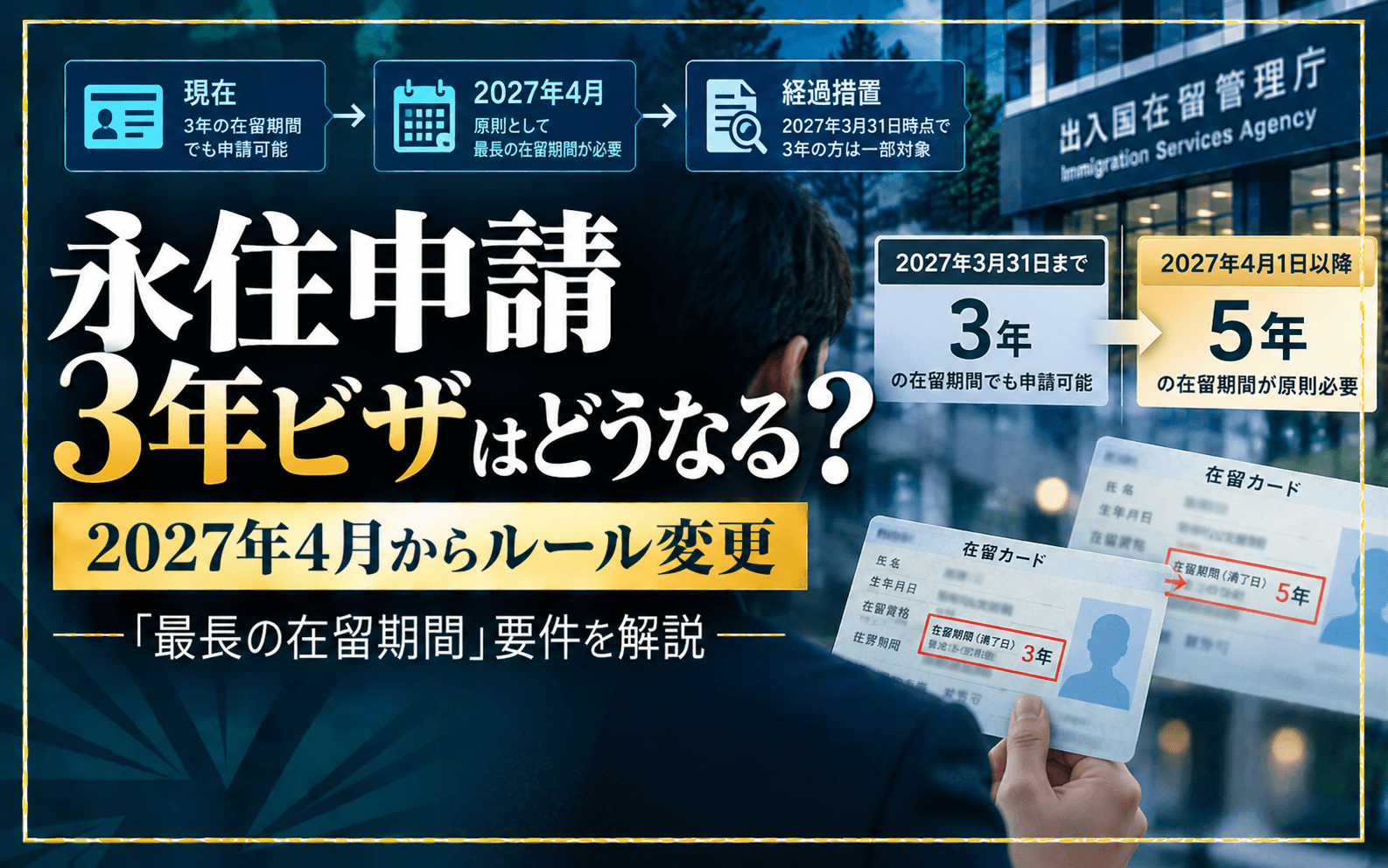
A three-year period of stay can currently satisfy the “maximum period of stay” requirement for Japanese Permanent Residence, but the general transitional treatment ends on March 31, 2027. From April 2027, applicants will generally need the actual maximum period available for their current status. A separate transitional rule, however, applies to certain people who still hold a three-year period on March 31, 2027.
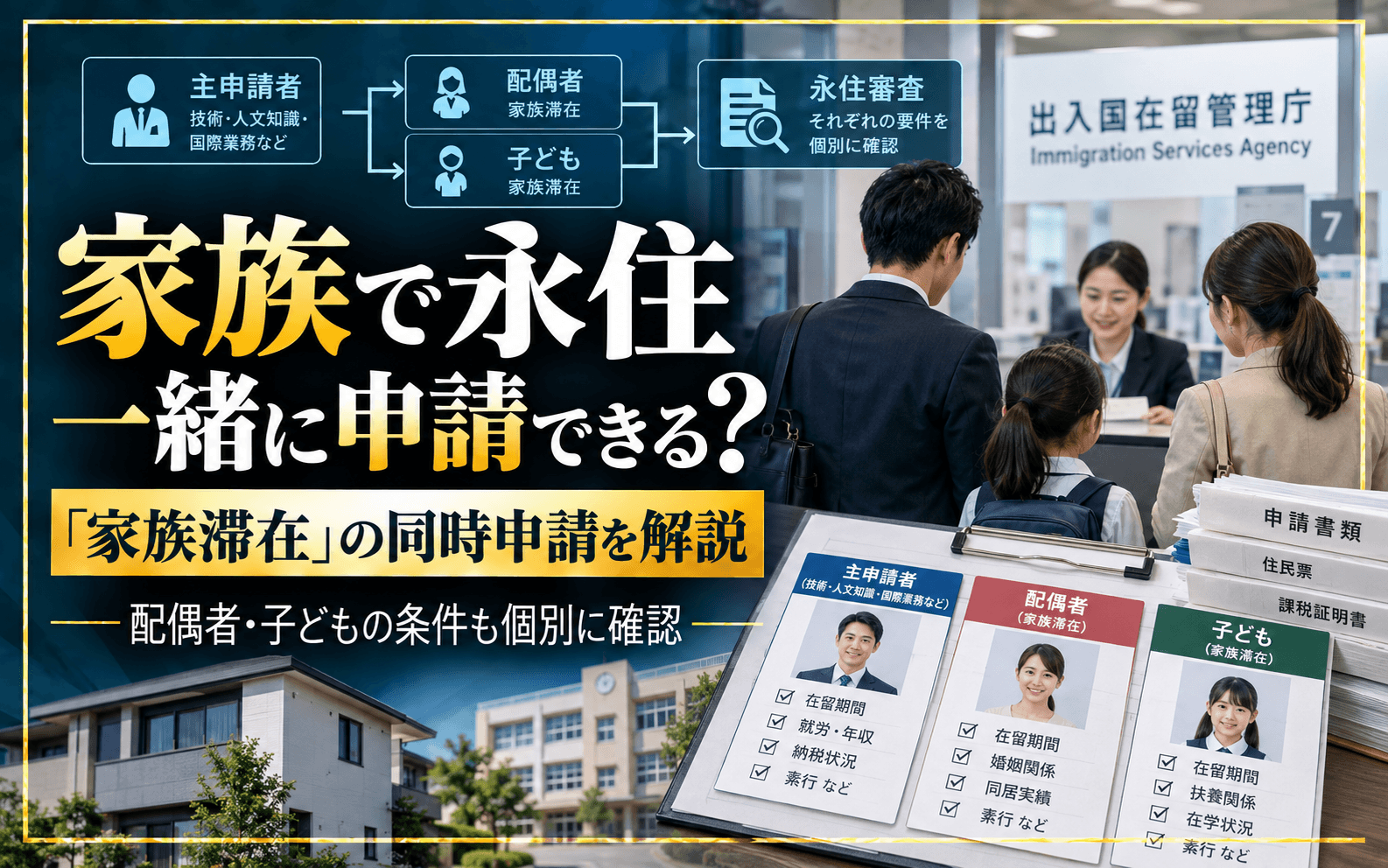
Read MoreWhen a work-status holder applies for Japanese Permanent Residence, can a spouse and children under Dependent status apply at the same time? Family applications require more than checking the principal applicant. Marriage duration, each child’s residence history, household income, taxes, pension, outside-status work, and overseas absences can all affect the appropriate filing strategy.
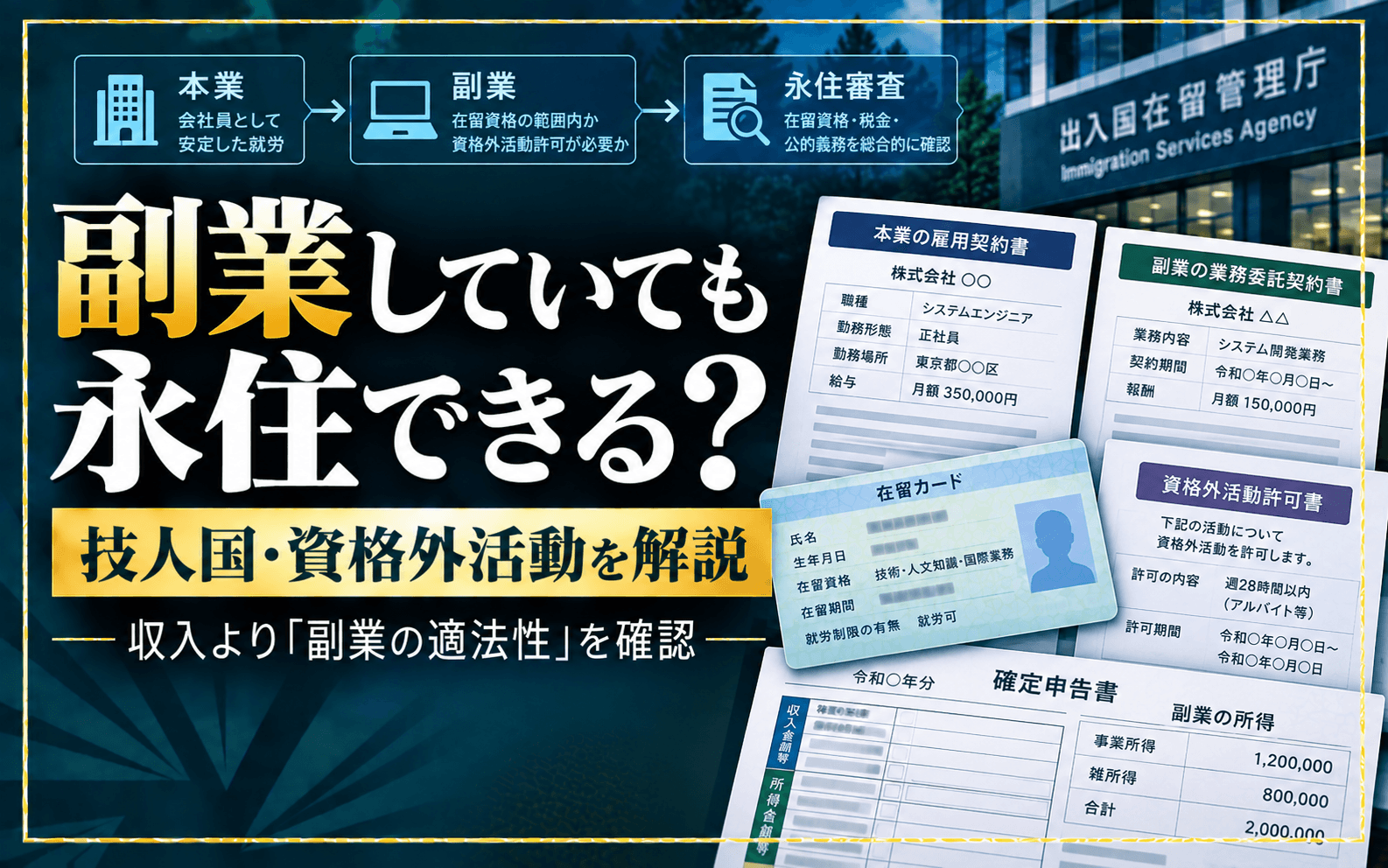
Read MoreCan an employee with side income still apply for Permanent Residence in Japan? Having a side job is not itself the issue. The important questions are whether the activity is permitted under the applicant’s current status of residence, whether Permission to Engage in Activity Other Than That Permitted is required, and whether side income has been properly handled for tax purposes.
Read MoreLet's Start
Our scrivener carefully answers your visa and naturalization questions. Online consultations are available.