Column
Can You Apply for Japanese Permanent Residence Right After Changing Jobs? 【2026 Update】
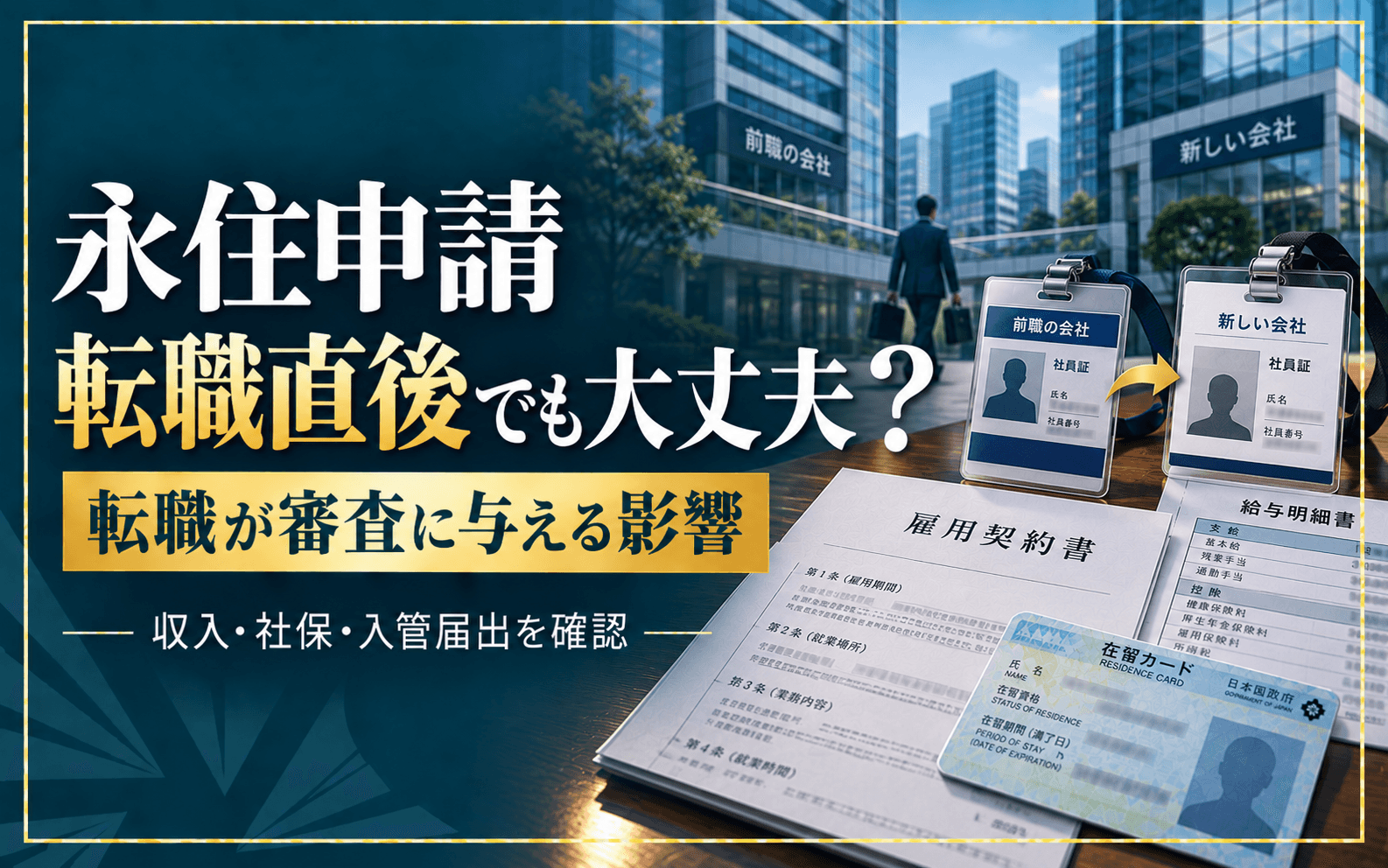
“Can I apply for Permanent Residence immediately after changing jobs?”
“Do I have to wait one year?”
“What happens if I change jobs after filing my PR application?”
There is no published nationwide rule requiring applicants to wait a fixed number of months after changing jobs.
The important question is whether the applicant’s circumstances remain stable after the change.
A Recent Job Change Does Not Automatically Prevent Permanent Residence
A person who has worked steadily for years and moves to another employer in the same professional field with stable or higher income may still be able to proceed.
A recent change becomes more complicated where it is combined with matters such as a probationary period, a major income reduction, a substantial change in duties, or gaps in social insurance.
Permanent Residence Looks at Future Financial Stability
The Permanent Residence framework requires the applicant to be expected to maintain a stable livelihood in Japan.
Past income is therefore relevant, but current employment also matters.
1. Submit Evidence From the Current Employer
Ordinary work-status applicants who are employees generally provide an employment certificate.
After changing jobs, documentation should reflect the current employer.
2. Current Salary May Differ From Last Year’s Tax Record
Resident-tax certificates reflect earlier income.
A recent job change may therefore create a difference between the income shown on tax records and the applicant’s current salary.
Current employment contracts, payslips, and employment certificates can help explain the present situation.
Higher Income Does Not Automatically Resolve Other Issues
A higher salary may support the financial-stability assessment, but applicants must still review immigration-status compliance, notifications, pension, health insurance, and resident tax.
3. Make Sure the New Job Fits the Current Status of Residence
Current Permanent Residence guidance also requires compliance with the standards applicable to the applicant’s existing status of residence.
Applicants holding Engineer/Specialist in Humanities/International Services should therefore confirm that their new duties remain compatible with that status.
4. Certain Work-Status Holders Must Report Job Changes Within 14 Days
For statuses such as Engineer/Specialist in Humanities/International Services, ending a contract with one organization and entering into a new contract generally triggers notification duties.
The required notification is generally due within 14 days.
If the deadline was missed, applicants should not simply ignore the issue; Immigration Services Agency guidance instructs people who discover an unfiled notification to submit it promptly.
5. Check Pension and Health-Insurance Gaps Between Jobs
Even a short period between employers can create separate National Pension or National Health Insurance obligations.
Ordinary work-status PR applications generally review the most recent two years of public pension and health insurance.
6. Resident Tax May Switch to Direct Payment
Resident tax is usually withheld from salary, but a job change can temporarily move the applicant to direct payment.
Ordinary work-status applicants generally provide five years of resident-tax evidence, and direct-payment periods may require proof of timely payment.
Does Frequent Job Changing Cause Refusal?
There is no published rule stating that a particular number of job changes automatically causes refusal.
However, repeated short-term employment, long unemployment periods, unstable income, or social-insurance gaps can make financial stability harder to establish.
Can You Apply During a Probationary Period?
No nationwide rule expressly prohibits filing during probation.
However, the stability of the current employment relationship may be less clear, so timing should be considered individually.
What If You Resigned and Have Not Found the Next Job?
For an ordinary work-status applicant who relied primarily on employment income, unemployment can raise questions about both financial stability and the current immigration status.
In addition, certain activity-based statuses can become subject to status-revocation rules where the authorized activity is not performed for an extended period without a justifiable reason.
Changing Jobs After Filing the PR Application
The Letter of Understanding submitted with a Permanent Residence application requires applicants to promptly contact the immigration office handling the case if their employment circumstances change before the decision.
The examples expressly include:
Resignation
Changing jobs
Do Not Hide a Post-Filing Job Change
The Letter of Understanding also warns that failure to report a material change before obtaining Permanent Residence may lead to cancellation of the permission if discovered later.
Applicants should therefore report the change rather than withholding it out of concern that it may affect the examination.
Highly Skilled Applicants Should Recalculate Points Before Changing Jobs
For 70- and 80-point Highly Skilled Professional routes, job changes can affect income, employer-related bonuses, duties, and therefore the total score.
An applicant who drops below 80 points after changing jobs may lose eligibility for the one-year route.
Frequently Asked Questions
Q. Do I Have to Wait Six Months After Changing Jobs?
No nationwide fixed six-month waiting period has been published.
Q. Do I Have to Wait One Year?
No general one-year waiting rule has been published either.
Q. My Salary Increased After the Job Change.
That can support financial stability, but the other PR requirements still need to be reviewed.
Q. I Forgot to Notify Immigration of My Job Change.
If your status is subject to the notification requirement, address the missed notification promptly.
Q. I Changed Jobs After Filing Permanent Residence.
Notify the immigration office handling the Permanent Residence application promptly.
Q. Will Many Job Changes Automatically Cause Refusal?
No fixed numerical rule has been published. The overall employment and financial history matters.
The Key Question Is Not “How Long Since the Job Change?”
The real issue is whether the applicant’s:
current employment, income, immigration status, taxes, pension, health insurance, and required notifications are in order.
Enlight Administrative Scrivener’s Office can review pre- and post-change income, immigration-status consistency, social-insurance gaps, resident-tax payments, and Highly Skilled Professional points before filing.
The initial Permanent Residence eligibility check is free of charge.
Permanent Residence support is generally limited to applicants within the jurisdiction of the Tokyo Regional Immigration Services Bureau.
References
Immigration Services Agency: Guidelines for Permission for Permanent Residence, revised February 24, 2026
Immigration Services Agency: Permanent Residence Application 3
Immigration Services Agency: Notification Concerning Affiliated Contracting Organizations
Immigration Services Agency: Q&A on Notifications Concerning Affiliated Organizations
Immigration Services Agency: Permanent Residence Letter of Understanding
Immigration Services Agency: Revocation of Status of Residence