Column
Permanent Residence From Long-Term Resident Status: Can You Apply After 5 Years? 【2026 Update】
“I have held Long-Term Resident status for five years.”
“I divorced a Japanese national two years ago and changed to Long-Term Resident, but I have lived in Japan for twelve years.”
“My current Long-Term Resident period is three years.”
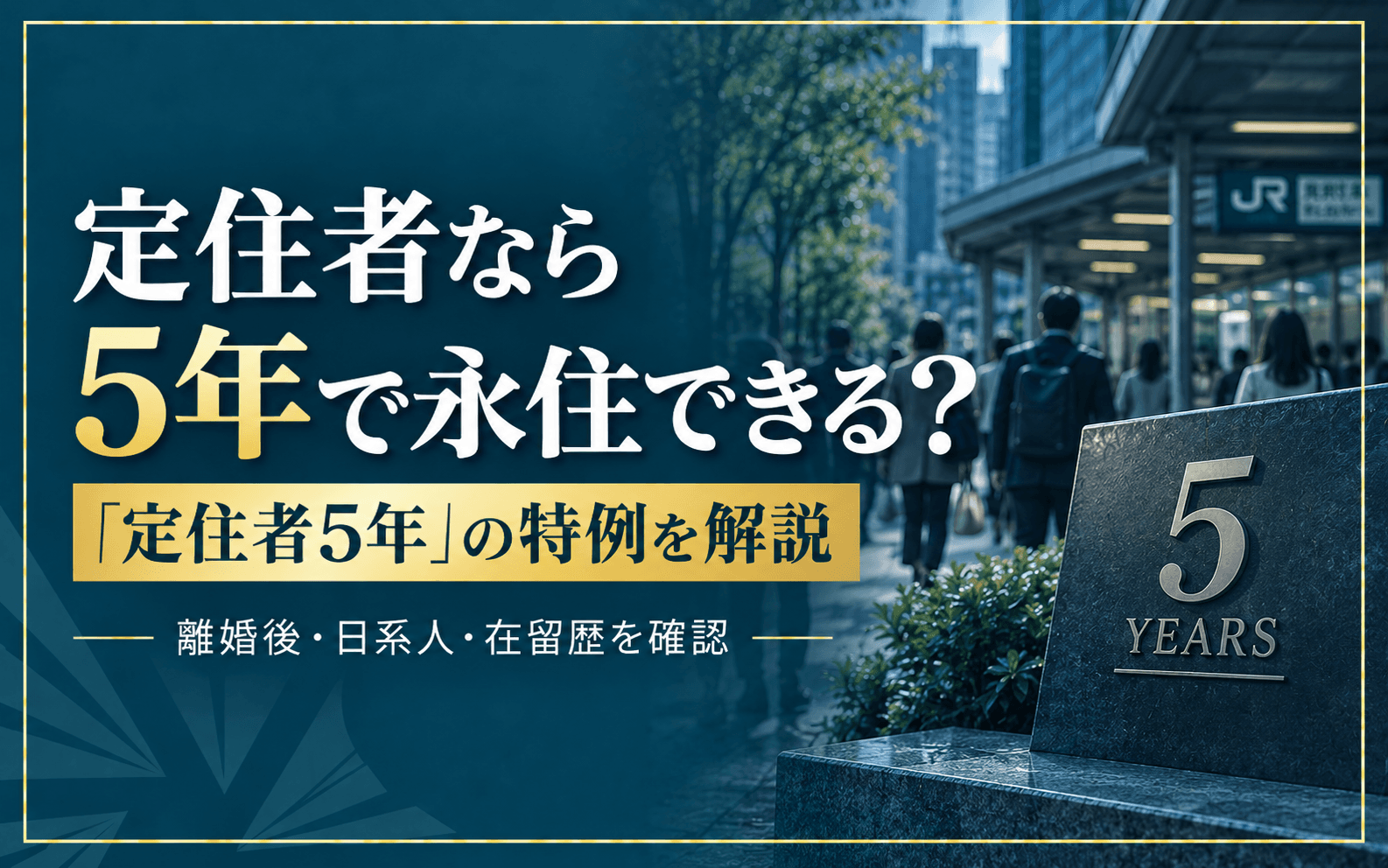
Long-Term Resident status has an important PR exception:
five or more continuous years in Japan under Long-Term Resident status.
This can replace the ordinary ten-year residence requirement.
However:
five years as a Long-Term Resident does not automatically guarantee PR.
The Exception Means 5 Years Under Long-Term Resident Status
The key is not simply:
five years since first arriving in Japan.
It is:
five continuous years holding Long-Term Resident status.
For example:
2 years under Spouse of Japanese National
5 years under Long-Term Resident
can satisfy the five-year Long-Term Resident exception.
By contrast:
6 years under Spouse of Japanese National
2 years under Long-Term Resident
does not yet satisfy that particular five-year exception.
1. What Is Long-Term Resident Status?
Long-Term Resident is a residence-based status granted where the Minister of Justice recognizes special circumstances.
Official examples include certain:
Third-generation Japanese descendants
Persons connected with Japanese nationals left in China
Qualifying children
Qualifying adopted children
Other individual circumstances can also result in Long-Term Resident status.
“Divorce Long-Term Resident” Is Not an Official Status Name
People sometimes informally refer to “divorce Long-Term Resident” status.
The official status is simply:
Long-Term Resident.
Divorce from a Japanese national does not automatically result in Long-Term Resident status. A change of status is individually examined.
2. If You Have Held Long-Term Resident Status for Less Than 5 Years, Is PR Impossible?
Not necessarily.
The five-year exception requires five years under Long-Term Resident status.
However, the applicant may separately satisfy the:
ordinary ten-year residence route.
Applicants With 10+ Total Years in Japan Should Also Check the Ordinary Route
For example:
8 years under Spouse of Japanese National
2 years under Long-Term Resident
=
10 years in Japan.
The five-year Long-Term Resident exception is not satisfied.
But the previous spouse status and current Long-Term Resident status are both residence-based statuses.
The applicant may therefore satisfy the ordinary framework requiring ten years in Japan, including at least five years under qualifying work or residence statuses.
This is why the entire residence history should be reviewed.
3. Long-Term Resident Status After Divorce
A common pattern is:
marriage to a Japanese national
↓
Spouse of Japanese National status
↓
divorce
↓
change to Long-Term Resident.
The applicant should review:
Total time in Japan
Time under spouse status
Time under Long-Term Resident status
Overseas absences
Current livelihood
The Years Before Divorce Are Not Automatically Lost
An applicant does not always need to “restart from zero” and wait another five years after becoming a Long-Term Resident.
For example:
7 years under spouse status
3 years under Long-Term Resident
may already require review under the ordinary ten-year PR route.
The Former Japanese-Spouse Exception Does Not Simply Continue After Divorce
The spouse PR exception is based on a current qualifying marital relationship.
After divorce, an applicant now holding Long-Term Resident status should generally be assessed under the Long-Term Resident exception or the ordinary residence route, depending on the facts.
4. Does the 5-Year Exception Remove Other PR Requirements?
No.
It only creates an exception to the ordinary ten-year residence period.
A Long-Term Resident applicant generally still needs to satisfy requirements concerning:
Good conduct
Stable livelihood
Proper fulfillment of public obligations
Maximum period of stay
Compliance with the current status of residence
This Is Different From Certain Spouse Cases
Qualifying spouses and children of Japanese nationals, Permanent Residents, and Special Permanent Residents receive statutory exceptions concerning good conduct and independent livelihood.
A person does not receive those same exceptions merely because they hold Long-Term Resident status.
Financial stability therefore remains particularly important.
5. Is There a Minimum Annual Income?
No nationwide fixed minimum income for Long-Term Resident PR is officially published.
The authorities can consider matters such as:
Current income
Income history
Employment stability
Number of dependents
Supporting spouse’s income
Overall household circumstances
Applicants Without Employment Still Require a Livelihood Review
The current PR document list for Long-Term Residents also requests financial and compliance information concerning the applicant and, where relevant, the person supporting the applicant.
However, the independent-livelihood requirement still generally applies.
6. Resident Tax: Generally 5 Years
The current Long-Term Resident PR document list generally requires:
five years
of resident-tax income and payment records.
Where there were periods of direct payment rather than payroll withholding, evidence of timely payment may also be required.
Paying Everything Before Filing Does Not Necessarily Erase Late Payment
The 2026 guidelines state that public obligations paid after their original deadlines can, in principle, still be evaluated negatively.
Actual payment timing therefore matters.
7. Pension and Health Insurance: Generally 2 Years
Current documentation generally covers:
the most recent two years
of public pension and public health-insurance compliance.
National Pension or National Health Insurance periods deserve particular attention because evidence of timely payment can be required.
8. Can You Apply With a 3-Year Long-Term Resident Period?
In 2026, a three-year period continues to receive transitional treatment as satisfying the PR maximum-period requirement.
Long-Term Resident status can be granted for five years, three years, one year, six months, or another individually specified period within the permitted range.
Treatment of 3-Year Periods Changes After March 2027
The general transitional treatment runs through:
March 31, 2027.
A separate transitional rule applies to certain people already holding three years on that date.
Applicants should therefore review both:
time held under Long-Term Resident status
and
the current period of stay.
9. The Basis for Long-Term Resident Status Can Affect the Documentation
Long-Term Resident status can arise from different family or historical circumstances.
For example:
Japanese-descendant cases
China-related historical categories
Post-divorce status changes
Qualifying child relationships
The basic PR rules may be the same, but civil-status and family documentation can differ.
Long-Term Resident Status Does Not Mean the Underlying Immigration Position Is Never Reviewed Again
The 2026 PR guidelines also require the applicant’s current status of residence to remain compliant with the applicable criteria.
The current Long-Term Resident position therefore still matters.
10. Remarriage After Obtaining Long-Term Resident Status
An applicant may divorce, change to Long-Term Resident, and later remarry.
Remarriage does not itself prevent PR, but the current:
Spouse
Children
Dependents
Household income
Immigration status
should be reviewed.
Remarriage to a Japanese National May Create Another Possible Route
Where the applicant is now married to a Japanese national and satisfies the applicable spouse conditions, the spouse PR exception may also deserve consideration.
Holding Long-Term Resident status does not necessarily mean that the five-year Long-Term Resident route is the only possible route.
11. Long Overseas Absences
The five-year Long-Term Resident exception requires continuous residence in Japan.
Long overseas assignments, repeated extended visits abroad, or other substantial absences can therefore require closer review.
There is no published nationwide rule establishing a fixed maximum number of days abroad.
12. Traffic Violations and Criminal Penalties
Long-Term Resident applicants remain subject to the conduct requirements.
Traffic offenses, fines, criminal penalties, and other legal issues can therefore still matter.
The five-year exception shortens only the residence requirement; it does not eliminate conduct review.
Cases That Particularly Deserve Pre-Filing Review
Professional review can be particularly useful where the applicant:
Has just reached five years under Long-Term Resident status
Changed to Long-Term Resident after divorce
Has less than five years under Long-Term Resident but more than ten years total in Japan
Holds Long-Term Resident status as a Japanese descendant
Currently has a one- or three-year period
Plans to apply after April 2027
Recently changed jobs
Has unstable current income
Has late resident-tax payments
Had National Pension or National Health Insurance periods
Has long overseas absences
Remarried after divorce
Has traffic or criminal history
Frequently Asked Questions
Q. I Have Held Long-Term Resident Status for Five Years. Can I Apply?
You may use the five-year exception to the ordinary ten-year residence requirement, subject to the remaining PR requirements.
Q. I Have Lived in Japan for Ten Years but Have Only Held Long-Term Resident Status for Two Years.
The five-year Long-Term Resident exception is not satisfied, but the ordinary ten-year route may be available depending on the complete residence history.
Q. I Changed to Long-Term Resident After Divorcing a Japanese National.
Both the five-year Long-Term Resident route and the ordinary ten-year route should be reviewed.
Q. Do the Years Under Spouse Status Before Divorce Count for Nothing?
No. Those years can be important when assessing the ordinary residence route.
Q. I Currently Have a 3-Year Long-Term Resident Period.
Transitional treatment remains available in 2026, but applicants should review the 2027 rule change and their expiration date.
Q. How Many Years of Tax Records Are Required?
The current standard Long-Term Resident documentation generally requires five years of resident-tax records.
Q. How Many Years of Pension Records?
Generally, the most recent two years.
Long-Term Resident PR Is About More Than the Number “5”
The five-year exception is valuable, but a real PR application still requires:
residence history + livelihood + taxes + pension + health insurance + current period of stay + conduct + current status compliance.
For applicants who changed to Long-Term Resident after divorce, the complete pre-divorce residence history can also be important because some applicants may qualify under the ordinary ten-year route before reaching five years as a Long-Term Resident.
Enlight Administrative Scrivener’s Office reviews the applicant’s entire immigration history and determines which PR route is currently applicable.
The initial Permanent Residence eligibility check is free of charge.
Permanent Residence support is generally limited to applicants within the jurisdiction of the Tokyo Regional Immigration Services Bureau.
References
Immigration Services Agency: Guidelines for Permission for Permanent Residence, revised February 24, 2026
Immigration Services Agency: Permanent Residence Application 2 — Long-Term Resident
Immigration Services Agency: Status of Residence — Long-Term Resident
Immigration Services Agency: List of Statuses of Residence
Immigration Services Agency: Published Examples of Changes From Spouse Status to Long-Term Resident Status