Column
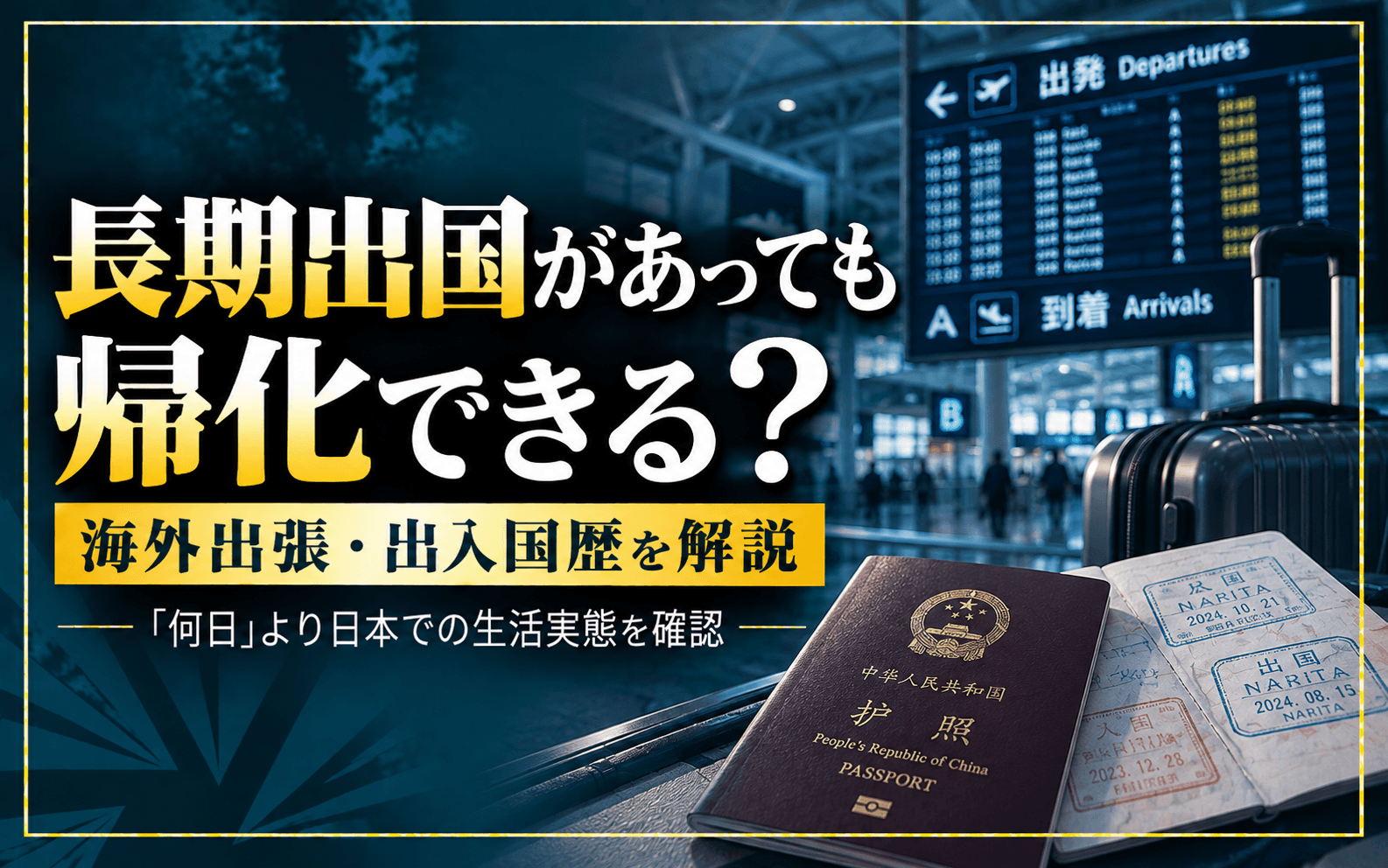
Can You Apply for Japanese Naturalization After Long Overseas Trips or Assignments? Residence and Travel History Explained 【2026 Update】
“I spent several months in China for work.”
“I return to China for several months every year.”
“I previously had a long overseas assignment.”
For naturalization, it is not enough simply to count the years from the applicant’s first arrival in Japan.
The Nationality Act’s ordinary residence requirement is:
continuous domicile in Japan for at least five years.
Current Ministry of Justice guidance also refers to social integration, including:
ten or more years of residence in Japan.
There Is No Published Nationwide “X Days Abroad = Ineligible” Rule
Applicants often hear informal figures such as:
“90 days”
or
“100 days per year.”
Current official Ministry and Tokyo Legal Affairs Bureau materials do not publish a nationwide rule stating that crossing one particular number automatically breaks the residence requirement.
The actual circumstances matter.
1. One Extended Trip Is Different From Repeated Long Absences
A single two-month business trip during several years in Japan is different from spending four or five months abroad every year for several consecutive years.
The second situation raises a more significant question:
Was Japan continuously the applicant’s actual center of life?
Total Days Alone Do Not Decide the Issue
Several short business trips totaling 120 days can present different circumstances from living overseas continuously for four months.
The pattern and reason for travel therefore matter.
The Official Naturalization Résumé Includes Travel History
Tokyo’s official “Résumé (Part 2)” contains fields for:
Departure and return periods
Number of days
Destination
Purpose
Companions
Total days outside Japan
The instructions require travel history during the statutory residence period, with at least the most recent year included.
Travel history is therefore a formal part of the naturalization review.
2. Passports Are Also Reviewed
For Chinese-national applicants, the Tokyo Legal Affairs Bureau currently asks for:
all passports, including expired passports,
together with copies of used pages containing entry/exit-related stamps and other records.
Travel history should therefore be accurately organized rather than omitted because it occurred several years ago.
No Passport Stamp Does Not Necessarily Mean No Travel
Automated immigration gates mean that not every movement necessarily leaves a physical stamp.
Applicants should therefore maintain an accurate travel history independent of passport stamps.
A Business Trip Is Not Automatically Exempt
A company-directed business trip has a clear temporary purpose and differs from permanently relocating overseas.
However, there is no published rule saying that any length of company business travel can never affect the naturalization residence analysis.
Relevant circumstances can include continued employment in Japan, housing, family location, and return to Japan.
3. Overseas Assignments Require Closer Review
Consider:
Japanese employer
↓
two-year assignment to a Chinese subsidiary
↓
home rented in China
↓
family moves to China.
This is substantially different from a short business trip.
The question becomes whether the applicant’s center of life actually moved abroad for that period.
Keeping a Japanese Resident Registration Does Not Automatically Decide the Issue
Naturalization domicile is not determined solely from the address shown on a resident record.
The applicant’s actual living and working circumstances matter.
Keeping a Home in Japan Is Also Only One Factor
Continuing to pay rent or a mortgage in Japan can be relevant.
But owning or renting a home in Japan does not by itself establish that Japan remained the center of life.
4. Extended Visits for Family Reasons
Chinese applicants may return home for:
Lunar New Year
Parental care
Childbirth
Family illness
An ordinary temporary visit does not automatically end continuous residence.
Long or repeated periods abroad, however, can require closer review.
A Reasonable Reason Does Not Automatically Answer the Residence Question
A parent’s serious illness may fully explain why the applicant needed to remain overseas.
The residence requirement still needs to be reviewed separately based on the actual period and living circumstances.
5. Returning to China for Childbirth
A person may temporarily return to China for childbirth and then return to the same job and home in Japan.
The number of months alone should not determine the conclusion.
Employment, maternity or childcare leave, housing, spouse location, and the clear intention to return to Japan can all be relevant.
Taxes and Social Insurance Can Also Change During Long Absences
Extended overseas stays may coincide with changes involving:
Resident registration
Resident tax
Japanese social insurance
Overseas-assignment insurance arrangements
Naturalization review therefore extends beyond travel dates alone.
6. Continued Employment With a Japanese Company Is Not Automatically Conclusive
An employee may remain formally employed in Japan while actually living abroad for years.
The real living arrangements still need to be examined.
The Same Applies to Remote Work From Abroad
Long-term remote work from another country can raise the same residence question even when the employer remains a Japanese company.
7. Immigration Status Must Also Remain Lawful
The Ministry explains that the applicant’s residence in Japan must be lawful and supported by a valid status of residence.
Long-absence cases may therefore also require review of:
Current status
Period of stay
Re-entry arrangements
Employment
Immigration notifications
Re-Entry Permission Does Not Automatically Establish Continuous Domicile for Naturalization
Re-entry permission is an immigration-law mechanism allowing the foreign national to return to Japan.
The naturalization domicile requirement arises under the Nationality Act.
They should not be treated as identical legal questions.
8. The Japanese-Spouse One-Year Route Also Uses “Continuous” Domicile
One Article 7 spouse exception applies after:
three years of marriage + at least one year of continuous domicile in Japan.
A person who first entered Japan more than one year ago but spent most of that period abroad should therefore not rely only on the calendar date.
9. The Current 10-Year Integration Guidance Also Makes Travel History Important
Current Ministry of Justice guidance refers to social integration, including ten or more years of residence.
Where substantial overseas living is included within that period, the first date of arrival alone may not provide the full answer.
10. Long Overseas Stays After Filing Also Require Care
Naturalization examination continues after filing until permission and Official Gazette publication.
If the applicant later receives a long overseas assignment, changes employment abroad, gives up housing in Japan, or moves the whole household overseas, the circumstances have materially changed.
In such a case, the applicant should consult the Legal Affairs Bureau handling the application about whether an explanation or additional documents are required.
Cases That Particularly Deserve Pre-Filing Review
Professional review is particularly useful where the applicant:
Had a business trip lasting several months
Spends several months in China every year
Had an overseas assignment
Moved overseas together with family
Returned home for prolonged parental care
Stayed abroad for childbirth
Worked remotely from overseas
Kept Japanese registration while living abroad long-term
Previously filed an overseas move-out notification
Wants to use the Japanese-spouse one-year exception
First arrived more than ten years ago but had long periods of overseas residence
Expects an overseas assignment while naturalization is pending
Frequently Asked Questions
Q. Does Spending More Than Three Months Abroad Prevent Naturalization?
No nationwide official three-month rule has been published.
Q. What About More Than 100 Days Abroad per Year?
There is likewise no published nationwide 100-day rule.
Q. It Was a Company Business Trip.
The work-related reason is relevant, but the period and the applicant’s actual Japanese living circumstances should still be reviewed.
Q. I Had a One-Year Overseas Assignment.
The impact on continuous domicile should be reviewed individually.
Q. My Resident Registration Remained in Japan.
Resident registration alone does not automatically determine the Nationality Act residence requirement.
Q. I Had Re-Entry Permission.
Re-entry permission and the naturalization domicile requirement are separate legal issues.
Q. I Spent Five Months in China for Childbirth.
The five-month figure alone should not decide the case. Employment, housing, family circumstances, and the temporary purpose should be reviewed.
In Long-Absence Naturalization Cases, Do Not Judge Eligibility by Days Alone
The key question is:
Did Japan remain the applicant’s continuous center of life during the relevant period?
Enlight Administrative Scrivener’s Office reviews passports, travel history, total days overseas, reasons for travel, Japanese employment and housing, family circumstances, taxes, pension, and current immigration status before determining whether the present residence history supports a naturalization application.
The initial naturalization eligibility check is free of charge.
References
Ministry of Justice: Nationality Act
Ministry of Justice: Nationality Q&A
Tokyo Legal Affairs Bureau: Naturalization
Tokyo Legal Affairs Bureau: Initial Naturalization Consultation
Tokyo Legal Affairs Bureau: Résumé (Part 2)
Tokyo Legal Affairs Bureau: Supporting Documents for Chinese-National Applicants
Tokyo Legal Affairs Bureau: Naturalization Consultation Checklist — China