Column
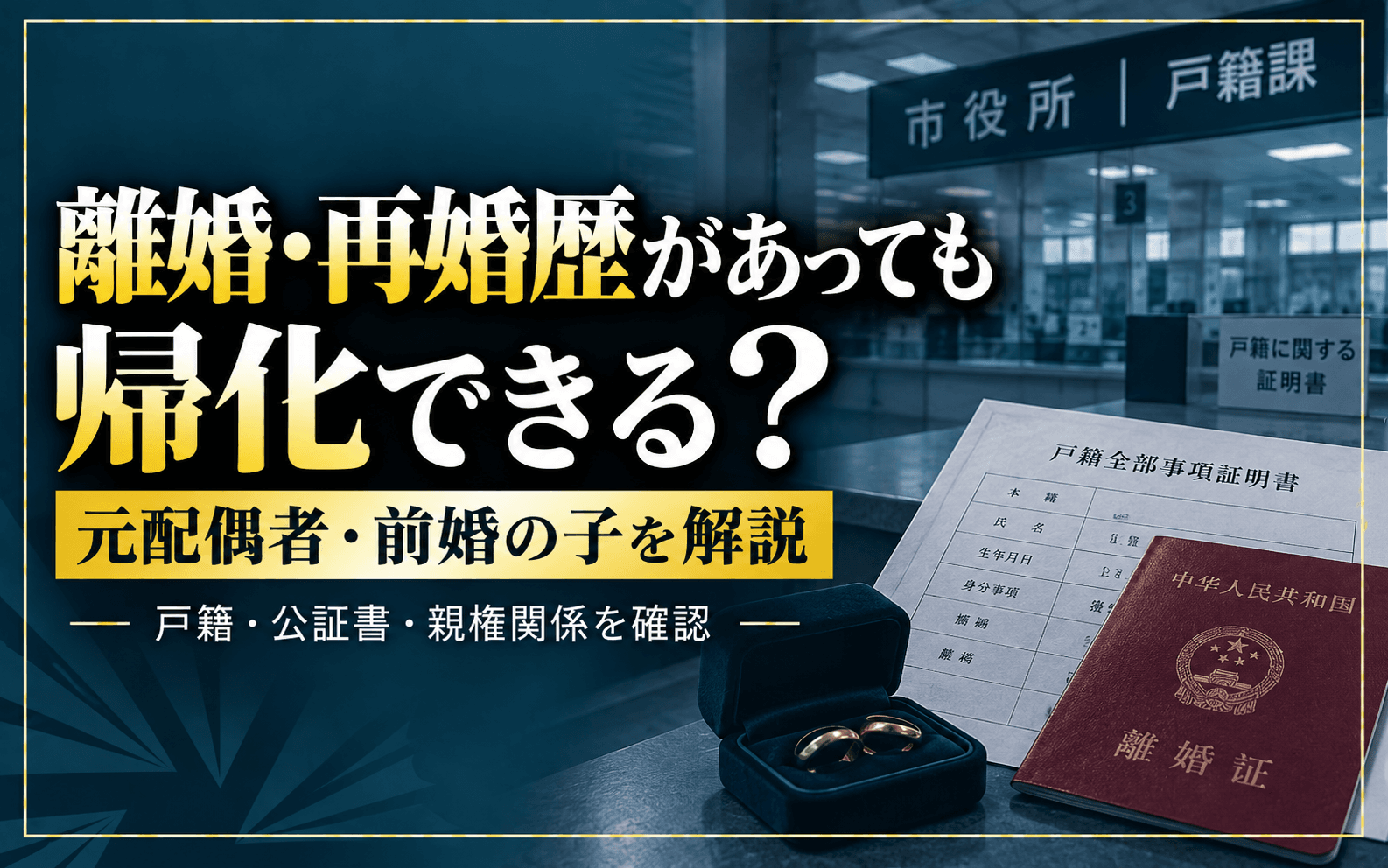
Can You Apply for Japanese Naturalization After Divorce or Remarriage? Former Spouses and Children From Previous Marriages 【2026 Update】
“I divorced in China and later remarried in Japan.”
“My child from my previous marriage lives in China.”
“I no longer have my old divorce certificate.”
“My Chinese and Japanese records show different divorce dates.”
These circumstances do not automatically prevent naturalization.
However, naturalization does not examine only the applicant’s current marriage.
Divorce History Is Not Itself a Published Bar to Naturalization
Current official naturalization materials do not state that a previous divorce automatically prevents naturalization.
In fact, the Tokyo Legal Affairs Bureau’s own forms and document lists expressly contemplate:
former spouses
and
divorce documentation.
The key issue is whether the applicant’s civil-status history can be accurately documented.
1. Former Spouses Are Included in the Family Information
The official family-information form covers more than people currently living with the applicant.
It can include:
Current spouse
Former spouse
Parents
Children
Siblings
Spouse’s parents
Common-law partner
Fiancé or fiancée
A former spouse can therefore remain relevant even where there has been no contact for many years.
No Current Contact Can Simply Be Stated Accurately
The form itself contains information about whether there is current contact.
The appropriate approach is therefore to record the actual circumstances rather than omit the former spouse.
Chinese Applicants May Need Divorce Notarial Certificates or Divorce Certificates
The Tokyo Legal Affairs Bureau’s current Chinese-national document list includes:
divorce notarial certificates or divorce certificates.
A marriage that ended before the applicant moved to Japan may therefore still form part of the naturalization documentation.
2. Divorce in China Followed by Remarriage in Japan
The applicant may need to document the full sequence:
first marriage → divorce → current marriage.
This can involve Chinese marriage and divorce documents together with Japanese family-register and marriage records.
Differences Between Chinese and Japanese Dates Need to Be Explained
A Chinese record may show the legal date of divorce while a Japanese record reflects the later date on which the divorce was reported in Japan.
A difference is not automatically an error.
What matters is understanding what each date represents.
3. Japanese Marriage, Divorce, or Custody Notifications
Where the applicant has submitted Japanese notifications concerning:
Marriage
Divorce
Change of custody
Adoption
Acknowledgment of parentage
the related official records may be required.
Where the same information is already recorded in a Japanese family register, separate notification-record documentation may sometimes be unnecessary.
Court Divorce Can Require Additional Documents
Where divorce, custody, adoption, or acknowledgment was determined by a court in Japan, China, or another country, the Tokyo Legal Affairs Bureau may require the relevant judgment or adjudication together with evidence that it has become final.
4. Children From a Previous Marriage
A child living abroad does not disappear from the applicant’s family history simply because the child does not live in Japan.
The current Chinese-national document list includes birth notarial certificates for the applicant’s children.
Overseas Children Are Still Included in Family Information
The family-information form separates relatives living in Japan from relatives living abroad.
A child from a previous marriage who lives in China therefore still needs to be properly identified.
5. Child Support Payments
Where the applicant regularly pays child support, that payment forms part of the real household budget.
Naturalization’s livelihood review should therefore reflect the applicant’s actual continuing financial obligations.
Paying Child Support Is Not Itself a Negative Factor
The important issue is whether the applicant’s present household can remain financially stable after those payments.
Likewise, where the applicant receives child support, the financial picture should accurately reflect that reality.
6. Adoption by the Current Spouse
Where a current Japanese spouse has adopted the applicant’s child from a previous marriage, the adoption itself becomes an important civil-status relationship.
Chinese adoption-related documents and Japanese adoption records may need to be reviewed.
Living Together Does Not Automatically Create a Legal Parent-Child Relationship
Where no adoption has occurred, the documents should simply reflect the real legal relationship.
Naturalization does not require creating a family status that does not exist.
7. Changes in Custody
Custody may have been determined at divorce and later changed.
The Tokyo Legal Affairs Bureau’s current materials expressly contemplate custody-change notifications and other custody-related public documents.
The applicant should therefore know who currently holds legal custody, not only where the child physically lives.
Acknowledgment of Parentage Can Also Matter
Where a child was born outside marriage and legal acknowledgment is relevant, additional civil-status records may become necessary.
8. A Former Spouse Who Is Japanese
Where a former husband or wife is or was a Japanese national, Japanese family-register records can become particularly important.
The current Tokyo materials expressly include former spouses when identifying cases where Japanese family-register or removed-register records may be required.
9. The Applicant’s Parents’ Divorce and Remarriage Can Also Affect the File
The current Chinese-national document list also includes marriage and divorce records concerning the applicant’s parents.
A family history involving remarriage, half-siblings, or step-relations may therefore require more extensive civil-status documentation.
Half-Siblings
The Tokyo Legal Affairs Bureau asks for kinship documentation showing the relationships among the applicant, parents, and siblings.
Additional birth records may be necessary if the kinship certificate does not fully establish all sibling relationships.
10. What If an Old Divorce Certificate Cannot Be Obtained?
The Tokyo Legal Affairs Bureau instructs applicants to explain during consultation where a required supporting document cannot be prepared.
The appropriate approach is therefore not to silently omit the document, but to explain why it is unavailable and obtain instructions concerning alternatives.
Do Not Decide on Your Own That a Civil-Status Document Is Unnecessary
Required documents can differ significantly depending on marriage history, children, custody, adoption, and the applicant’s parents’ family history.
Complicated family cases are particularly unsuitable for relying only on a generic checklist.
11. Do Not Conceal a Previous Divorce
Chinese notarized records, Japanese family registers, marriage/divorce notifications, and other official records can overlap.
The more important risk is often not the divorce itself but:
inconsistent information across official documents.
Multiple Marriages Are Not Judged by the Number Alone
There is no published nationwide rule stating that two or three divorces automatically prevent naturalization.
The practical issue is that each additional marriage can increase the amount of civil-status documentation that must be reconciled.
Pending Divorce Proceedings
An applicant currently negotiating divorce may soon experience major changes involving:
Address
Household income
Child custody
Post-divorce livelihood
Immigration status
Where the applicant relies on a Japanese-spouse naturalization exception, a change in marital status can be especially significant.
Cases That Particularly Deserve Pre-Filing Review
Professional review can be useful where the applicant:
Divorced in China
Divorced in Japan
Has remarried
Has multiple previous marriages
Has a former Japanese spouse
Has a child from a previous marriage living in China
Has an adopted child in the current family
Has experienced a custody change
Pays or receives child support
Has a legally acknowledged child
Has parents with divorce and remarriage histories
Has half-siblings
Cannot obtain an old divorce document
Has inconsistent Chinese and Japanese civil-status dates
Is currently negotiating divorce
Frequently Asked Questions
Q. I Have Been Divorced Before. Can I Naturalize?
A previous divorce is not itself a published prohibition, but the former marriage and divorce must be accurately documented.
Q. I Have Remarried.
The previous marriage, divorce, and current marriage should form a consistent documentary history.
Q. My Child From My Previous Marriage Lives in China.
The child can still be relevant to the family-information and civil-status documentation.
Q. I No Longer Speak to My Former Spouse.
That can be stated accurately. The former spouse should not simply be omitted.
Q. I Lost My Divorce Certificate.
The circumstances should be explained to the Legal Affairs Bureau so that the appropriate substitute documents can be confirmed.
Q. The Chinese and Japanese Divorce Dates Are Different.
First determine whether one represents the legal divorce date and the other a later Japanese notification date.
Q. I Pay Child Support.
That should be reflected as part of the applicant’s actual household financial position.
Naturalization After Divorce or Remarriage Is About Connecting the Family History—not Erasing It
The goal is not to make the applicant’s previous family relationships disappear.
The important task is to make sure that:
Chinese civil-status records + Japanese family-register records + the applicant’s current family circumstances
form one consistent history.
Enlight Administrative Scrivener’s Office reviews former marriages, divorces, current spouses, children from previous marriages, custody, adoption, Chinese notarized documents, Japanese family registers, and household finances before determining whether the naturalization file is internally consistent.
The initial naturalization eligibility check is free of charge.
References
Tokyo Legal Affairs Bureau: Naturalization
Tokyo Legal Affairs Bureau: Initial Naturalization Consultation
Tokyo Legal Affairs Bureau: Supporting Documents for Chinese-National Applicants
Tokyo Legal Affairs Bureau: Naturalization Consultation Checklist — China
Tokyo Legal Affairs Bureau: Family Information Form
Tokyo Legal Affairs Bureau: Guide to Naturalization Applications