Column
Late Taxes or Pension Payments and Japanese Permanent Residence: Does Paying Everything Later Solve the Problem? 【2026 Update】
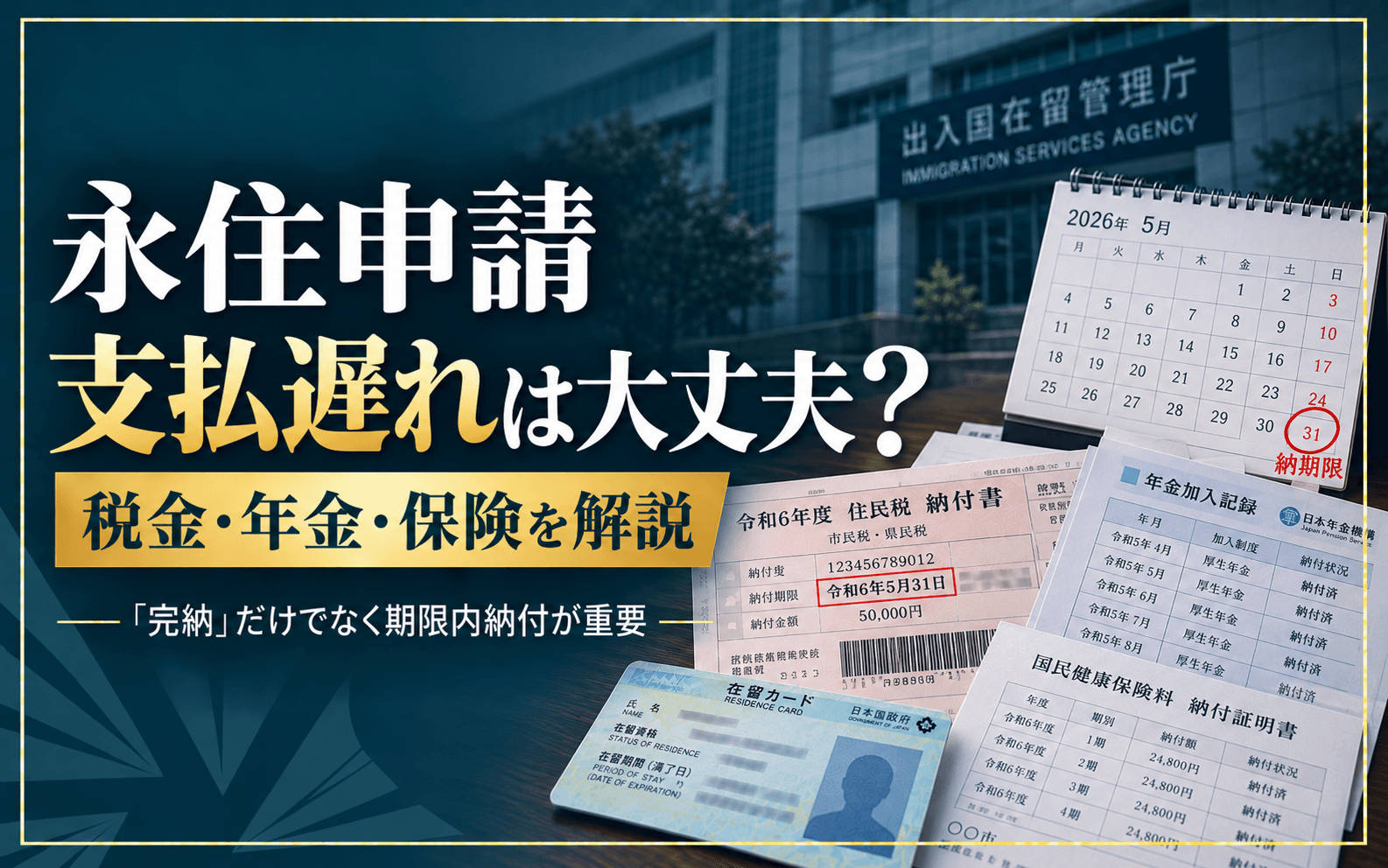
“I paid resident tax late once. Can I still apply?”
“I later paid all of my National Pension contributions. Is that enough?”
“I have no unpaid balance now. Does past lateness still matter?”
Permanent Residence review focuses not only on whether an amount remains unpaid.
Timely payment is also important.
Current PR Guidance Emphasizes Payment by the Deadline
Applicants are expected to properly fulfill public obligations, including:
Taxes
Public pension
Public health insurance
Immigration-law notification duties
Current guidance states that even where an obligation has been fully paid by the application date, failure to fulfill it within the original payment period is generally evaluated negatively.
Unpaid and Late Are Different
Unpaid
An amount remains outstanding today.
Late payment
The amount has now been paid, but payment occurred after the original deadline.
Both can be relevant to a Permanent Residence application.
Resident Tax: Payroll Withholding vs. Direct Payment
Resident tax may be paid through:
special collection — withheld by the employer
or
ordinary collection — paid directly by the taxpayer.
Direct-payment periods are particularly important because the applicant may need to prove that each installment was paid on time.
Ordinary Work-Status Applicants: Generally Five Years of Resident Tax
Applicants under ordinary work statuses generally provide resident-tax evidence for the most recent:
five years.
Where any period involved direct payment, additional evidence may include:
Receipts
Bankbook records
Online bank transaction records
Job Changes Can Create Direct-Payment Periods
An applicant may normally have tax withheld from salary but temporarily switch to direct payment after leaving one employer.
This is why applicants should review the actual payment method across the full relevant period.
Does One Late Resident-Tax Payment Automatically Mean Refusal?
No automatic rule has been published stating that one late payment always results in refusal.
However, late fulfillment is expressly treated negatively under the current guidelines.
The timing, frequency, and subsequent payment history therefore matter.
Pension: Generally the Most Recent Two Years
Ordinary work-status applicants generally provide public pension evidence covering the most recent:
two years.
National Pension Periods Require Particular Care
Receipts for National Pension are requested specifically to help confirm that contributions were not paid after their due dates.
Paying several missed months later therefore does not automatically erase the issue.
Employees Can Also Have National Pension Gaps
Changing jobs may create periods in which a person needed to enroll in National Pension between employers.
Applicants should check for gaps in their pension record.
Approved Exemptions Are Different From Simple Non-Payment
National Pension has formal systems such as:
Contribution exemption
Payment deferment
Student special payment arrangements
A formally approved period is different from simply failing to pay without taking any procedure.
Its effect on a particular Permanent Residence case still requires individual review.
Health Insurance Is Also Reviewed for Timely Payment
Ordinary work-status applicants generally provide public health-insurance information for the most recent two years.
Applicants who spent time in National Health Insurance may need payment certificates and receipts confirming timely payment.
Business Owners Must Also Review Company Social Insurance
Where the applicant operates a business subject to employee social insurance, the company’s health-insurance and Employees’ Pension contributions for the relevant period may also be reviewed.
Spouse Route
For qualifying spouse applications, the standard periods are generally:
Resident tax: three years
Pension and health insurance: two years
70-Point Highly Skilled Route
Generally:
Resident tax: three years
Pension and health insurance: two years
80-Point Highly Skilled Route
Generally:
Resident tax: one year
Pension and health insurance: one year
The shorter evidence period does not remove the timely-payment requirement.
National Tax Is Reviewed Differently
Permanent Residence applications also generally require National Tax Payment Certificate No. 3 for five specified taxes.
The certificate establishes whether there are unpaid amounts as of the certification date rather than providing a simple five-year history.
How Long Must You Wait After a Late Payment?
There is no published nationwide rule stating:
“Wait X years after a late payment and approval is guaranteed.”
Relevant factors include:
What obligation was paid late
When it occurred
Length of delay
Number of late payments
Subsequent payment history
Which Permanent Residence route applies
Does Falling Outside the Standard Evidence Period Guarantee No Problem?
No such rule has been published.
For example, ordinary work-status applications generally require five years of resident-tax records and two years of pension records.
That does not create an official rule that any older event is automatically irrelevant to the overall Permanent Residence assessment.
What to Review Before Applying
Check:
Resident-tax certificates
Periods of ordinary collection
Tax receipts
Bank payment history
Monthly pension records
National Pension receipts
National Health Insurance payments
Job-change dates
Social-insurance enrollment dates
Objective records are more useful than relying on memory.
Frequently Asked Questions
Q. Does One Late Resident-Tax Payment Automatically Cause Refusal?
No automatic rule says so, but late performance is generally evaluated negatively.
Q. Everything Is Paid Now. Is That Enough?
Not necessarily. The original payment deadlines can also matter.
Q. I Paid Several Months of National Pension Later.
The timing of those payments needs to be reviewed.
Q. Is a Formally Approved Pension Exemption the Same as Non-Payment?
No. A formally approved exemption differs from simple non-payment, although the individual case still needs review.
Q. Does a Late Payment More Than Five Years Ago Definitely Not Matter?
No nationwide rule guarantees that.
Q. How Many Years Should I Wait?
No fixed nationwide waiting period has been officially published.
Permanent Residence Requires Both Payment and Timely Compliance
The key question is not only:
“Is everything paid now?”
but also:
“Were public obligations fulfilled by their required deadlines?”
Enlight Administrative Scrivener’s Office can review resident tax, pension, public health insurance, employment changes, and the applicable Permanent Residence route before filing.
The initial Permanent Residence eligibility check is free of charge.
Permanent Residence support is generally limited to applicants within the jurisdiction of the Tokyo Regional Immigration Services Bureau.
References
Immigration Services Agency: Guidelines for Permission for Permanent Residence, revised February 24, 2026
Immigration Services Agency: Permanent Residence Application 1
Immigration Services Agency: Permanent Residence Applications for Work-Status Applicants
Immigration Services Agency: Permanent Residence Applications for Highly Skilled Foreign Professionals