Column
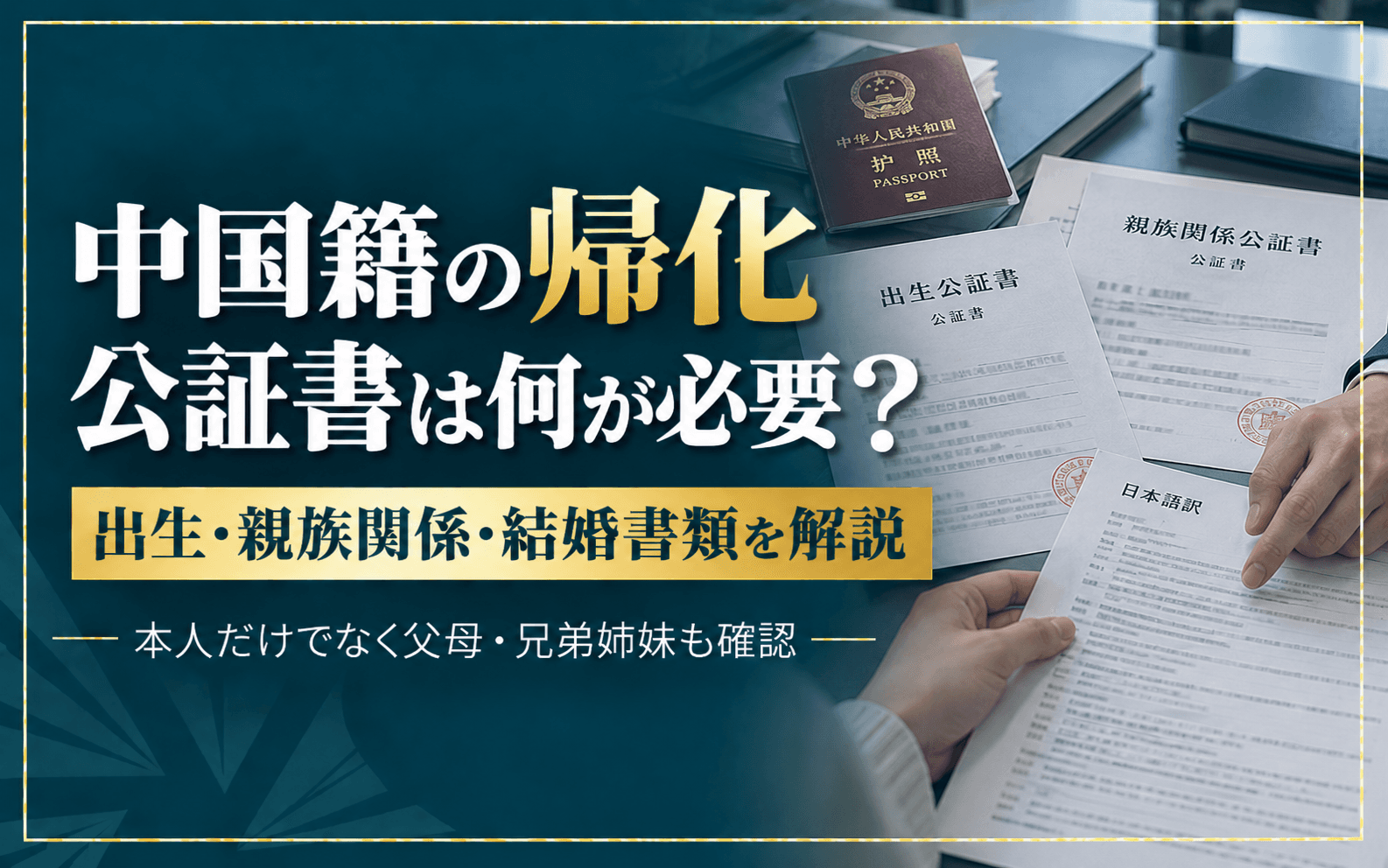
What Chinese Notarial Documents Are Required for Japanese Naturalization? Birth, Family Relationship, and Marriage Records 【2026 Update】
“How many Chinese notarial certificates do I need?”
“My family-relationship certificate does not list my siblings.”
“My parents are divorced.”
“My name is written slightly differently on Japanese and Chinese records.”
For Chinese nationals, naturalization documentation is not limited to Japanese tax, pension, and employment records.
A major part of the application concerns:
Chinese civil-status documents proving the applicant’s birth and family relationships.
The Tokyo Legal Affairs Bureau currently provides a dedicated document list for Chinese-national applicants. 法務局
A Chinese Naturalization Application Can Require Documents About the Entire Family Structure
The authorities may need to confirm:
Parents
Siblings
Marriage
Divorce
Children
Adoption
Custody and other legal family relationships
This is because naturalization requires the applicant’s civil status to be established accurately.
1. Certificate of Nationality
Chinese applicants are currently instructed to obtain a:
consular certificate proving nationality
from the Chinese Embassy or a Chinese consulate in Japan. 法務局
2. Expired Passports Can Also Be Relevant
The Tokyo Legal Affairs Bureau currently requests copies of:
all passports, including expired passports,
with the relevant used pages. 法務局
Applicants should therefore not assume that only the current passport matters.
3. Birth Notarial Certificate
A birth notarial certificate is a core document used to establish the applicant’s birth and parentage.
Its contents should be consistent with Japanese records such as the residence certificate and immigration documents.
4. Family-Relationship Notarial Certificate
The Tokyo Legal Affairs Bureau currently requires a family-relationship certificate showing the relationship among:
the applicant, father, mother, and all siblings. 法務局
If Siblings Are Missing, Additional Birth Certificates May Be Required
Where siblings are not listed on the family-relationship certificate, the Bureau expressly requests separate:
birth notarial certificates for the siblings. 法務局
5. Siblings Living Abroad Still Form Part of the Family Relationship
Living in another country or having little current contact does not eliminate the legal family relationship.
The naturalization file should accurately reflect the actual family structure.
6. Marriage Documents
For a married applicant, the current Tokyo guidance lists:
a marriage notarial certificate or marriage certificate. 法務局
Where the marriage has also been registered in Japan, the Chinese and Japanese records should be consistent.
7. Divorce History
Applicants with divorce history may need:
a divorce notarial certificate or divorce certificate. 法務局
Where court proceedings concerning divorce, custody, adoption, or acknowledgment are involved, additional final court documents may also be relevant.
8. Parents’ Marriage and Divorce Documents
A point that often surprises applicants is that the Bureau also lists documents concerning the applicant’s parents’ marriage and divorce. 法務局
This helps establish the applicant’s family relationship and parentage.
9. Parents Who Are Divorced or Deceased
The Bureau notes that certain parental marriage documents may not be issuable where the parents are divorced or deceased. 法務局
Do Not Simply Omit an Unavailable Document
Where a requested document cannot be obtained, applicants are instructed to explain the circumstances to the Legal Affairs Bureau during consultation. 法務局
10. Documents for Children
Where the applicant has children, the Bureau lists the children’s:
birth notarial certificates
among the relevant civil-status documents. 法務局
This can be relevant even where the child lives overseas or is from a previous marriage.
11. Adoption, Custody, and Other Special Relationships
Where adoption, custody, acknowledgment, or similar family relationships exist, additional notarial or court documents may be necessary.
Complex family histories should not be treated as though they were the same as a simple unmarried case.
12. Japanese Family Registry Documents
Where a spouse, former spouse, child, parent, or other relevant relative is Japanese, Japanese family-registry documents may also be required. 法務局
A relative who previously naturalized in Japan can also create additional Japanese-document requirements.
13. Family Events Registered in Japan
Where births, marriages, divorces, adoption, custody changes, or acknowledgment have been reported to a Japanese municipality, records concerning those filings may also be required. 法務局
Chinese and Japanese Records Need to Tell the Same Story
The important issue is not merely whether each document exists.
The documents should consistently explain the applicant’s:
birth, marriage history, parentage, and family relationships.
14. Full Japanese Translation Is Required
Foreign-language documents require Japanese translations.
Current Tokyo guidance requires the translation to include the translator’s:
Address
Name
Translation date
and states that:
partial translation is not accepted. 法務局
15. Can the Applicant Translate the Documents?
Yes.
The Tokyo Legal Affairs Bureau states that any person capable of translating accurately—including the applicant—may prepare the translation. 法務局
However, consistent rendering of personal names, places, and family relationships remains especially important.
16. Names and Birthplaces Should Not Be Written Only in Roman Letters
Current Tokyo guidance instructs applicants to use Japanese script—such as kanji or kana—rather than only alphabetic spelling for names and birthplaces in translations. 法務局
17. Originals and Duplicate Sets
The Tokyo Legal Affairs Bureau currently generally requires:
an original and a duplicate set
of the naturalization materials.
For documents such as passports that cannot be surrendered, copies are prepared and the originals are brought for confirmation. 法務局
18. Old Records and Current Family Relationships May Differ
A family’s legal relationships can change through:
Divorce
Remarriage
Adoption
Name changes
Children from previous marriages
In such cases, one notarial certificate may not explain the entire history.
The file should allow the Legal Affairs Bureau to trace the family relationship from birth to the present.
19. What if a Required Chinese Document Cannot Be Obtained?
There is no universal rule that an unavailable document either automatically prevents naturalization or can simply be ignored.
The applicant should explain why the document cannot be obtained, and the Legal Affairs Bureau will determine what additional or alternative evidence is appropriate. 法務局
Cases That Particularly Deserve Pre-Filing Review
Careful review is useful where:
There are several siblings
Siblings are missing from the family-relationship certificate
The parents divorced or remarried
A parent is deceased
The applicant divorced or remarried
There are children from a previous marriage
Adoption or custody issues exist
A spouse or close relative is Japanese
A family member has already naturalized
Names differ between Chinese and Japanese records
A notarial certificate cannot be obtained
Old passports are missing
Frequently Asked Questions
Q. Is a Birth Notarial Certificate Required?
The Tokyo Legal Affairs Bureau’s current Chinese-national document list includes the applicant’s birth notarial certificate.
Q. Who Must Appear in the Family-Relationship Certificate?
The current guidance calls for a certificate showing the relationship among the applicant, father, mother, and all siblings.
Q. My Sibling Is Not Listed.
Separate sibling birth notarial certificates may be required under the current Tokyo guidance.
Q. Why Are My Parents’ Marriage Documents Relevant?
They help establish the applicant’s family and parent-child relationships.
Q. Can I Translate the Chinese Documents Myself?
Yes, if the translation is accurate. The entire document must be translated and the translator’s identifying information and date must be stated.
Q. What if a Notarial Certificate Cannot Be Obtained?
The circumstances should be explained to the Legal Affairs Bureau rather than simply omitting the document.
For Chinese Naturalization Cases, the Goal Is Not Merely to Collect Certificates
The key is to make sure that:
Chinese notarial documents + Japanese civil records + naturalization forms
all describe the same family history.
Enlight Administrative Scrivener’s Office reviews the applicant’s birth, parents, siblings, marriage, divorce, children, Japanese registrations, translations, and differences in names or civil-status information before organizing the naturalization file.
The initial naturalization eligibility check is free of charge.
References
Tokyo Legal Affairs Bureau: Supporting Documents for Chinese-National Naturalization Applicants, updated September 4, 2026
Tokyo Legal Affairs Bureau: Naturalization Consultation Document Checklist — China
Tokyo Legal Affairs Bureau: Initial Naturalization Consultation
Tokyo Legal Affairs Bureau: Guide to Naturalization Applications
Ministry of Justice: Nationality Q&A