Column
Can Former International Students Apply for Japanese Naturalization? Do Student Years Count, and How Long Must You Work After Graduation? 【2026 Update】
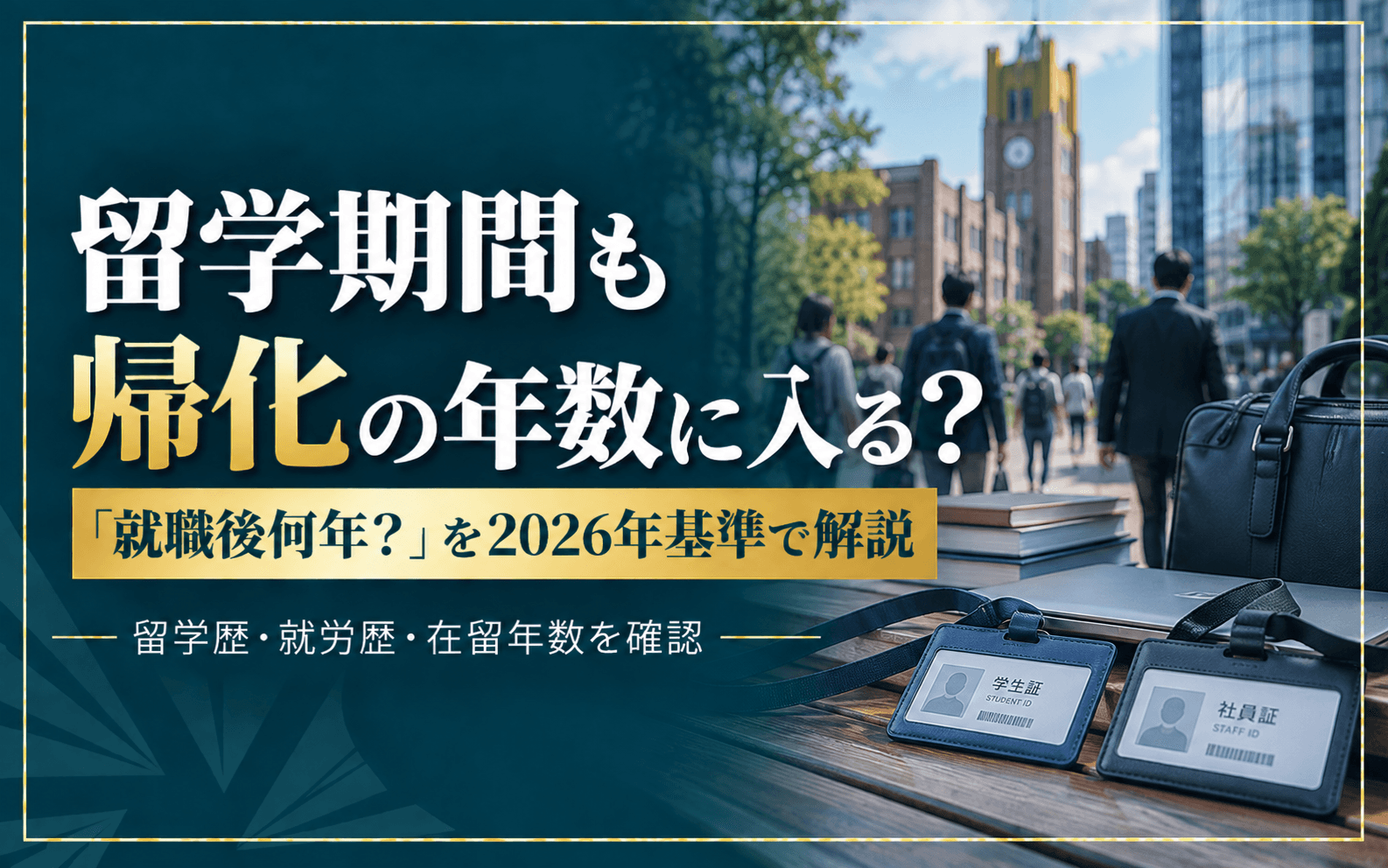
“I have lived in Japan for ten years, but I have only worked for three.”
“I spent four years at graduate school and four years working.”
“PR requires qualifying work status for five years. Is naturalization the same?”
These are common questions for foreign nationals who came to Japan as students and later entered the Japanese workforce.
The first point to understand is:
the residence-period rules for naturalization and Permanent Residence are different.
Student Years Are Not Automatically Excluded From Naturalization Residence History
Article 5 of the Nationality Act provides an ordinary domicile requirement of:
five or more consecutive years of domicile in Japan.
The Ministry of Justice also states that the residence must be lawful and based on an appropriate status of residence.
The statute does not state that all five years must be under a work status.
Accordingly, a period of lawful residence under Student status is not automatically treated as zero merely because the applicant was studying.
However, the domicile requirement is only one part of the current naturalization assessment.
1. Ten or More Years in Japan Is Also Important in 2026
The Ministry of Justice currently explains that integration into Japanese society includes matters such as:
Sufficient Japanese for daily life
Ten or more years of residence in Japan
Accordingly:
“The statute says five years, so five student years are enough”
is not a reliable way to assess a 2026 case.
2. What About 6 Years of Study and 4 Years of Work?
Suppose an applicant:
arrived in 2016,
studied for six years,
and then worked for four years.
The person has approximately ten years of continuous life in Japan.
Naturalization does not simply restart the residence clock from the first day of full-time employment.
The complete history is reviewed together with:
Overseas absences
Current employment
Income
Taxes
Pension and health insurance
Japanese ability
Conduct
Naturalization Does Not Have the Same 5-Year Work-Status Rule as Ordinary PR
Under the ordinary PR route, a qualifying work or residence status must generally be held continuously for a specified five-year period.
Naturalization law does not contain the same blanket rule requiring:
five years after starting work.
The PR rule should therefore not simply be imported into a naturalization case.
3. Is There a Mandatory 3-Year Employment Rule?
A common online statement is:
international students must work for three years after graduation before naturalizing.
The Ministry of Justice does not publish a nationwide rule requiring every former student to complete exactly three years of employment.
There is likewise no universal rule requiring three years:
As a permanent employee
With the current employer
No Fixed 3-Year Rule Does Not Mean Immediate Filing Is Always Appropriate
Consider:
March: university graduation
April: first full-time job begins
May: naturalization filing.
The applicant has almost no employment record with the new company.
The review may therefore need to consider:
Employment terms
Salary
Probation
Household income
Savings
Previous livelihood
4. One or Two Years of Employment Is Not Automatically Disqualifying
There is no official formula stating:
one year = no,
two years = no,
three years = yes.
The full Japanese residence history and the present stability of the applicant’s life matter more than a single number.
5. Japanese-Language School Is Also Part of the History
The Tokyo Legal Affairs Bureau requires the naturalization résumé to cover the applicant’s history chronologically without unexplained gaps.
Accordingly:
Japanese-language school
↓
university
↓
graduate school
↓
employment
should be organized as a continuous history.
Educational History Is Supported by School Records
Current Tokyo guidance identifies documents such as:
Graduation certificates
Copies of diplomas
Certificates of enrollment
School records
as examples of evidence supporting important parts of the applicant’s history.
Study in Japan is therefore an important component of the naturalization record.
6. Long Master’s or Doctoral Programs
Consider:
1 year language school
2 years master’s
4 years doctorate
3 years employment
=
10 years in Japan.
The fact that the applicant has only worked for three years does not create an automatic five-year-employment bar for naturalization.
However, the applicant’s current livelihood still requires separate assessment.
A Higher Academic Degree Does Not Waive the Other Requirements
A Japanese master’s or doctoral degree does not eliminate requirements concerning taxes, pension, conduct, livelihood, or Japanese-language ability.
7. Does Graduating From a Japanese University Waive Japanese-Language Review?
No nationwide automatic exemption of this kind is published.
The Ministry of Justice currently expects Japanese sufficient for everyday life, including:
speaking, reading, and writing.
A Japanese university degree may be relevant background, but it does not guarantee that no Japanese-language confirmation will occur.
8. English-Taught Programs Require Particular Attention
Some Japanese graduate programs operate largely or entirely in English.
A Japanese graduate degree therefore does not always prove practical Japanese reading and writing ability.
The actual language ability remains relevant.
9. Student Part-Time Jobs Also Form Part of the Employment History
Tokyo guidance instructs applicants to include part-time employment undertaken after entering Japan in the résumé.
Past student work may therefore need to be organized accurately.
Compliance With Permission for Outside Activities Can Matter
Student employment should have remained within the permitted scope of outside activities.
Where there may have been issues concerning hours or type of work, they should be reviewed before naturalization.
10. What About Student Pension Deferral?
Many students aged 20 or over use the National Pension student payment special system.
A formally approved student payment special period is not the same as an ordinary unpaid contribution.
The applicant should nevertheless verify the actual pension record.
11. A Gap Between Graduation and Employment
For example:
March graduation
October employment.
A six-month gap does not automatically bar naturalization.
However, the résumé should explain what the applicant was actually doing during that period, such as:
Job searching
Unemployment
Temporary return overseas
Part-time work
Preparing for further study
12. Immigration Status After Graduation Must Also Be Consistent
Applicants should review the relationship between:
Graduation date
Change of status
Employment start date
The actual activity should have remained consistent with the status of residence.
13. Long Trips Abroad During Study
The question is not only how long the residence card has existed.
The authorities also consider whether Japan was genuinely the applicant’s continuing place of life.
The current Tokyo consultation questionnaire asks about the number and total duration of overseas trips during the relevant period.
14. Can a Person Naturalize While Still a Student?
The livelihood condition is assessed on a household basis, so the applicant’s own lack of salary does not automatically mean the statutory condition can never be satisfied.
However, where a student has no stable personal income and their future Japanese livelihood is not yet established, the timing may require closer review.
In Many Cases, Employment Makes the Future Japanese Livelihood Easier to Demonstrate
Graduation followed by stable employment, salary, and social-insurance participation can make the applicant’s long-term Japanese life easier to explain.
That still does not create a universal requirement to wait exactly three or five years.
15. Cases That Particularly Deserve Pre-Filing Review
Review is especially useful where the applicant:
Progressed from language school to university
Spent many years in graduate school
Has ten years in Japan but only one to three years of employment
Has only five to nine total years in Japan
Recently started the first full-time job
Is still on probation
Graduated from an English-taught program
Had multiple student part-time jobs
Has concerns about outside-activity limits
Used the student pension payment special system
Has gaps in pension records
Had an unemployment gap after graduation
Spent long periods outside Japan while studying
Changed jobs after graduation
Frequently Asked Questions
Q. Do Student Years Count?
Student years are not automatically excluded merely because the residence status was Student.
The authorities still review whether the applicant lawfully and continuously maintained Japan as the actual place of residence.
Q. How Many Years Must I Work After Graduation?
There is no published nationwide rule requiring exactly three or five years.
Q. Do I Need Five Years Under a Work Status Like PR?
Naturalization does not have the same blanket five-year qualifying work-status rule as the ordinary PR route.
Q. I Studied for Four Years and Have Worked for Six.
With approximately ten years of continuous life in Japan, the remaining conditions—employment, livelihood, taxes, pension, language ability, and conduct—should also be reviewed.
Q. I Spent Six Years in Graduate School and Have Worked for Three.
The case is not determined solely by years of employment, although the current 2026 emphasis on overall residence and integration remains important.
Q. I Graduated From a Japanese University. Is the Japanese-Language Check Waived?
No nationwide automatic exemption is published.
Q. I Used the Student Pension Payment Special System.
An approved special-payment period differs from an ordinary unpaid period, but the actual pension record should be checked.
For Former Students, the Key Question Is Not Simply “How Many Years Have I Worked?”
The proper analysis is:
study history + employment history + complete immigration history + current livelihood stability.
Enlight Administrative Scrivener’s Office reviews the applicant’s arrival, schools, graduation, change of status, part-time employment, overseas absences, current employer, income, taxes, pension, and health insurance chronologically before assessing whether the applicant is currently ready to proceed with naturalization.
The initial naturalization eligibility check is free of charge.
As an office policy, we generally do not accept naturalization cases where annual income is below ¥3 million.
References
Ministry of Justice: Nationality Q&A
Tokyo Legal Affairs Bureau: Initial Naturalization Consultation
Tokyo Legal Affairs Bureau: Naturalization Consultation Questionnaire
Tokyo Legal Affairs Bureau: Guide to Naturalization Applications
Tokyo Legal Affairs Bureau: Supporting Documents for Chinese-National Applicants
Legal Affairs Bureau: Naturalization